Showing posts with label Wildfire. Show all posts

Wednesday, August 16, 2023

Hawaii wildfire death toll surpasses 100: governor

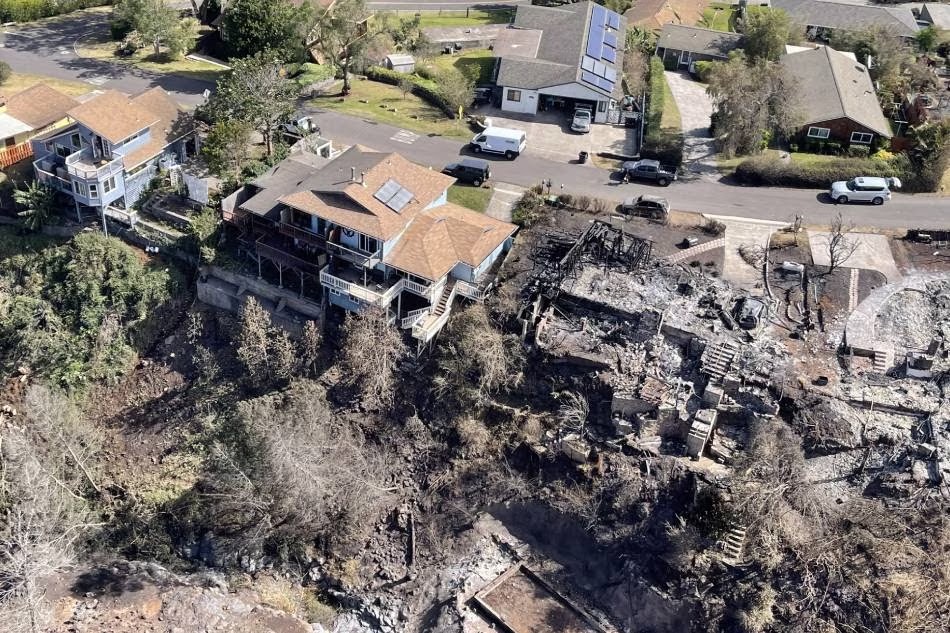
KAHULUI, United States - The number of people known to have died in the horrific wildfire that levelled a Hawaiian town topped 100 Tuesday, the state's governor said.

"101 lives have now been lost," Josh Green said, raising by two a toll that has crept up slowly over the last few days.

Over a quarter of the disaster zone has been searched, Green said, with dogs trained to look for bodies combing the ashes of what was once Lahaina, a picturesque tourist spot on Maui.

Green has repeatedly warned that the final count from the tragedy will be significantly higher, urging Hawaiians to gird for a number that could be two or three times its present level.

The toll has already made last week's wildfire the deadliest in the United States for over a century.

Agence France-Presse

Sunday, August 8, 2021

8 reported missing in huge California wildfire

LOS ANGELES - US authorities said Saturday they were searching for eight people missing as a huge wildfire raged in northern California, leaving two towns in little more than cinders.

The Dixie Fire, the largest active wildfire in the United States, recently became the third-largest in California history.

As of Saturday it had blackened 446,723 acres (180,782 hectares) in four counties, up from the previous day's 434,813 and surpassing the vast Bootleg Fire in southern Oregon. Dixie is now 21 percent contained, the CalFire website reported.

While the fire continued to grow, officials said Saturday that cooler, calmer weather was giving firefighters a much-needed break.

Those conditions are expected to continue into Sunday.

"We expect the same fire behavior as yesterday, which was fairly moderate," Jake Cagle, a firefighter sections chief, said in a briefing Saturday.

Earlier, the Dixie Fire left the Gold Rush town of Greenville charred and in ruins, while also burning through the small town of Canyondam.

The Plumas County sheriff's office said it had received the descriptions of eight people considered missing in Greenville and was searching for them.

RESIDENTS REFUSE TO LEAVE

As authorities urge thousands of locals to evacuate, they have been met at times by armed residents refusing to budge, the Los Angeles Times reported Saturday.

Law enforcement officers are asking any residents who stay for the names of next-of-kin -- to be notified if the fire claims their lives.

The Dixie Fire's movement northeastward has been slowed in part because it has reached the "scar" of an earlier blaze, the 2007 Moonlight Fire, reducing available fuel, CalFire said.

More than 5,000 personnel are now battling the Dixie blaze, which is sending enormous clouds of smoke into the air that are easily visible from space.

A preliminary investigation has suggested the fire was started when a tree fell on a power cable owned by regional utility Pacific Gas & Company (PG&E), a private operator that was earlier blamed for the huge Camp Fire in 2018, which killed 86 people.

By late July, the number of acres burned in California was up more than 250 percent from 2020 -- itself the worst year of wildfires in the state's modern history.

A long-term drought that scientists say is driven by climate change has left much of the western United States parched -- and vulnerable to explosive and highly destructive fires.

Agence France-Presse

Monday, June 29, 2020

Wildfire burns homes in Southern California desert town


NILAND, Calif. (AP) — A wind-driven wildfire destroyed homes and forced evacuations as it tore through a rural Southern California desert town near the Salton Sea, authorities said Monday.

The fire erupted Sunday evening in Niland, a small and poor agricultural community about 100 miles (160 kilometers) from San Diego.

Damage was still being assessed but the current estimate was 20 homes destroyed and about 130 people displaced, said Linsey Dale, a spokeswoman for Imperial County.

The American Red Cross Southern California Southern California Region said it was working to provide shelter.

“It’s very devastating in that area right now,” Dale said.

Niland, population about 1,000, is located at the north end of an agricultural region that stretches south to the U.S.-Mexico border.

The fire was pushed by strong winds, forcing evacuation of the entire township.

Every local fire truck and firefighting team responded and firefighting help also came from elsewhere.

The fire is the latest blow to California’s Imperial County, which has been hit hard by the coronavirus pandemic.

More than 500 patients have been moved to hospitals in other counties over the past five weeks to relieve strain on the county’s healthcare system.

Associated Press

Wednesday, November 6, 2019

California utility meets with governor amid bankruptcy case


SACRAMENTO, California — California’s governor called the chief executive of a troubled utility to his office on Tuesday for a closed-door meeting as the company struggles to emerge from a high-profile bankruptcy while facing criticism for its practice of shutting off power for millions of people to prevent wildfires.

A spokesman for Gov. Gavin Newsom says the first-term governor “spelled out in vivid detail” how the blackouts have prevented people from “refilling lifesaving prescriptions and power breathing machines” and how small businesses and schools were closed for days.

Newsom also reiterated the state would consider a potential takeover of the utility if the bankruptcy is not resolved by June 30.

Pacific Gas & Electric Corp. CEO Bill Johnson defended the company, telling reporters after the meeting that the power shutoffs have been “well planned and executed.”

“I came to California with one basic purpose: Let’s make sure we don’t kill anybody at our operations,” said Johnson, who worked for a Tennessee power supplier before joining PG&E in April. “I think we achieved that this year. I understand the hardship, I apologize for it, but for me, safety has to come first.”

State and local government leaders disagree, saying PG&E has communicated poorly and often given conflicting accounts about when the lights would go out. In a response to the Public Utilities Commission last week, the company acknowledged “various, and in some cases, extreme, shortcomings.”

Last year, strong winds knocked down some of PG&E’s power lines, which sparked a series of devastating wildfires. One in Northern California mostly destroyed the town of Paradise, burning down more than 18,000 buildings and killing 85 people. In January of this year, facing potential damages of up to $30 billion, PG&E filed for bankruptcy.

This year, the company has been aggressive in shutting off power during dry, windy conditions to prevent wildfires. Johnson said Tuesday he believes the company won’t have power shutoffs on this scale in 10 years as it works to “sectionalize the system.”

“There will be fewer (power shutoffs) every year, and eventually we will get out of it,” he said.

Since the utility’s bankruptcy filing in January, PG&E’s shareholders and creditors have battled for control of the company, putting forth competing plans in bankruptcy court that would maintain PG&E’s long-running setup as a for-profit company. It’s a structure that critics contend caused management to look for ways to cut corners instead of investing in equipment and other measures that would have made its electricity system far safer than it is now.

A judge appointed a mediator, and the first meeting is scheduled for Wednesday in San Francisco. But Tuesday, mayors and local leaders from more than two dozen cities and counties scattered across PG&E’s sprawling service area endorsed an alternative proposal by urging regulators to consider a still-nascent proposal to convert the utility into a customer-owned cooperative.


The request outlined in letter to the California Public Utilities Commission echoes an idea already floated by Newsom and San Jose Mayor Sam Liccardo, who joined the chorus of other leaders pushing for an alternative to keeping PG&E under the ownership of profit-driven investors.

Turning the utility into a nonprofit company “would allow PG&E to begin the process of restoring public confidence, in part by allowing the public to have greater role in determining decisions that increasingly have come to define matters of life and death,” the letter asserted.

To make it happen, the participating counties and cities would likely have to raise tens of billions of dollars in the municipal bond market to buy PG&E and then pay for the expensive improvements needed to ensure the utility could keep the power on instead of resorting to planned blackouts during the late summer and early autumn when California’s climate traditionally escalates the risk of wildfires.

Johnson, the PG&E CEO, told reporters Tuesday he understands the cities’ interests. But he said it is not the best solution for customers in the 70,000 square miles (181,300 sq. km.) covered by the company as it would potentially shift costs to rural customers outside of the big cities.

“I think the way it is structured now is the best idea for the majority of customers,” he said. /jpv

source: newsinfo.inquirer.net

Monday, August 6, 2018

California’s largest wildfire burns nearly 115,000 hectares of land


Two blazes mercilessly charring northern California have grown so rapidly that they became the US state’s largest in recorded history Monday, authorities said.

Collectively dubbed the Mendocino Complex, the wildfires have burned through 283,800 acres (114,850 hectares) — an area nearly the size of the sprawling city of Los Angeles — and are just 30 percent contained, according to state fire authority CalFire. Two people have died in the inferno.


“Today a higher pressure system brought warmer weather, drying, and strong winds to the region,” CalFire said in an evening update.


“Tonight fire crews will try to take advantage of the lower temperatures to increase suppression and hold current containment lines.”

It was the second fire to break records in the fire-prone, most populous US state in as many years, following the Thomas Fire in December 2017, which stood at 281,893 acres.

Further north in the state, the deadly Carr Fire has scorched more than 164,400 acres of land since July 23, and killed another seven people along the way.

Its intensity was so great at one point, that it generated a tornado-like whirl of fire — as well as its own weather system.

Authorities say it was triggered by the “mechanical failure of a vehicle” that caused sparks to fly in tinderbox-dry conditions.

The fire has razed more than 1,600 buildings, including some 1,000 homes, state officials say.

More than 14,000 firefighters were battling the blazes across the state.

Several thousand people have been evacuated as the fires swept across the state, although some have been given permission in recent days to return to their homes.

The wildfires are “extremely fast, extremely aggressive, extremely dangerous,” said Scott McLean, a deputy chief with the California Department of Forestry and Fire Protection.

“Look how big it got, just in a matter of days… Look how fast this Mendocino Complex went up in ranking. That doesn’t happen. That just doesn’t happen.”

President Donald Trump raised eyebrows by tweeting about the wildfires inaccurately, claiming there was not enough water to fight them and appearing to place the blame on environmental laws, not climate change.

“California wildfires are being magnified & made so much worse by the bad environmental laws which aren’t allowing massive amounts of readily available water to be properly utilized,” Trump said.

“It is being diverted into the Pacific Ocean. Must also tree clear to stop fire from spreading!”

In fact, “we have plenty of water to fight these wildfires, but let’s be clear: It’s our changing climate that is leading to more severe and destructive fires,” Daniel Berlant, CalFire assistant deputy director, told The New York Times.

In an unrelated long-running dispute, farmers have demanded more water to irrigate crops for years, while environmentalists say diverting more water to crops would kill off fish stock and hurt rivers.  /vvp

source: newsinfo.inquirer.net

Thursday, July 26, 2018

Homes burn as crews battle separate blazes in California


Homes burned as a fast-moving wildfire forced an entire Southern California mountain town to evacuate Wednesday, while tourists emptied from the heart of Yosemite National Park so firefighters could battle a growing blaze nearby.

Authorities ordered residents to leave Idyllwild, home to about 12,000 people, and surrounding forest communities in the San Jacinto Mountains east of Los Angeles. At least four homes burned as crews used aircraft to attack the flames that quickly burned nearly 5 square miles (12 square kilometers) of dry brush and timber in inaccessible terrain. No injuries were reported.

Officers detained a motorist for questioning after people called 911 to report a suspicious vehicle near the fire’s starting point in Riverside County, the California Highway Patrol said.

As his neighbors tried to corral dogs and horses, William Blodgett fled when flames hopped a highway near his home in Idyllwild.

“We were all peeling out of there as fast as we could,” he told KNBC-TV. “It was apocalyptic.”

The fire is one of several across California amid a statewide heat wave. To the north, in the San Francisco Bay Area, at least one home burned in a fast-moving blaze in Clayton, where houses are spread out around windy roads.

Yosemite Valley, the scenic heart of the national park, was closed at noon Wednesday during the height of tourist season as smoke cast a pall on the region from a fire in the Sierra Nevada. The closure was heartbreaking for travelers, many of whom mapped out their trips months in advance to hike and climb amid the spectacular views of cascading waterfalls and sheer rock faces.

“We had one guest who planned a weeklong trip,” said Tom Lambert, who owns a vacation rental property near Yosemite Valley. “It was a father-daughter trip, for her high school graduation … Now it’s done. It’s sad.” Another guest had to delay plans to climb Half Dome.

The closure has also been a financial blow to Lambert and other businesses that rely on the summer tourist traffic.

Most people left the valley Tuesday, when officials reluctantly announced the closure, park spokesman Scott Gediman said. The remaining campers packed up their gear Wednesday, joining the exodus that has been mostly orderly.

“People have been very understanding,” Gediman said.


Officials emphasized that Yosemite wasn’t in imminent danger from the fire. Authorities decided on the shutdown to allow crews to perform protective measures such as burning away brush along roadways without having to deal with traffic in the park that welcomes 4 million visitors annually.

On Wednesday, an extended family from Los Angeles on their annual trip to Yosemite prepared to leave the Upper Pines campground.

“Very disappointed,” Lisa Salgado said. “We look forward to this all year. This is the trip of our summer.”

The group arrived Monday and had planned to stay through Saturday. Instead, they packed tents and other gear into vehicles, hoping they could find another campground elsewhere.

“So, this is a new memory,” said Miguel Martinez. “I’ve never been evacuated before.”

Yosemite Valley will be closed until at least Sunday, along with a winding, mountainous, 20-mile (32-kilometer) stretch of California’s State Route 41 that leads into the area, Gediman said.

At least 1,000 campground and hotel bookings were canceled — to say nothing of the impact on day visitors, park workers and small businesses along the highway, Gediman said.

The last time the 7.5-mile-long (12-kilometer-long) valley was closed because of fire was 1990, he said.

Lambert and his wife, Theresa Ho, were briefly evacuated last week when smoke cast an unhealthy pall over the home where they live upstairs and rent the downstairs to tourists.

“Basically June, July and August are the big revenue months,” he said, estimating that about 100 nearby vacation properties would be forced to offer refunds.  “We’re gonna lose half of July and half of August probably.”

Yosemite Valley is the centerpiece of the visitor experience, offering views of landmarks such as Half Dome, Bridal Veil Fall, El Capitan and Yosemite Falls. The glacial valley has been enveloped by a choking haze of smoke from the Ferguson Fire.

Over nearly two weeks, flames have churned through 60 square miles (155 square kilometers) of timber in steep terrain of the Sierra Nevada just west of the park. The fire was just 25 percent contained.

Mandatory evacuations are in place in several communities while other people have been told to get ready to leave if necessary.

More than 3,300 firefighters are working the fire, aided by 16 helicopters. One firefighter was killed July 14, and six others have been injured.

Gediman suggested valley visitors divert to Tuolumne Meadows, on Yosemite’s northern edge, or to Sequoia and Kings Canyon National Parks to the south.

In the state’s far north, a 7-square-mile (18-square-kilometer) wildfire has forced the evacuation of French Gulch, a small Shasta County community that dates to the Gold Rush.  /muf

source: newsinfo.inquirer.net
Sunday, January 10, 2016

Australia bushfire kills two, destroys scores of homes


PERTH, Australia — At least two people have died in a bushfire which has destroyed 121 homes in Western Australia, reports said Saturday as officials admitted the emergency was not yet over.

Fire crews found two bodies in burnt-out houses in Yarloop, some 110 kilometres (70 miles) south of Perth, the Australian Broadcasting Corporation reported, citing police. Another two people are missing.

The bodies have not been formally identified but are believed to be those of two men in their 70s who had been reported missing after fire tore through the old mill town early on Friday, destroying scores of homes.

That number of houses rose to 121 on Saturday after a fuller assessment, as hundreds of firefighters continued to battle the huge blaze which threatens nearby areas.

“It is still a cause for concern,” Fire and Emergency Services Commissioner Wayne Gregson told reporters of the blaze.

“It has been a very challenging fire for us — it’s still a challenge, (we’re) not out of the woods yet.”

Residents of Yarloop and other towns in the area were advised to evacuate if possible, with an bushfire emergency warning still in place.

“There is a threat to lives and homes in Harvey, Cookernup, Wokalup and surroundings areas,” the Department of Fire and Emergency Services said on its website.

“Unless you are ready and prepared to actively defend your property, evacuate to the south via the South Western Highway if safe to do so,” it said.

Western Australia’s Premier Colin Barnett said the event had been declared a natural disaster, a measure which gives residents access to greater financial support.

But he admitted that the damage bill was going to be a “large one”.

Bushfires are common in Australia’s hotter months, with four deaths in Western Australia last November.

Australia’s worst firestorm in recent years devastated parts of the southern state of Victoria in 2009, razing thousands of homes and killing 173 people.

source: newsinfo.inquirer.net

Tuesday, November 11, 2014

Slow-moving lava sets house ablaze in Hawaii town


HONOLULU — A stream of lava set a home on fire Monday in a rural Hawaii town that has been watching the slow-moving flow approach for months.

The molten rock hit the house just before noon, said Hawaii County Civil Defense Director Darryl Oliveira. The home’s renters already had left the residence in Pahoa, the largest town in Big Island’s isolated and mostly agricultural Puna district.


Earlier in the day, lava burned down a small corrugated steel storage shed on the property, Oliveira said.

The lava from Kilauea volcano emerged from a vent in June and entered Pahoa Oct. 26, when it crossed a country road at the edge of town. Since then, it has smothered part of a cemetery and burned down a garden shed. It also burned tires, some metal materials and mostly vegetation in its path.

Firefighters will basically let a structure burn, but they will fight any wildfires that spread or threaten other structures, Oliveira said.

The county estimates the value of the home at about $200,000, Oliveira said.

Oliveira said officials would make arrangements for homeowners to watch any homes burn as a means of closure and to document the destruction for insurance purposes.

The leading edge of the molten rock had stalled Oct. 30, but lava was breaking away at several spots upslope. The leading edge remained about 480 feet (150 meters) from Pahoa Village Road, the main street that goes through downtown.

Crews have been working on alternate routes to be used when lava hits a major highway in a lifeline for the Puna district.

Many residents have evacuated or are ready to leave if necessary.

Imelda Raras lives on the other end of Apaa Street from where the lava burned its first house.

She and her family have put a lot of their belongings in storage and are ready to go to a friend’s home if the lava gets close.

source: newsinfo.inquirer.net

Sunday, August 18, 2013

1,600 homes evacuated as Idaho wildfire grows


BOISE, Idaho—A wind-driven wildfire burned its way through sage and pine trees near the Idaho mountain resort community of Sun Valley as sheriff’s deputies expanded evacuation orders to 1,600 homes.

The Beaver Creek Fire grew by 15 square miles (39 million square kilometers) Friday night and early Saturday to more than 144 square miles (373 million square kilometers).

The evacuation orders included homes in drainages and foothills west of the towns of Hailey and extending to north of Ketchum in central Idaho. Flames also crept closer to the Sun Valley Resort.

State and federal firefighters were working to get the blaze under control and protect property in the affluent resort region that’s a second home to celebrities such as Arnold Schwarzenegger, Tom Hanks and Bruce Willis.

More than 700 firefighters are focused mostly on protecting homes and property. But hundreds more firefighters are en route as wildfires elsewhere in Idaho and other western states are brought under control.

Fire managers say the fire grew rapidly Friday thanks to wind gusts topping out at 30 mph (48 kph), low humidity and tinder-dry ground fuels.

“It’s safe to say we’ve got a lot of structures at risk,” said Shawna Hartman, spokeswoman for the Beaver Creek Fire.

Managers at the Sun Valley Ski Resort turned on water cannons that are normally used for wintertime snowmaking.

One home in an outlying valley was destroyed Thursday night, said Bronwyn Nickel, a spokeswoman for Blaine County, where the fire is burning.

In addition, some private insurers have sent in their own crews to provide structural protection for homes with values that can stretch into the millions of dollars, Nickel said.

“There are private engines that insurance companies have sent in,” she said. “They’re on site, they’re working with our local firefighters and law enforcement.”

Fire officials said crews spent the day building fire lines and trying to funnel the fire into areas burned during another blaze in 2007. A huge DC-10 tanker, capable of carrying 12,000 gallons (45,400 liters) of retardant, was among aircraft making drops on the blaze.

Jack Sibbach, a Sun Valley Resort spokesman, had to leave his home south of Ketchum on Friday. He said he watched as airplanes and helicopters made runs in roughly 3-minute intervals, dropping water and red retardant to create a barrier against flames west of US Highway 75.

The resort turned on snow cannons on Bald Mountain, he said, largely to protect lodges atop the mountain, should the fire advance that far.

Flying in separate aircraft, Idaho Gov. C.L. “Butch” Otter and US Forest Service Chief Tom Tidwell took an aerial tour of the fire.

The towns of Ketchum, with a population of 2,700, and Sun Valley, with 1,400 people, were under pre-evacuation orders, with residents advised to prepare their belongings in case they were required to leave on a moment’s notice.—Brady Mccombs with Todd Dvorak in Boise

source: newsinfo.inquirer.net