Showing posts with label Investors. Show all posts

Wednesday, July 15, 2020

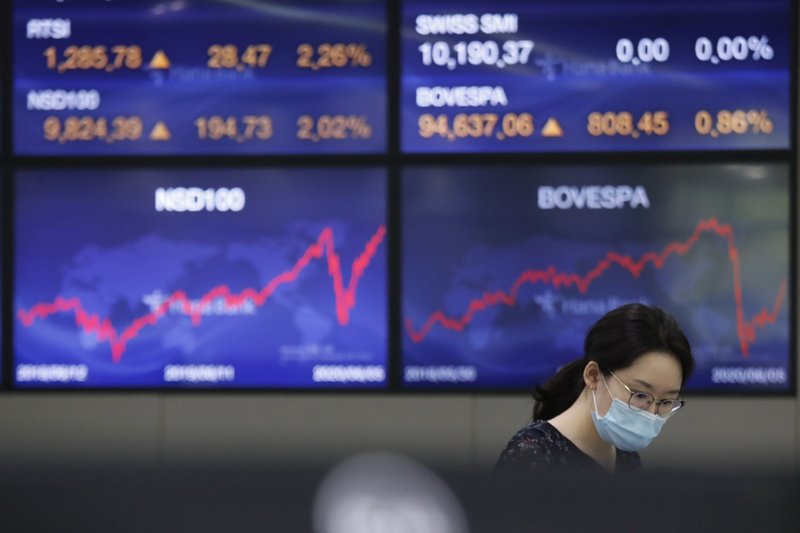
Asian markets mostly higher on hopes for coronavirus vaccine


Shares were mostly higher in Asia on Wednesday as investors were encouraged by news that an experimental COVID-19 vaccine under development by Moderna and the U.S. National Institutes of Health revved up people’s immune systems just as desired.

Tokyo’s Nikkei 225 advanced 1.6% to 22,945.50, while the Kospi in South Korea added 0.9% to 2,201.96. In Australia, the S&P/ASX 200 added 1.7% to 6,039.50. Hong Kong’s Hang Seng was nearly unchanged at 25,476.31, while the Shanghai Composite Index slipped 0.5% to 3,397.63. Shares were mixed in Southeast Asia and rose in Taiwan.

The Bank of Japan kept its ultra-easy monetary stance unchanged as it wrapped up a policy meeting. It forecast that the economy would improve later in the year, assuming there is no major “second wave” of outbreaks of the new coronavirus.

But the central back acknowledged very high uncertainties over the outlook for the world’s third largest economy. The bank’s growth forecast for the year was downgraded to minus 5.7%- minus 4.5% from the earlier forecast of minus 5%-minus 3%.

The report also raised the issue of financial stability, noting that the “vulnerability of the financial system could increase,” said Marcel Thieliant of Capital Economics.

Investors are awaiting April-June economic growth data for China, which is due later in the week.

The focus for now was on news that scientists soon will begin a 30,000-person study to see if the experimental vaccine developed by Moderna and the NIH is strong enough to protect against the coronavirus.

News about the vaccine came after the end of trading for U.S. markets, where after another day of unsettled trading the S&P 500 rose 1.3% to 3,197.52. The Dow Jones Industrial Average added 2.1% to 26,642.59, lifted by gains for UnitedHealth Group and Caterpillar, among others.

Upbeat earnings news is helpful, “But the cherry on top has to be the positive virus vaccine update as optimism on the vaccine is more than a show stopper. Its the ultimate recession stopper,” Stephen Innes of AxiCorp said in a commentary.

“The positive coverage on a potential Covid-19 vaccine represents a rotating carousel of positive news that is overwhelming rising virus cases in the U.S.,” he said.

On Wall Street, big tech-oriented stocks lagged behind, holding the Nasdaq composite to a more modest gain of 0.9% to 10,488.58.

The earnings reporting season has kicked off with three of the nation’s biggest banks painting a mixed picture of how badly the coronavirus pandemic is ripping through their businesses.

Like the broader market, financial stocks drifted between gains and losses for much of the day before turning higher in the afternoon. JPMorgan Chase, Wells Fargo and Citigroup said they collectively set aside nearly $27 billion during the second quarter to cover loans potentially going bad due to the recession.

The yield on the 10-year Treasury held at 0.63% after rallying back from a morning dip on Tuesday to 0.60%. It tends to move with investors’ expectations of the economy and inflation.

Benchmark U.S. crude oil rose 10 cents to $40.39 per barrel in electronic trading on the New York Mercantile Exchange. It gained 19 cents to settle at $40.29 per barrel on Tuesday. Brent oil, the international standard, picked up 13 cents to $43.03 per barrel. It rose 18 cents to $42.90 a barrel in London.

In currency dealings, the dollar bought 107.27 Japanese yen, up from 107.23 yen late Tuesday. The euro also was almost unchanged, rising to $1.1406 from $1.1401.

Associated Press

Monday, June 8, 2020

Wall Street tilts higher again on economic recovery hopes


NEW YORK (AP) — Wall Street’s rally is spilling into a new week as most stocks continue to ride the high supplied by Friday’s surprisingly encouraging report on the U.S. jobs market.

The S&P 500 was up 0.5% in midday trading on Monday, bringing it back within 5.3% of its record set in February, as optimism strengthens that the worst of the coronavirus-induced recession may have already passed. Stocks that would benefit most from an economy that’s growing again were rising the most, but pullbacks for a handful of big tech stalwarts were keeping the market’s overall gains in check.

The Dow Jones Industrial Average was up 248 points, or 0.9%, at 27,359, as of 11:53 a.m. Eastern time, and the Nasdaq composite was up 0.2%.

Stocks have been rising since late March, at first on relief after the Federal Reserve and Capitol Hill pledged to support the economy and more recently on hopes that the recovery may happen more quickly than forecast.

IMPACT ON THE ECONOMY:

– Survey: Business economists expect worst slump since 1940s
– BP to cut 10,000 jobs worldwide amid virus pandemic
– Left out: More workers now losing hope of getting back jobs

Such hopes got a huge boost Friday when the U.S. government said that employers added 2.5 million jobs to their payrolls last month. Economists were expecting to see 8 million more lost.

States across the country are slowly relaxing restrictions on businesses meant to slow the spread of the coronavirus outbreak, which is raising expectations that the economy can pull out of its coma. New York City began reopening on Monday, for example, allowing construction and “nonessential” retailers to start operating again with some restrictions.

That puts more pressure on economic reports this week to confirm that Friday’s jobs report was a true inflection point and not just an aberration.

Even if the economy did hit its bottom a month or two, economists warn that many risks are still looming over a very long road back to full recovery, such as a flareup in U.S.-China tensions. Critics are also still saying the stock market may have risen too quickly and may be setting investors up for disappointment, with the biggest risk being another wave of infections that leads to more lockdowns.

It’s still unclear whether the economy can recover anywhere near as quickly as the stock market, which has rallied sharply after earlier being down nearly 34% from its February record.

“There’s a lot of risk that businesses and the economy don’t recover as fast,” said Tom Martin, senior portfolio manager at Globalt Investments. “When money starts running out in July, are we enough on a path to getting people employed and businesses open?”

Among this week’s economic highlights are reports on inflation and the number of workers applying for jobless benefits. The headliner, though, is likely the Federal Reserve’s meeting on interest rates in the middle of the week.

Full Coverage: Financial markets
The Fed has already promised unprecedented amounts of support to keep markets running smoothly, but will the recent upturn in job growth mean it will pull back at all?

Treasury yields have been climbing in recent days, reflecting rising expectations in the market for the economy and inflation. The 10-year Treasury yield dipped to 0.86% from 0.90% late Friday, but it’s up sharply from 0.66% a week earlier.

Too quick a rise in yields could slow spending and the anticipated economic recovery, though. It can also be a heavy weight on the stock market.

Higher yields make bonds more attractive as investments, which would pull some investors’ dollars away from stocks. High-dividend stocks would likely get hurt in particular, because some income investors had turned to them instead of bonds when yields were lower.

Stocks that would benefit most from a growing economy, meanwhile, were leading the market on Monday to continue their recent trend.

Energy producers, banks and industrial companies were leading the S&P 500, and more than 70% of the stocks in the index were higher.

Travel-related stocks were again notable standouts as investors raised expectations for a reopening economy. Norwegian Cruise Line, Carnival, Alaska Air Group and United Airlines all rose more than 8.5%.

Smaller company stocks also climbed more than the rest of the market, which often happens when expectations for the economy are rising. The Russell 2000 index of small-cap stocks was up 1.4%.

But several titans were giving back a portion of their gains made earlier this year, when investors were piling into the few companies that could hold up in a weak, stay-at-home economy. Microsoft slipped 0.4%, Apple slipped 0.3% and Netflix lost 2.1%. These are some of the biggest companies in the market, which gives their movements more sway over the S&P 500 and other indexes.

In global markets, Japan’s Nikkei 225 index jumped 1.4% after the government reported the economy contracted at a 2.2% annual rate in the January-March quarter, better than the initially estimated minus 3.4%.

Indexes in other countries were more subdued. The Kospi in South Korea was up 0.1%, while the Hang Seng in Hong Kong was virtually flat.

France’s CAC 40 was down 0.4%, Germany’s DAX lost 0.2% and the FTSE 100 in London was down 0.2%.

Oil was down, even after major oil producing nations agreed over the weekend to extend a production cut of nearly 10 million barrels of oil a day through the end of July to counter the blow to demand from the coronavirus pandemic.

Oil had already climbed last week on anticipation of the move, and OPEC officials did not commit to extending the cuts past July or establishing a way to enforce the production limits.

U.S. crude for July delivery fell 3.6% to $38.13 per barrel. Brent crude, the international standard, fell 3.3% to $40.90 per barrel.

___

AP Business Writer Elaine Kurtenbach contributed.

The Associated Press

Wednesday, May 27, 2020

Stock markets mixed as China-US tensions return to fore


Equities were mixed Wednesday as profit-taking and worries about deteriorating China-US relations were weighed against optimism over the gradual reopening of economies around the world.

Hong Kong extended losses as police fired pepper-ball rounds as anti-China protesters took to the city's streets, with investors fearing the demonstrations could erupt into the worst unrest since last summer.

The broad trend across global markets has been upward for weeks as virus deaths and infections ease in most countries and governments begin to reopen their battered economies, fanning hopes for a recovery in the second half of the year.

Confidence has also come from mind-boggling amounts of stimulus and central bank pledges of support, with the latest coming from the eurozone, where European Commission President Ursula von der Leyen is due to unveil a trillion-euro revival plan for the bloc.

However, there was little fresh desire for risk assets with eyes on the simmering row between the world's top two economies, fuelled by Donald Trump's barracking of China over its role in the pandemic, and made worse this week by Beijing looking to tighten its grip on Hong Kong.

The financial hub was thrown back into the spotlight Friday when Chinese officials proposed a controversial security law that many fear could ring the death knell for the city.

And Trump appeared to agree, with his press secretary Kayleigh McEnany telling a briefing he had said it is "hard to see how Hong Kong can remain a financial hub if China takes over".

Washington has already said it could terminate its preferential trading status over the issue.

Markets are also fretting over reports that the US has warned it will impose sanctions on Chinese entities and officials if it goes ahead with the law.

While China and Hong Kong leader Carrie Lam have sought to ease worries about the extent of the law plans, Jeffrey Halley at OANDA warned that no matter how they try to dress it up "the passage of the security legislation from Beijing will have consequences for the beleaguered (city) and will further darken relations between the US and China."

Concerns about the growing crisis have weighed on the yuan, losing almost three percent this year, with observers suggesting it could hit a record low.

- Hong Kong protest worries -

Meanwhile, there are concerns about another flare-up in the city as lawmakers prepare to discuss a law that bans insulting China's national anthem.

Seven months of sometimes violent demonstrations last year hammered the local economy and raised questions about its future.

Hong Kong fell 0.4 percent, Shanghai lost 0.3 percent and Sydney fell 0.1 percent, while Kuala Lumpur dropped more than one percent as Malaysia struggled to contain its virus. There were also losses in Jakarta, Bangkok and Singapore.

But Tokyo, Mumbai, Manila, Seoul, Taipei and Wellington saw gains.

In early trade, London, Paris and Frankfurt were all higher. The gains in Paris as dealers brushed off a warning from officials that France's economy could contract 20 percent in the second quarter.

Still, National Australia Bank's Tapas Strickland, said in a note: "Risk sentiment continues to surge as activity lifts following the gradual easing of containment restrictions around the world, while vaccine hopes remain high with 10 different vaccines currently at the human trial stage."

He also cited comments from Federal Reserve official James Bullard that the third quarter "very likely, right behind the worst quarter, will be the best quarter of all time on the growth perspective".

Wall Street, where the New York Stock Exchange trading floor reopened after two months of closure, finished higher, with the Dow gaining 2.2 percent.

Oil markets slipped on China-US tensions, and after reports said Russia could begin easing up on its supply cuts in July.

Massive reductions by Moscow and other major producers including Saudi Arabia have helped fuel a surge in prices over the past month, with WTI doubling since the end of April.

But analysts said the commodity will likely continue to win support from the easing of lockdowns, which is expected to boost demand as people get back on the road.

- Key figures at around 0810 GMT -

Tokyo - Nikkei 225: UP 0.7 at 21,419.23 (close)

Hong Kong - Hang Seng: DOWN 0.4 percent at 23,301.36 (close)

Shanghai - Composite: DOWN 0.3 percent at 2,836.80 (close)

London - FTSE 100: UP 0.7 percent at 6,112.97

Euro/dollar: DOWN at $1.0954 from $1.0984 at 2040 GMT Friday

Dollar/yen: UP at 107.51 yen from 107.54 yen

Pound/dollar: DOWN at $1.2292 from $1.2335

Euro/pound: DOWN at 89.11 pence from 89.04 pence

West Texas Intermediate: DOWN 2.3 percent at $33.55 per barrel

Brent North Sea crude: DOWN 2.2 percent at $35.37 per barrel

New York - Dow: UP 2.2 percent at 24,995.11 (close)

Agence France-Presse

Friday, February 14, 2020

US stocks edge mostly lower after China virus cases spike

Stocks closed lower on Wall Street Thursday as investors turned cautious following a surge in cases of a new virus in China that threatens to crimp economic growth and hurt businesses worldwide.


The modest losses snapped a three-day streak of record highs for the S&P 500 and Nasdaq composite. The selling marked only the second day this month that the market has declined.

Investors largely set aside worries about the economic impact of the virus outbreak the past two weeks. Markets rallied this week partly due to reports that the number of new cases of the new virus in China had declined.

Hopes that the spread of the virus had peaked were dashed Thursday, when China reported a sharp rise in cases and deaths after the hardest-hit province of Hubei took a new approach to classifying and diagnosing the virus.

“We’re in a data-dearth period in the sense that we’re not really going to know fully the effects of the impact of that on Asian and Chinese growth, as well as global growth, for at least several weeks,” said Lisa Erickson, head of traditional investments at U.S. Bank Wealth Management. “You’re just going to see some back-and-forth movement (in the market) until that time.”

The S&P 500 index dropped 5.51 points, or 0.2%, to 3,373.94. The Dow Jones Industrial Average slid 128.11 points, or 0.4%, to 29,423.31. It was down as much as 205 points earlier.

The Nasdaq fell 13.99 points, or 0.1%, to 9,711.97. The Russell 2000 index of smaller company stocks rose 4.36 points, or 0.3%, to 1,693.74.

Markets in Europe and Asia finished mostly lower. The yield on the 10-year Treasury held steady at 1.62%.

The major U.S. indexes wobbled for much of the day as investors weighed company earnings reports and the latest news on the virus outbreak in China.

The change in how Hubei determines and reports cases of the new virus pushed the number of cases worldwide to more than 60,000.

The spike came after two days in which the number of new cases dropped, complicating efforts to understand the trajectory of the outbreak.


Businesses have already been hurting due to the outbreak and more of them are warning that the effects will linger through the year. Organizers of the world’s biggest mobile technology fair cancelled the event, set to take place in Spain, because of health and safety concerns over the outbreak.

Travel-related companies fell broadly Thursday, shedding some of their gains from earlier in the week. Airlines helped pull industrial sector stocks lower. United Airlines fell 1.5%.

MGM Resorts International, which gets about 20% of its revenue from the gambling haven of Macau, pulled its profit forecast for 2020. The stock lost 5.5%. Cruise line operator Carnival slid 2%.

Technology and health care stocks were among the biggest decliners, along with companies that rely on consumer spending. Cisco Systems fell 5.2%, Mylan slid 2.3% and Hanesbrands dropped 2.6%.

Household goods makers, utilities, real estate companies and communication services stocks notched gains.

Fashion company Ralph Lauren warned that the viral outbreak cut into fourth-quarter sales by an estimated $55 million to $70 million. The stock fell 0.6%.

Alaska Air Group bucked the trend, adding 1.5% after the airline said it will cooperate more closely with American Airlines on West Coast service. The airlines asked for government permission to expand revenue-sharing to cover international flights in Seattle and Los Angeles.

Benchmark crude oil rose 25 cents to settle at $51.42 a barrel. Brent crude oil, the international standard, gained 55 cents to close at $56.34 a barrel. Wholesale gasoline was unchanged at $1.58 per gallon. Heating oil was also unchanged at $1.68 per gallon. Natural gas fell 1 cent to $1.83 per 1,000 cubic feet.

Gold rose $7.70 to $1,575.10 per ounce, silver rose 12 cents to $17.60 per ounce and copper rose 1 cent to $2.62 per pound.
The dollar fell to 109.79 Japanese yen from 110.08 yen on Wednesday. The euro weakened to $1.0843 from $1.086.

source: business.inquirer.net

Friday, January 24, 2020

Asian markets gain as China closes down for Lunar New Year


BANGKOK — Shares were mostly higher in quiet trading on Friday in Asia as China began a week-long Lunar New Year festival that is being overshadowed by the outbreak of a new virus that has killed 25 people and sickened more than 800.

Japan’s Nikkei 225 index rose less than 0.1% to 23,811.54 and in Hong Kong the Hang Seng gained 0.2% to 27,949.64.


Australia’s S&P ASX/200 picked up 0.2% to 7,100.30 and the Sensex in India also rose 0.2%, to 41,473.97.

Markets were closed in Shanghai and the rest of mainland China, South Korea, Malaysia and Taiwan.

As authorities confirmed more cases of the new virus first reported in the central Chinese city of Wuhan, investors continued to monitor developments in the international effort to keep it from spreading further and potentially harming the global economy.

The World Health Organization decided Thursday against declaring the outbreak a global emergency for now.

Such a declaration could increase resources for battling the outbreak but also result in trade and travel restrictions and other economic damage.

Fears that the coronavirus could spread have weighed on global markets this week, driving up demand for U.S. government bonds and safe-play stocks.

Market “traders are weighing the anticipated China growth fallout against the backdrop of the current global growth recovery. While the calculus is not coming up roses, it’s far from a state of global market panic,” Stephen Innes of AxiCorp said in a commentary.

“Still, if risk aversion starts to spread beyond China’s borders and starts to affect more than the usual suspect’s luxury, travel, and tourism, then we will likely see a more significant dive in the broader global indices,” he said.

Major U.S. stock indexes closed mostly higher Thursday, as gains in technology and industrial companies offset declines elsewhere in the market.


The S&P 500 notched a small gain for the second straight day, climbing 0.1% to 3,325.54, while a modest pickup nudged the Nasdaq composite to an all-time high of 9,402.48, up 0.2%.

The Dow Jones Industrial Average edged 0.1% lower to 29,160.09, its third straight day of losses as the benchmark was weighed down by a steep drop in shares of Travelers Cos.

The Russell 2000 index of smaller company stocks rose less than 0.1%, to 1,685.01.

Traders also had their eye on a mixed batch of company earnings reports, including encouraging quarterly results from American Airlines and Citrix Systems, and disappointing report cards from Travelers and Raymond James Financial.

“Today was driven a bit by earnings, but also by the coronavirus fears,” said J.J. Kinahan, chief strategist with TD Ameritrade. “Asian markets had a really tough night and that was our lead-in, that put a bit of extra pressure on the market coming in.”
Excluding the Nasdaq, the major U.S. stock indexes are on track to end the week with a loss.

Bond prices rose, pulling the yield on the 10-year Treasury lower to 1.73% from 1.77% late Wednesday.

Benchmark crude oil gained 14 cents to $55.73 per barrel in electronic trading on the New York Mercantile Exchange. It fell $1.15 to settle at $55.59 a barrel on Thursday. Brent crude oil, the international standard, picked up 18 cents to $62.22 per barrel. It dropped $1.17 to close at $62.04 a barrel overnight.

Gold fell back, losing $4.30 to $1,561.10. Silver shed 3 cents to $17.80 per ounce and copper fell 4 cents to $2.73 per pound.
The dollar rose to 109.52 Japanese yen from 109.49 yen on Thursday. The euro weakened to $1.1053 from $1.1056.

source: business.inquirer.net

Tuesday, October 29, 2019

US stocks set another record, the champagne’s still corked


NEW YORK  – U.S. stocks are back at a record. Don’t feel excited? Neither does Wall Street.

After a shaky few months, the stock market has pushed through worries about President Donald Trump’s trade wars, weakening corporate profits and the slowing global economy to set another all-time high. The S&P 500 closed Monday at 3,039.42, eclipsing the previous record set on July 26.


The resurgence belies how much caution still runs through markets, however. The strongest performers in recent months have been companies that pay big dividends and are more likely to hold up during downturns. Investors, meanwhile, remain hesitant to plow their money into stocks.

“We’ve slowly crept up to these all-time highs, but there’s still a lot of uncertainty,” said Emily Roland, co-chief investment strategist at John Hancock Investment Management. “We’re open to the idea that there could be a reacceleration in global economic growth, but we haven’t seen confirmation yet.”

Some glimmers of increased optimism have shone through the past couple of days, such as improved performance for smaller companies and tech stocks, but plenty of apprehension is still apparent in the catalysts for the S&P 500’s return to a record high:

— Defense has been the best offense.

Of the 11 sectors that make up the S&P 500, the ones seen as the stodgiest have been the best recently. Since July 26, utilities have jumped 6.3%. Profits for these kinds of companies are generally steadier than for the rest of the market, but also slower growing. That’s why they don’t typically do better than the overall market when times are good.

But their relatively high dividends look more alluring now that the Federal Reserve has cut interest rates twice since August, in hopes of protecting the economy. The only other sector in the S&P 500 to rise more than 1.4% is another high-dividend sector, real-estate, which is up 5.6%.

— Stocks THAT RISE WITH A STRONG ECONOMY are scuffling.

If investors were feeling gung ho, they’d likely be piling into areas of the market closely tied to the strength of the economy, which are known as “cyclical” stocks. They are not.

Energy stocks have been the worst performers in the S&P 500 since July 26, down 5%, for example. And tech stocks lagged the S&P 500 from late July until last week, after surging ahead of the rest of the market in the early part of this year.


The struggles tie into all the uncertainty that still exists about how much trade wars will hurt the economy, said Willie Delwiche, investment strategist at Baird. That would hurt cyclical stocks more than defensive stocks.

— Low interest rates DRIVE the market as much as anything else.

In addition to utilities and real-estate investment trusts, homebuilders have been among the market’s best performers recently. Lennar, PulteGroup and D.R. Horton are all up more than 16% in the last three months as lower mortgage rates have drummed up more business for them. The average 30-year fixed mortgage has a rate of 3.75%, down from 4.51% at the start of the year, according to Freddie Mac.

— Euphoria is still lacking.

Investors are still cautious, and they’re not chasing after the rising stock market. In four of the seven weeks through Oct. 16, they pulled more money out of U.S. stock funds and ETFs than they put in, according to the latest estimates from the Investment Company Institute.

Before that, investors yanked a net $101 billion through the year’s first eight months and instead poured money into the safety of bond funds.

To a contrarian, this is actually an encouraging sign. It means stocks could push even higher if investors do decide to get more aggressive with their portfolios. Recent performance suggests they might need a confidence-booster, such as a U.S.-China trade deal.

“We’re not seeing an excessive amount of optimism out there,” said John Hancock Investment Management’s Roland. “That’s one reason the market could still have some legs here. We’re open to that, but we’re just waiting for some confirmation that the backdrop can support earnings growth going forward.” /gsg

source: business.inquirer.net

Monday, October 21, 2019

Asian shares mixed amid uncertainties on Brexit, China trade


TOKYO –  Asian shares were mixed Monday amid uncertainties about Britain’s exit from the European Union and the ongoing trade conflict between the U.S. and China

Japan’s benchmark Nikkei 225 gained nearly 0.3% in early trading to 22,548.07. South Korea’s Kospi picked up 0.2% to 2,065.68, while Hong Kong’s Hang Seng added 0.2% to 26,778.99. The S&P/ASX 200 in Australia lost 0.1% to 6,640.40, while the Shanghai Composite slipped 0.1% to 2,934.30.

Shares fell in Taiwan and were mixed in Southeast Asia.

British Prime Minister Boris Johnson is trying to win over rebellious lawmakers in time to meet the Oct. 31 Brexit deadline for the UK’s exit from the 28-nation European Union.

A vote over the weekend ended with an amendment that delays the proposed deal, leaving the situation uncertain. And EU officials have not yet responded to Johnson’s reluctant request for an extension of the month’s end deadline.

“The can is not kicked far down the road with UK Prime Minister Boris Johnson expected to seek a new ‘meaningful vote’ on his deal as soon as Monday with the countdown to the Brexit deadline,” Jingyi Pan of IG said in a commentary.


Meanwhile, Japan reported that its exports fell 5.2% from a year earlier in September while imports slipped 1.5%. The resulting deficit of 123 billion yen ($1.1 billion) reflected weak exports to China, South Korea and other Asian countries, customs data showed.

The mixed performance to start the week is a continuation of the wobbles that ended last week, when the S&P 500 index logged its second straight weekly gain even though stock indexes ended lower on Friday.

Technology companies led the slide, which erased the major U.S. indexes’ gains from the day before. Communication services, industrials and health care stocks also fell, outweighing gains in real estate companies, banks and elsewhere in the market.

Investors are focusing on company earnings reports, searching for a clearer picture on the impact that the trade war between the U.S. and China is having on corporate profits and the broader economy.

The S&P 500 index fell 0.4% to 2,986.20. The index is just 1.3% below its all-time high set in late July.

The Dow Jones Industrial Average dropped 1% to 26,770.20 and the Nasdaq lost 0.8%, to 8,089.54. The Russell 2000 index of smaller stocks gave up 0.4% to 1,535.48.

Uncertainty over the standoff between Beijing and Washington has been roiling markets. Negotiators reached a truce last week that kept the conflict over trade and technology from escalating further, but both sides still have many issues to work out before reaching a substantive deal.

ENERGY: Benchmark crude oil dipped 10 cents to $53.68 a barrel in electronic trading on the New York Mercantile Exchange. It fell 15 cents to $53.78 a barrel Friday. Brent crude oil, the international standard, dropped 20 cents to $59.22 a barrel.

CURRENCIES: The dollar rose to 108.50 Japanese yen from 108.38 yen on Friday. The euro slipped to $1.1158 from $1.1174./gsg

source: business.inquirer.net

Tuesday, October 1, 2019

Stocks climb as markets cap turbulent quarter with calm end


NEW YORK – U.S. stocks climbed on Monday and gave one last nudge to ensure the S&P 500 emerged from yet another tumultuous quarter with a modest gain.

As has been the case throughout the quarter, movements in President Donald Trump’s trade war with China helped drive the market on Monday. Investors found encouragement after China said that its top trade negotiator will lead talks with the United States that are expected to take place next week. The Trump administration also calmed some worries that it may limit U.S. investment in Chinese companies.

The developments helped push technology stocks higher in particular. Those companies often move along with news about trade because of how reliant they are on China as both a customer and a supplier. The S&P 500 climbed 14.95 points, or

0.5%, to 2,976.74.

The Dow Jones Industrial Average rose 96.58, or 0.4%, to 26,916.83, and the Nasdaq composite added 59.71, or 0.8%, to 7,999.34.

The moves left the S&P 500 with a 1.2% gain for the quarter. While that was its smallest quarterly gain this year, the index had been on track for a much worse performance just a month ago.


Trump shocked markets in August when he said he’d raise tariffs on Chinese goods, and the announcement sent stocks and bond yields reeling. The S&P 500 dropped more than 6% in the weeks following July 26, when it set its last record. But stocks began climbing again in September as both sides made conciliatory moves to ease tensions.

Yields, meanwhile, remained lower for the quarter after the Federal Reserve cut short-term rates twice. They were the first rate cuts for the Fed since the financial crisis was swamping the economy in 2008. Across the Atlantic, the European Central Bank was likewise working to keep rates low in hopes of shoring up a slowing global economy.

The yield on the 10-year Treasury dipped to 1.65% from 1.67% late Friday. At the end of the last quarter, it was at 2%.

Like the S&P 500, the Dow also ended the quarter with a gain of 1.2%. The technology-heavy Nasdaq was a touch lower, with a loss of 0.1%.

Small companies took on more damage, as they typically do when investors are worried about the threat of a recession. The Russell 2000 lost 2.8% during the quarter.

Don’t expect the tumult to end with the close of the quarter.

Aside from the U.S.-China talks, the next three months have plenty of events on the schedule to keep markets on edge. Beyond the United Kingdom’s pending exit from the European Union, investors are also waiting to see whether Germany will enter a recession and how the new incoming head of the European Central Bank performs.

Closer to home, the impeachment inquiry into Trump could create even more uncertainty. That puts more pressure on the consumer, the bulwark of the U.S. economy recently, particularly when businesses have become reluctant to spend due to the trade war.

“The consumer’s been enough to keep the economy moving, but things like consumer confidence seem to be plateauing,” said Emily Roland, co-chief investment strategist at John Hancock Investment Management.

In the next few weeks, companies are scheduled to tell investors how much profit they made during the third quarter. Expectations are generally low again, with analysts forecasting a drop of nearly 4% from a year ago. The results, plus what CEOs say about their spending and revenue forecasts, should give a better picture of the economy’s potential direction.

“We need that earnings engine to kick in to drive markets higher,” Roland said.

Last year, the S&P 500 slumped 14% in the fourth quarter for its worst performance in seven years when fear spiked that the Federal Reserve’s plans to keep raising interest rates and a slowing global economy would knock the United States into a recession.

This time around, the Federal Reserve has shifted gears, and many investors expect the central bank to cut rates at least one more time this year. That could help support markets, even with all the potential flashpoints on the calendar.

Benchmark U.S. crude fell $1.84 to settle at $54.07 per barrel Monday. Brent crude, the international standard, fell $1.13 to $60.78 a barrel.

Natural gas dropped 7 cents to $2.33 per 1,000 cubic feet, heating oil lost 4 cents to $1.91 per gallon and wholesale gasoline fell 5 cents to $1.60 per gallon.


Gold fell $33.40 to $1,465.70 per ounce, silver fell 65 cents to $16.90 per ounce and copper fell 2 cents to $2.56 per pound.

Stock markets around the world were mixed during the quarter, as European growth remained stubbornly weak and Hong Kong saw increasingly violent political protests. In Europe, France’s CAC 40 finished with a 2.5% gain for the quarter. Germany’s DAX rose 0.2%, and the FTSE 100 lost 0.2%.

In Asia, Japan’s Nikkei 225 index rose 2.3% for the quarter, while South Korea’s Kospi fell 3.2% and the Hang Seng in Hong Kong lost 8.6%.

The dollar rose to 108.07 Japanese yen from 107.81 yen on Friday. The euro weakened to $1.0902 from $1.0941. /gsg

source: business.inquirer.net

Friday, September 27, 2019

Asian stocks decline as traders mull Trump inquiry


BEIJING  — Asian stocks fell Friday as traders weighed data showing slower U.S. economic growth and also the possible impact of an impeachment inquiry of President Donald Trump.

The congressional inquiry into Trump is throwing more volatility into a market that already was nervous over U.S.-Chinese trade tension.

“The impeachment of Trump will now become a drawn-out saga that feels like annoying supermarket music,” Jeffrey Halley of Oanda said in a report.

Also Thursday, the Commerce Department reported the U.S. economy grew at a modest 2% in the second quarter, sharply lower than the past year’s 3%-plus growth rates.

The Shanghai Composite Index advanced 0.2% to 2,933.47 on the last day of trading before Chinese markets close for a weeklong holiday.

Tokyo’s Nikkei 225 lost 1.4% to 21,747.82 as a long-dreaded Oct. 1 hike in Japan’s sales tax to 10% from the current 8% loomed. The Hang Seng in Hong Kong shed 0.3% to 25,982.54 and Seoul’s Kospi dropped 1.2% to 2,048.86.

Sydney’s S&P-ASX 200 gained 0.4% to 6,703.70. Markets in Taiwan, New Zealand and Southeast Asia retreated.

Traders were encouraged by a Chinese Commerce Ministry announcement that importers had agreed to buy U.S. soybeans as the two sides make conciliatory gestures ahead of trade talks. That followed an earlier decision to list punitive tariffs on soybeans, the biggest Chinese import from the United States.

Plans to go ahead with negotiations next month have helped to ease market jitters but there has been no sign of progress toward resolving the bruising tariff war over trade and technology.

On Wall Street, the Standard & Poor’s 500 index fell 0.2% to 2,977.62 and the Dow Jones Industrial Average slid 0.3% to 26,891.12. The Nasdaq dropped 0.6% to 8,030.66.

While many analysts say the Trump probe isn’t likely to affect the market significantly, it does add a degree of uncertainty and could complicate the White House’s efforts to resolve trade disputes with China and other nations.

ENERGY: Benchmark U.S. crude lost 29 cents to $56.12 per barrel in electronic trading on the New York Mercantile Exchange. The contract gave up 8 cents to $56.41 on Thursday. Brent crude, used to price international oils, fell 56 cents to $61.18 per barrel in London. It retreated 31 cents the previous session to $61.74.

CURRENCY: The dollar declined to 107.72 yen from Thursday’s 107.83 yen. The euro rose to $1.0925 from $1.0920./gsg

source: business.inquirer.net

Tuesday, June 25, 2019

Asian stocks lower ahead of Trump-Xi meeting at G-20 summit


BEIJING – Major Asian stock markets declined Tuesday as traders looked ahead to a meeting between the American and Chinese presidents amid hopes for renewed trade talks.

Benchmarks in Tokyo, Shanghai and Hong Kong declined. Seoul and Sydney were little-changed.

Investors were encouraged by the announcement that top U.S. and Chinese negotiators, Trade Representative Robert Lighthizer and Vice Premier Liu He, talked Monday by phone. No details were released.

Traders looked ahead to a planned meeting between Presidents Donald Trump and Xi Jinping at this week’s Group of 20 meeting of major economies in Japan.

Forecasters expect the leaders to reassure financial markets by agreeing to revive trade talks without a timeline or committing to any details.

The conflict over Beijing’s technology ambitions and trade surplus was weighed on global trade and fed fears it will depress global growth.

Tensions have worsened after Washington tightened sanctions on Chinese tech giant Huawei.

“Both presidents have a very low bar of merely agreeing to resume trade talks, without having to iron out any of the sticking points at the G20,” said Chang Wei Liang of Mizuho Bank in a report.

The realities of achieving a settlement “will probably be relegated to the backseat as the ‘feel good’ factor of the G20 displaces caution,” Chang said.

The Shanghai Composite Index lost 1.1% to 2,974.69 and Tokyo’s Nikkei 225 shed 0.2% to 21,241.28. Hong Kong’s Hang Seng retreated 0.9% to 28,268.14.

Seoul’s Kospi added one point to 2,128.00 while Sydney’s S&P-ASX 200 gained three points to 6,667.40. Taiwan also declined while markets in Southeast Asia and New Zealand advanced.

On Wall Street, smaller company stocks had their worst day since May, helping to erase some of last week’s gains after the benchmark Standard & Poor’s 500 index closed at an all-time high.

The S&P 500 index slipped 0.2% to 2,945.35. The Dow Jones Industrial Average rose less than 0.1% to 26,727.54. The Nasdaq composite dropped 0.3% to 8,005.70.

The Russell 2000 index of smaller companies slid 1.3% to 1,530.08, its biggest single-day loss since May 31.

Investors have been reassured by statements from the Federal Reserve this month that suggest the central bank is prepared to cut interest rates in response to a slowing global economy. Even so, traders remain concerned that corporate profits might suffer should the kind of economic slowdown that would prompt the Fed to cut rates take hold.

The U.S.-Chinese standoff was triggered by complaints Beijing steals or pressures companies to hand over technology.

Lighthizer and Liu wrapped up their latest round of talks in May with no date to meet again. China laid out conditions for a settlement in early June, saying it must be “balanced,” reflecting complaints Washington is pushing for a one-sided deal and to retain punitive tariffs on Chinese goods.

ENERGY: Benchmark U.S. crude fell 50 cents to $57.40 per barrel in electronic trading on the New York Mercantile Exchange. The contract gained 47 cents on Monday to close at $57.90. Brent crude, used to price international oils, lost 51 cents to $63.67 per barrel in London. It shed 27 cents the previous session to $64.18.

CURRENCY: The dollar declined to 107.05 yen from Monday’s 107.29 yen. The euro edged up to $1.1403 from $1.1400. /gsg

source: business.inquirer.net

Monday, June 17, 2019

Asian shares mostly higher as investors look ahead to Fed


TOKYO – Asian shares were mostly higher Monday amid a wait-and-see attitude about the direction of interest rates and the trade dispute between the U.S. and China.

Japan’s benchmark Nikkei 225 gained 0.3% to 21,170.63 in morning trading.

Australia’s S&P/ASX 200 lost 0.3% to 6,535.50, while South Korea’s Kospi edged up nearly 0.2% to 2,099.26.

Hong Kong’s Hang Seng gained 1.2% to 27,447.42, while the Shanghai Composite was up 0.2% at 2,888.58.

On Wall Street, stocks ended a choppy week of trading with modest losses.

The S&P 500 index fell 4.66 points, or 0.2%, to 2,886.98 Friday and ended the week with a slim gain of 0.5%.

The Dow Jones Industrial Average dropped 17.16 points, or 0.1%, to 26,089.61.

The Nasdaq composite slid 40.47 points, or 0.5%, to 7,796.66.

The Russell 2000 index of small company stocks dropped 13.30 points, or 0.9%, to 1,522.50.

Earlier this month, Federal Reserve Chair Jerome Powell set off a market rally after he signaled that the central bank is willing to cut interest rates to help stabilize the economy if the trade war between Washington and Beijing starts to slow economic growth.

The Fed holds its next meeting of policyholders this week, but no action on rates is expected.

Economists expect Fed officials to wait until the second week of July to indicate whether they intend to cut rates, after seeing the next government report on the jobs market and other economic data.

Market watchers are also closely watching the results of the G-20 summit in late June, where President Donald Trump and Chinese President Xi Jinping could meet and try to negotiate a deal on trade.

“Sentiments around the ability to achieve a positive turn in U.S.-China trade negotiations, should the Trump-Xi meeting materialize at the sidelines of the G-20, remain tentative,” says Vishnu Varathan of Mizuho Bank in Singapore.

“And the G-20 itself is merely a stage to kick the can down the road and a long, long way off a complete retraction of global trade tensions.”

ENERGY:

Benchmark crude oil added 15 cents to $52.66 a barrel. It rose 0.4% to settle at $52.51 a barrel Friday. Brent crude oil, the international standard, added 29 cents to $62.30 a barrel.

CURRENCIES:

The dollar rose to 108.57 Japanese yen from 108.23 yen on Friday. The euro weakened to $1.1222 from $1.1263. /gsg

source: business.inquirer.net

Thursday, June 13, 2019

Asian shares mixed on jitters over Hong Kong protests


SINGAPORE – Asian stocks were mixed on Thursday as protesters in Hong Kong vowed to keep opposing a proposed extradition bill they fear would whittle down the Chinese territory’s legal autonomy.

The protests threaten to shake confidence in the hub for many regional and international businesses and investors.

Hong Kong’s Hang Seng gave up 0.5% to 27,163.46, extending its losses after closing down 1.7% on Wednesday.

The Shanghai Composite index added 0.1% to 2,912.47 while South Korea’s Kospi lost 0.8% to 2,092.11.

Japan’s Nikkei 225 index lost 0.8% to 20,958.25.

Australia’s S&P ASX 200 picked up 0.1% to 6,550.10 after the release of better-than-expected jobs data.

Shares fell in Taiwan and throughout Southeast Asia.

On Wednesday, thousands of protesters clashed with police and were confronted with rounds of tear gas as they demonstrated on the streets of Hong Kong.

At least 72 people were brought to hospitals, with two in serious condition, the Hong Kong Hospital Authority said.

They obstructed the flow of traffic and delayed a debate on a bill that would allow criminal suspects in Hong Kong to be sent for trial in mainland China.

“The Hong Kong crisis could continue to escalate in the coming days and should weigh on risk appetite. Trade deal updates could fall to the second page of papers, but eventually we could see Chinese politics blend together,” Edward Moya of OANDA said in a market commentary.

President Donald Trump has said he expects to meet Chinese leader Xi Jinping at the Group of 20 summit in Osaka later this month.

But he said he’s prepared to expand existing tariffs if a deal with Beijing falls through. Representatives from both countries have had 11 rounds of trade talks but have yet to ink an agreement.

Wall Street suffered its second straight loss on Wednesday as bank and technology companies slid. Investors were worried that a trade dispute between the world’s two largest economies would drag on for longer than expected.

The S&P 500 index eased 0.2% to 2,879.84 and the Dow Jones Industrial Average also fell 0.2% to 26,004.83. The tech-heavy Nasdaq composite dropped 0.4% to 7,792.72. The Russell 2000 index of smaller company stocks edged up less than 0.1% to 1,519.79.

ENERGY: Benchmark U.S. crude lost 9 cents to $51.05 per barrel in electronic trading on the New York Mercantile Exchange. It shed $2.13 to $51.14 per barrel on Wednesday. Brent crude oil, the international standard, fell 7 cents to $59.90 per barrel. The contract lost $2.32 to $59.97 per barrel in the previous session.

CURRENCIES: The dollar slipped to 108.32 Japanese yen from 108.50 yen late Wednesday. The euro rose to $1.1293 from $1.1288. /gg

source: business.inquirer.net

Friday, May 24, 2019

Asia shares retreat on fears China-US trade row might spread


TOKYO – Asian shares were mostly lower on Friday as worries that the trade standoff between the U.S. and China might expand put investors in a selling mood.

Japan’s benchmark Nikkei 225 fell 0.2% to finish at 21,117.22.


Australia’s S&P/ASX 200 lost 0.6% at 6,456.00. South Korea’s Kospi dropped 0.8% to 2,043.43.

Hong Kong’s Hang Seng edged 0.4% higher to 27,361.48, while the Shanghai Composite inched up 0.1% to 2,855.67.

“Finally, markets appear to be starting to price in the effect of an extended U.S.-China trade war on global growth,” Jeffrey Halley, senior market analyst at Oanda, said in a commentary.

Stocks ended sharply lower on Wall Street on Thursday in a broad sell-off that left the benchmark S&P 500 index on track for its third straight weekly loss and had the Dow Jones Industrial Average down more than 400 points until late afternoon.

Traders sought safety in the bond market, driving bond prices higher, which pulled the yield on the 10-year Treasury to 2.31%, the lowest level in more than a year.

It was at 2.33% by midday Friday in Asia.

The stock market has been gyrating since Washington and Beijing escalated their dispute over trade earlier this month. Now, the two sides have broken off negotiations and appear set for a long standoff.

Investors are concerned that a prolonged trade war could stunt economic growth and hurt corporate profits.

Overnight, President Donald Trump reiterated his complaints that China has “taken advantage” of the United States, with no hint of any progress in resolving the conflict over technology and Beijing’s industrial policies.

The S&P 500 index fell 1.2% to 2,822.24.

The index was down 2.5% before the selling eased. The Dow lost 1.1% to 25,490.47.

The Nasdaq composite dropped 1.6% to 7,628.28. The Russell 200 index of small company stocks gave up 2% to 1,501.38.

The U.S. and China concluded their 11th round of trade talks earlier this month with no agreement.

Instead, the U.S. moved to increase tariffs on Chinese goods, prompting China to reciprocate.

The trade dispute escalated further after the U.S. proposed restrictions on technology sales to China, though it has temporarily backed off.

China is looking for ways to retaliate and has reached out for support from Russia and its neighbors in Asia.

Both the U.S. and China have made overtures about continuing trade talks, but none are scheduled.

That uncertainty has many traders nervous about how and when the trade dispute will be resolved.

ENERGY: Benchmark U.S. crude rose 61 cents to $58.53 a barrel. It plunged 5.7% to settle at $57.91 a barrel on Thursday. Brent crude, the international standard, added 75 cents to $68.51 per barrel.

CURRENCIES: The dollar fell to 109.54 yen from 110.08 yen Thursday. The euro strengthened to $1.1196 from $1.1135. /gg

source: business.inquirer.net

Friday, May 10, 2019

Your Uber has arrived, on Wall Street


SAN FRANCISCO — Uber’s next stop is the stock market, where it hopes to pick up more investors willing to bet on a ride-hailing market brimming with potential and conspicuously lacking in profits.

The world’s largest ride-hailing service reached a major milestone Thursday when Uber priced its long-awaited initial public offering at $45 price per share to set the stage for its stock to begin trading Friday morning.


The IPO came in at the lower end of Uber’s targeted price range of $44 to $50 per share. The caution may have been driven by escalating doubts about the ability of ride-hailing services to make money since Uber’s main rival, Lyft, went public six weeks ago.

Even at the tamped-down price, Uber now has a market value of $82 billion — five times more than Lyft’s.

No matter how Uber’s stock swings Friday, the IPO has to be considered a triumph for the company most closely associated with an industry that has changed the way millions of people get around. That while also transforming the way millions of more people earn a living in the gig economy.

“We’re going to be measuring success in three to five to 10 years, not in one day,” said CEO Dara Khosrowshahi in an interview with CNBC on the steps of the New York Stock Exchange less than two hours before the opening bell.

Uber’s IPO raised another $8.1 billion as the company it tries to fend off Lyft in the US and help cover the cost of giving rides to passengers at unprofitable prices. The San Francisco company already has lost about $9 billion since its inception and acknowledges it could still be years before it turns a profit.


That sobering reality is one reason that Uber fell well short of reaching the $120 billion market value that many observers believed its IPO might attain.

Another factor working against Uber is the cold shoulder investors have been giving Lyft’s stock after an initial run-up. Lyft’s shares closed Thursday 23% below its April IPO price of $72.

Uber “clearly learned from its ‘little brother’ Lyft, and the experience it has gone through,” Wedbush Securities analysts Ygal Arounian and Daniel Ives wrote late Thursday.

The jitters about an intensifying U.S. trade war with China also have roiled the stock market this week.

Despite all that, Uber’s IPO is the biggest since Chinese e-commerce giant Alibaba Group debuted with a value of $167.6 billion in 2014.

“For the market to give you the value, you’ve either got to have a lot of profits or potential for huge growth,” said Sam Abuelsamid, principal analyst at Navigant Research.

Uber boasts growth galore. Its revenue last year surged 42% to $11.3 billion while its cars completed 5.2 billion trips around the world either giving rides to 91 million passengers or delivering food.

Uber might be even more popular if not for a series of revelations about unsavory behavior that sullied its image and resulted in the ouster of its co-founder, Travis Kalanick, as CEO nearly two years ago.

The self-inflicted wounds included complaints about rampant internal sexual harassment , accusations that it stole self-driving car technology , and a cover-up of a computer break-in that stole personal information about its

passengers. What’s more, some Uber drivers have been accused of assaulting passengers, and one of its self-driving test vehicles struck and killed a pedestrian in Arizona last year while a backup driver was behind the wheel.

Uber hired Khosrowshahi as CEO to replace Kalanick and clean up the mess, something that analysts say has been able to do to some extent, although Lyft seized upon the scandals to gain market share.

Kalanick remains on Uber’s board, although he isn’t expected to be on the podium to help ring the opening bell at the New York Stock Exchange to herald the company’s debut Friday. Instead, he will be left standing on the sidelines while the spotlight shines on other Uber executives, although Kalanick can still savor his newfound wealth. At $45 per share, his stake in Uber will be worth $5.3 billion. Hundreds, if not thousands, of other Uber employees are expected to become millionaires in the IPO.

Meanwhile, scores of Uber drivers say they have been mistreated by the company as they work long hours and wear out their cars picking up passengers as they struggle to make ends meet. On Wednesday, some of them participated in strikes across the United States to highlight their unhappiness ahead of Uber’s IPO but barely caused a ripple. A similar strike was organized ahead of Lyft’s IPO to the same effect.

In its latest attempt to make amends, Uber disclosed Thursday that it reached a settlement with tens of thousands of drivers who alleged they had been improperly classified as contractors. The company said the settlement covering most of the 60,000 drivers making claims will cost $146 million to $170 million.


Now, Uber will focus on winning over Wall Street.

Uber may be able to avoid Lyft’s post-IPO stock decline because it has a different story to tell than just the potential for growth in ride-hailing, says Alejandro Ortiz, principal analyst with SharesPost. Uber, he said, has plans to be more than a ride-hailing company by being all things transportation to users of its app, offering deliveries, scooters, bicycles and links to other modes of transportation including public mass transit systems.

“Whether or not that pitch will work kind of remains to be seen. It’s nearly impossible to tell now,” he said. “Obviously the risk to the company now is they have a lot more shareholders that they have to convince.” /ee

source: technology.inquirer.net

Monday, March 25, 2019

Asian shares sink, tracking Friday’s retreat on Wall Street


BANGKOK — Shares tumbled in Asia on Monday after Wall Street ended last week with a broad retreat, while Thailand’s market saw a moderate loss following a general election that appeared likely to keep the incumbent, junta-backed prime minister in power.

Japan’s Nikkei 225 stock index tumbled 3.2 percent to 20,930.27, while the Shanghai Composite index declined 1.1 percent to 3,072.06.


The Hang Seng in Hong Kong lost 1.8 percent to 28,583.60 and South Korea’s Kospi declined 1.7 percent to 2,149.39.

The S&P ASX 200 gave up 1.2 percent to 6,120.60.

Investors are awaiting China-U.S. trade talks that are due to resume Thursday in Beijing.

Thailand’s SET dropped 0.9 percent after a military-backed party won the most votes in the country’s first election since a 2014 coup after tilting the electoral system in its favor.

The outcome is likely to add to nearly two decades of political instability in Thailand.

The preliminary results raise the likelihood that Prayut Chan-ocha, will stay on as prime minister with backing from a coalition.

“However, the transition to the new government may not be smooth,” Sian Fenner of Oxford Economics said in a commentary.

“It is unlikely that any party will win a clear majority and potential friction between political parties and the military could lead to economic activity being significantly disrupted,” Fenner said.

Shares also were lower across the rest of Southeast Asia and India’s Sensex fell 0.9 percent to 37,820.15.

Wall Street was roiled Friday by new signs that global economic growth is slowing.

The jitters triggered a sell-off in stocks and sent bond yields sharply lower, flashing a possible recession warning.

The wave of selling knocked 460 points off the Dow Jones Industrial Average and gave the benchmark S&P 500 index its worst day since Jan. 3.

The Russell 2000 index of smaller company stocks fell more than the rest of the market as traders offloaded risker assets.

The S&P 500 index dropped 1.9 percent to 2,800.71 and the Dow Jones Industrial Average gave up 1.8 percent to 25,502.32.

The Nasdaq composite, which is heavily weighted with technology stocks, slid 2.5 percent to 7,642.67. The Russell 2000 lost 3.6 percent, to 1,505.92.

Worried investors shifted money into bonds, which sent yields much lower. The yield on the 10-year Treasury dropped to 2.43 percent from 2.54 percent late Thursday, a big move.

The slide in bond yields hurt bank stocks which, along with technology companies, accounted for much of the broad decline in stocks. The utilities sector was the only one to eke out a gain.

Factory production in the euro currency alliance fell at its steepest rate in about six years, according to surveys of manufacturers’ purchasing managers.

ENERGY: Energy futures continued their slide. Benchmark U.S. crude oil slid 51 cents to $58.53 per barrel in electronic trading on the New York Mercantile Exchange. It lost 1.6 percent to settle at $59.04 a barrel on Friday. Brent crude shed 48 cents to $66.55 per barrel. It fell 1.2 percent to close at $67.03 a barrel on Friday.

Wall Street was roiled Friday by new signs that global economic growth is slowing.

The jitters triggered a sell-off in stocks and sent bond yields sharply lower, flashing a possible recession warning.

The wave of selling knocked 460 points off the Dow Jones Industrial Average and gave the benchmark S&P 500 index its worst day since Jan. 3.

The Russell 2000 index of smaller company stocks fell more than the rest of the market as traders offloaded risker assets.

The S&P 500 index dropped 1.9 percent to 2,800.71 and the Dow Jones Industrial Average gave up 1.8 percent to 25,502.32.

The Nasdaq composite, which is heavily weighted with technology stocks, slid 2.5 percent to 7,642.67. The Russell 2000 lost 3.6 percent, to 1,505.92.

Worried investors shifted money into bonds, which sent yields much lower. The yield on the 10-year Treasury dropped to 2.43 percent from 2.54 percent late Thursday, a big move.

The slide in bond yields hurt bank stocks which, along with technology companies, accounted for much of the broad decline in stocks. The utilities sector was the only one to eke out a gain.

Factory production in the euro currency alliance fell at its steepest rate in about six years, according to surveys of manufacturers’ purchasing managers.

ENERGY: Energy futures continued their slide. Benchmark U.S. crude oil slid 51 cents to $58.53 per barrel in electronic trading on the New York Mercantile Exchange. It lost 1.6 percent to settle at $59.04 a barrel on Friday. Brent crude shed 48 cents to $66.55 per barrel. It fell 1.2 percent to close at $67.03 a barrel on Friday.

CURRENCIES: The dollar was lower against the Japanese yen, at 109.85 yen, down from 109.91 yen on Friday. The euro was little changed at $1.1301, down from $1.1303./gsg

source: business.inquirer.net

Friday, March 8, 2019

iPhone Sales Are Falling, and Apple’s App Fees Might Be Next


SAN FRANCISCO (AP) — Last year, every time someone paid $11 for Netflix through an iPhone app, Apple pocketed as much as $3.30. Multiply that by every charge made through iPhone apps and you can see why Netflix and other companies are fed up about what they consider Apple’s unfair market power.

Late last year, Netflix rebelled against Apple’s fees, which can range from 15 percent to 30 percent. Analysts fear other companies may follow. And attorneys representing consumers in a pending Supreme Court case charge that Apple is an unfair monopolist in the market for iPhone apps. An adverse decision in that case could open a legal door that might eventually force Apple to cut its generous commissions.

That could spell more bad news for Apple, which is already reeling from a slump in iPhone sales that has knocked down its shares by 25 percent. The company has been positioning its booming digital-services business as its new profit engine. That plan could hit a snag if the app store takes a hit, since it currently generates about a third of the company’s services revenue.

Investors are now hanging onto Apple services as a “life preserver in the choppy seas” just as it’s about to float away, Macquarie Securities analyst Benjamin Schachter concluded after the Netflix move.

These app-store fees mostly hit app developers themselves, although some pass along the costs to users of their iPhone apps. Spotify, for instance, used to tack $3 onto the cost of its $10-a-month paid service — but only for users who signed up via its iPhone or iPad app.

Apple has doubled down on digital services as consumers cling to older iPhone models, hurting sales. Apple’s iPhone revenue this year is expected to drop by 15 percent from last year $141 billion, according to analysts surveyed by FactSet.

Services, by contrast, are expected to generate about $46 billion in revenue this year, according to the same survey. Schachter estimates the app store will account for $16 billion of the services revenue. By those estimates, both services and app store revenue will have doubled in just three years.

Apple didn’t respond to the AP’s inquiries about its app fees. It has previously defended the system as reasonable compensation for reviewing all apps and ensuring its store remains a safe and secure place for e-commerce. Google charges similar fees in its own app store, although its overall business isn’t as dependent on them.

Besides the app fees, Apple’s services division includes revenue from its Apple Music streaming service, iCloud storage, Apple Care, Apple Pay and ad commissions that Google pays to be the iPhone’s built-in search engine. Apple is also expected to roll out its own streaming-video service this spring, although few details are available.

The potential streaming competition from Apple may have triggered Netflix decision’s to bar customers from paying for new video subscriptions through its iPhone app. Instead, it directs users to its website, thus avoiding the extra fees. (Netflix did likewise with Google’s app store last year.)

Netflix alone won’t put a significant dent in Apple’s finances, even though it paid Apple more money last year than any other non-gaming app, according to App Annie, a firm that tracks the app market. That sum came to about $110 million, accounting for just 0.3 percent of the services division revenue, based on disclosures made in Apple’s earnings calls last year. More than 30,000 third-party apps now accept subscriptions through Apple’s store.

Netflix declined to discuss its reasons for ending new subscriptions through the app store. But its move drew more attention to an app store tax that other technology companies have already attacked as an abuse of the power that Apple has amassed since opening its app store years ago.

Almost three years ago, Spotify also stopped accepting new subscriptions through Apple’s app store. Its move followed the debut of Apple Music, which obviously doesn’t have to pay any commissions.

“They’re trying to have their cake and eat ours, too,” Spotify spokesman Jonathan Prince told The Associated Press in 2016.

“We find it bad for consumers, unfair to consumers and ultimately something that could stifle music streaming subscriptions across the board.”

Spotify regularly harps on the unfairness of Apple’s app-fee system in its securities filings. The company didn’t respond to interview requests for this story.

Few other apps reach as many customers as Netflix and Spotify, making it unlikely that the rebellion against Apple’s app store commissions will greatly swell, said Amir Ghodrati, director of market insights for App Annie.

Apple doesn’t seem to be worried. In fact, it’s reportedly demanding an even higher commission — roughly 50 percent — for a Netflix-like news service that it is trying to create with a variety of publishers, according to a recent Wall Street Journal report based on unidentified people familiar with the negotiations.

That proposal faces resistance from The New York Times, The Washington Post and other publishers who believe Apple is trying to exploit its market power to extract excessive fees.

Most app makers, however, are too worried about losing access to the app stores to speak out against the fees. Epic Games, maker of the popular Fortnite video game, has been a notable exception.

Epic CEO Tim Sweeney lashed out at app fees as a “parasitic loss ” at a video game conference 18 months ago, according to the trade publication GamesIndustry.biz. “We should be angry about this, and we should constantly be on the lookout for other solutions, and new ways to reach gamers,” Sweeney said at the time. The North Carolina company didn’t respond to interview requests.


Since then, Epic has refused to release its Fortnite app in Google’s Play store for Android phones, although it continues to offer an iPhone version. But Epic has opened its own app store for all video games built for personal computers, and only takes 12 percent of the revenue — a rate that Schachter fears Apple may eventually be pressured into adopting as well.

Sweeney broadcast a rallying cry for app maker on his Twitter account in January, not long after the news broke about Netflix abandoning Apple’s subscription system.

A 30 percent commission “completely breaks the economics of content distribution businesses like Netflix, Spotify, Kindle, and any digital stores that aim to compete,” Sweeney tweeted . “This has got to change in 2019!”

source: usa.inquirer.net

Thursday, February 14, 2019

Asian shares waver as China, US begin trade negotiations


SINGAPORE  — Asian stocks were mixed in narrow trading on Thursday as China and the U.S. kicked off two days of trade negotiations in Beijing. Regional indexes have advanced for three straight days on hopes that both sides will make headway on big issues like Beijing’s technology policy.

Hong Kong’s Hang Seng edged 0.2 percent lower to 28,433.04. Australia’s S&P/ASX 200 shed 0.1 percent to 6,059.40 while the Kospi in South Korea rebounded 1.1 percent to 2,225.85. The Shanghai Composite index inched 0.1 percent higher to 2,724.20.


Japan’s benchmark Nikkei 225 finished almost flat at 21,139.71, despite preliminary data showing that its economy grew by 1.4 percent in 2018’s fourth quarter, helped by strong domestic demand. This was a vast improvement from a broad contraction in the previous quarter. Shares were flat in Taiwan but rose in Singapore, Thailand and the Philippines.

“For Asia markets, the exhaustion of the positive sentiment that powered U.S. markets overnight looks to invite the region to tread water in the session,” Jingyi Pan of IG said in a commentary.

China-U.S. trade talks under way in Beijing have spurred trading on hopes that the two sides might resolve their dispute before the U.S. raises tariffs on $200 billion in Chinese goods as of March 2.

Trump has hinted that he might hold off on these tariffs if enough progress was made at the talks. On Wednesday, he told reporters discussions were “going along very well”.

On Thursday, China said its exports expanded 9.1 percent in January from a year earlier to $217.6 billion, reversing a decline in December. But its exports to the United States fell 2.4 percent to $36.4 billion and imports from the U.S. plunged 41.2 percent to $9.2 billion. The country’s overall imports dropped 1.5 percent to 178.4 billion.

WALL STREET: U.S stocks edged higher on hopes that negotiators will come close to a deal after trade talks. Energy companies, retailers and industrial stocks climbed. The S&P 500 added 0.3 percent to 2,753.03 and the Dow Jones Industrial Average gained 0.5 percent to 25,543.27. The Nasdaq composite rose 0.1 percent to 7,420.38. The Russell 2000 index of smaller company stocks gained 0.3 percent to 1,542.94.

ENERGY: U.S. crude rose 41 cents to $54.31 per barrel in electronic trading on the New York Mercantile Exchange. It picked up 80 cents to settle at $53.90 per barrel in New York. Brent crude, used to price international oils, gained 58 cents to $64.19 per barrel. It added $1.19 close at $63.61 per barrel in London.

CURRENCIES: The dollar rose to 111.12 yen from 110.98 yen late Wednesday. The euro strengthened to $1.1284 from $1.1261. /gsg

source: newsinfo.inquirer.net

Tuesday, January 1, 2019

Wall Street stocks end their worst year since 2008


NEW YORK, United States — The US stock market concluded its worst year since the global financial crisis on Monday following a late-season collapse that also raised doubts about the prospects for 2019.

Major indices notched modest gains in the year’s final session, but it barely made a dent compared with the rest of December, the market’s worst month in nearly a decade.

Ending in the red for 2018 did not appear in the cards in the first weeks of the year, when Wall Street repeatedly shot to new records on the heels of a sweeping tax cut signed into law in December 2017 by President Donald Trump.

But it did not take long for a host of worries to shake that confidence, from unease over an unpredictable series of trade wars launched by Trump, to angst over rising interest rates, to nervousness over economists’ warnings of slowing growth, or worse, a possible recession.

And the declines rapidly accelerated in the final weeks of 2018, erasing all the gains since January.

Concluding the year with losses is “astonishing,” Manulife senior portfolio manager Nate Thooft told AFP. “From an investor perspective, it probably shakes them a bit.”

There was a spurt of renewed optimism on Monday, and the Dow Jones Industrial Average finished the final session with a gain of 1.2 percent at 23,327.46.

The broad-based S&P 500 climbed 0.9 percent to end at 2,506.85, while the tech-rich Nasdaq Composite Index advanced 0.8 percent to 6,635.28.

But even with Monday’s boost, the Dow finished 2018 with loss of 5.6 percent compared to the end of 2017, the S&P 500 with a drop of 6.2 percent and the Nasdaq with a decline of 3.9 percent.

That was after a year in which they indices jumped 25.1 percent, 19.4 percent and 28.2 percent — before companies logged massive jumps in profits this year due in part to the tax cut.

Euphoric start

At the start of 2018, investor sentiment ranged somewhere between optimism and euphoria as the Dow surged above 25,000 for the first time and then hit 26,000 less than two weeks later.

But after that frothy start, stocks experienced their first cracks in late January, just ahead of a leadership transition at the Federal Reserve as Jerome Powell took over as Fed chairman, after Trump declined to nominate Janet Yellen for a second term.

Wall Street suffered an especially profound wobble on Powell’s first day, February 5, with the Dow plunging nearly 1,600 points at one stage before ending a grim session down more than four percent.

At the time, analysts cited worries the Fed would have to hike rates too aggressively.

But Trump’s escalating trade wars and tariff threats soon took over as the main focus of investor concern. He announced the first salvo on March 1: tariffs on imported steel and aluminum. The following day on Twitter he proclaimed that “trade wars are good, and easy to win.”

That has been followed by increasingly aggressive tariff moves against China.

Many key US economic indicators stayed robust even as business leaders recoiled at Trump’s rising protectionism, with unemployment lingering at a 49-year low, corporate earnings notching their strongest growth in eight years, and business and consumer sentiment remaining well above historic trends.

In August, the S&P 500 celebrated the longest-ever “bull market,” with 3,453 straight sessions — more than nine years — without a drop of 20 percent. In October, the Dow surged to an all-time high of 26,828.39.

But it’s been a rough ride ever since.

Bruising finale

Besides worries over the difficult US-China trade talks, much of current angst is focused on the Federal Reserve, which faces a tricky balancing act of boosting interest rates enough to contain inflation without choking off the economic expansion.

Market watchers are always nervous about Fed tightening cycles, especially as they reach their end, fearing they might overdo it, but Trump has dialed up the jitters with repeated attacks on Powell.

Economists warn that such criticism can easily backfire by compelling the US central bank to continue to raise interest rates to demonstrate its independence.

White House officials have denied Trump intends to fire Powell, but many market watchers say the possibility has further pressured stocks, especially given the president’s penchant for setting policy by tweet without consulting his advisors.

A US government shutdown over Trump’s desire to fund a wall along the border with Mexico will extend into 2019 also has dented sentiment, especially amid signs economic growth has peaked.

“To be clear, the challenges we see ahead don’t look to us like the makings of another financial crisis,” said a recent investor note by JPMorgan Private Bank said in a recent investor note.

“Our base case assumes slowing growth in the US economy throughout 2019 and a moderate recession in 2020.”

Thooft of Manulife said the gloom of December feels “a bit overdone” given that most data is still strong.

But he warned that investors are unnerved, and the sense of waning optimism could soon show up in consumer and business sentiment indexes.

“You’re going to need more than one (positive) outcome” to push stocks higher in 2019, he said. “It’s probably bigger than just the trade issue.” /cbb

source: business.inquirer.net

Wednesday, December 14, 2016

Asian stocks mostly higher ahead of Fed’s rate decision


SEOUL, South Korea — Asian stock markets were mostly higher on Wednesday ahead of the Federal Reserve’s decision on interest rates. The Fed was widely expected to announce later in the day an increase in the key policy rate for the first time in a year.

KEEPING SCORE: Japan’s Nikkei 225 edged 0.1 percent higher to 19,270.35 and the Shanghai Composite Index rose 0.1 percent to 3,157.06. South Korea’s Kospi slipped 0.1 percent to 2,035.12, but Hong Kong’s Hang Seng index gained 0.5 percent to 22,558.20 and Australia’s S&P/ASX 200 rose 0.8 percent to 5,588.10. Stocks in Southeast Asia were mixed.

FED WATCH: Market investors expect the Federal Reserve to announce a rate hike, the first since December 2015, at the end of the two-day Federal Open Market Committee meeting on Wednesday. Investors will listen for clues about future policy and the economic outlook under President-elect Donald Trump from Fed Chair Janet Yellen’s press conference. The central bank has kept rates low since the 2008 financial crisis.

ANALYST’S TAKE: “Against a backdrop of solid US economic data, an improving jobs market and changes that Trump Administration could potentially bring to the capital market, expectation for a 25 basis points rate hike by the Federal Reserve hit 100 percent several weeks ago,” said Margaret Yang of CMC Markets.

WALL STREET: U.S. stocks finished higher on Tuesday. The Dow Jones industrial average climbed 114.78 points, or 0.6 percent, to 19,911.21. The Standard & Poor’s 500 index picked up 14.76 points, or 0.7 percent, to 2,271.72. The Nasdaq composite climbed 51.29 points, or 0.9 percent, to 5,463.83.

JAPAN TANKAN: The Bank of Japan’s quarterly “tankan” survey of more than 10,000 companies found improved confidence among big Japanese manufacturers as the yen has weakened against the U.S. dollar since Trump was elected U.S. president. The report comes a day before the Bank of Japan is due to hold its last meeting of the year, where it is expected to leave policy unchanged given hints of improved conditions in the economy, the world’s fourth largest.

OIL: Benchmark U.S. crude fell 61 cents at $52.37 per barrel in New York. The contract rose 15 cents to close at $52.98 on Tuesday. Brent crude, the international standard, lost 58 cents to $55.14 a barrel in London.

CURRENCIES: The dollar rose to 115.20 yen from 115.06 yen. The euro was flat at $1.0635. TVJ

source: business.inquirer.net

Thursday, June 30, 2016

Eurozone inflation back to positive; Brexit worries weigh


BRUSSELS, Belgium—Eurozone inflation left negative territory in June, statistics showed Thursday, but economic uncertainty from Brexit sparked concerns that damaging deflation could return to Europe.

The rise in consumer prices is welcome news after months of an unprecedented stimulus program by the European Central Bank to jumpstart sluggish growth and low prices in the eurozone.

Consumer prices in June rose a slight 0.1 percent after slipping 0.1 percent in May, the EU’s Eurostat statistics agency said. This was higher than the zero percent forecast by analysts surveyed by data provider Factset.

“Amid the heightened uncertainties triggered by the Brexit vote, some cheery news for the ECB as the eurozone exited deflation in June,” said Howard Archer, chief economist at IHS Global Insight.

Energy prices again drove consumer prices lower, dropping by 6.5 percent, but this was far less than the negative 8.5 percent a month earlier.

Faced with low prices, the European Central Bank has embarked on a series of unprecedented stimulus programs in a desperate battle to kick-start sluggish growth and inflation in the eurozone.

Slow eurozone growth has seen inflation slide in and out of negative territory, threatening a dangerous downward spiral of falling prices and wages. The ECB aims to get inflation back to two percent or just below, a level it deems healthy for growth.

But analysts warned that knock-on effects from the shock decision by voters in Britain to leave the EU could reverse any progress made towards boosting inflation and growth.

At an EU summit on Tuesday, ECB head Mario Draghi warned leaders that the fallout from Brexit could cost the eurozone up to 0.5 percent in GDP growth over the next three years.

“Uncertainty over the effects of Brexit could add to downward pressure on wage growth and increase firms’ reluctance to raise their prices in the coming months,” said Jennifer McKeown, senior European economist at Capital Economics.

The Frankfurt-based central bank this month took the controversial step of buying corporate bonds, its latest weapon in the fight against deflation that also includes negative interest rates for banks.

Critics in powerful Germany however charge that the ECB is overstepping its mandate by lavishing billions on corporate giants and say it could be distorting markets and creating bubbles.

The ECB has already made unprecedented amounts of ultra-cheap loans available to banks on condition they pass it on as credit for businesses and households.

The ECB has also embarked on a major asset purchase program known as quantitative easing, or QE.

source: business.inquirer.net