Showing posts with label COVID Variant. Show all posts

Tuesday, November 30, 2021

Did vaccine inequality lead to the Omicron variant?

In October 2020, as scientists around the world raced to develop a vaccine to fight Covid-19, the leader of the World Health Organization warned against looming "vaccine nationalism".

In a video address, Tedros Adhanom Ghebreyesus said at the time that the only way to beat the pandemic was by making sure poorer countries had fair access to a vaccine.

"When we have an effective vaccine, we must also use it effectively," he said.

"And the best way to do that is to vaccinate some people in all countries rather than all people in some countries. Vaccine nationalism will prolong the pandemic, not shorten it."

Over a year later, vaccine inequality is undeniable. 

Rich nations like France and Japan have given at least one dose to over 75 percent of their populations.

In South Africa -- where the Omicron variant was first sequenced -- only a quarter of the population has been vaccinated. And is one of the highest inoculation rates on the continent.

But is vaccine inequality the reason behind Omicron's emergence?

French experts tasked with informing their government's pandemic response say Omicron likely came from a patient with a depressed immune system and is the result of a long line of mutations that accumulated during a chronic infection.

But wherever it came from, its spread would have been "slower, the higher the immunity of the surrounding population," Arnaud Fontanet, scientific advisory board member and epidemiologist at the Pasteur Institute, told AFP.

"You can imagine that the growth of the virus during uncontrolled epidemics creates more opportunities for variants to emerge," he said. 

- 'Shock the world' -

"I would like for this new worry to shock the world into realising the importance of vaccinating people on a global scale," Fontanet said.

"The planet will only be safe when we achieve a level of global immunity that significantly limits the spread and opportunities for new variants to emerge," he said.

The WHO sounded the alarm on vaccine inequality again in September when countries with plenty of resources began eyeing booster shots for vaccinated adults and others considered vaccines for children.

Speaking from WHO's headquarters in Geneva, Tedros called on countries to avoid giving out extra Covid jabs until the end of the year, pointing to the millions worldwide who have yet to receive a single dose.

"I will not stay silent when the companies and countries that control the global supply of vaccines think the world's poor should be satisfied with leftovers," he said.

A global vaccine-sharing system called Covax, led by WHO and the Gavi vaccine alliance among others, is meant to provide 92 low- and middle-income countries with jabs financed by rich states.

Covax says it has succeeded in administering 500 million doses in 144 countries and territories, and on Monday, Chinese president Xi Jinping promised a billion vaccine doses to Africa through donations or subsidies for local production.

But in a joint statement on Monday, the African Vaccine Acquisition Trust, the Africa Centres for Disease Control and Prevention and Covax said the quality of donations needs to improve. 

"The majority of the donations to-date have been ad hoc, provided with little notice and short shelf lives," they said. 

"This has made it extremely challenging for countries to plan vaccination campaigns and increase absorptive capacity."

Fontanet agrees.

"Vaccinating the world is not only a question of doses," he says.

"We have to support fragile health systems and work to persuade people to get the jabs."

- 'Follow the science' -

Now that Omicron has been identified, countries are taking measures to prevent its spread by banning flights from Southern Africa where it seems to have originated. 

Japan and Israel are closing their borders.

But epidemiologists say these sweeping gestures are beside the point.

"If you're worried about your risk from omicron, get vaccinated if you aren't already," US virologist Angela Rasmussen tweeted on Sunday. 

"Continue to layer other precautions. And more than anything, follow the science and advocate for collaborative global health. Travel bans won't do [expletive]. Vaccines and global health equity WILL."

Agence France-Presse 

Omicron coronavirus variant ‘not a cause for panic’, says Biden

President Joe Biden on Monday told Americans not to "panic" over the newly identified COVID-19 variant Omicron and said he does not foresee new lockdowns or extending travel restrictions for now.

The virus variant, first detected in South Africa but already appearing in multiple countries, "is a cause for concern, not a cause for panic," Biden said.

He stressed that the United States was in a good position to control Omicron's spread without having to resort to lockdowns or more travel bans beyond restrictions already imposed on eight southern African countries.

"We have more tools today to fight the variant than we've ever had before," he said, adding that his chief medical advisor Anthony Fauci expects current vaccines to work against the new variant, with boosters enhancing protection.

"We'll fight this variant with scientific and knowledgeable actions and speed, not chaos and confusion," Biden said in nationally televised remarks from the White House, flanked by Fauci and Vice President Kamala Harris.

Biden promised a "detailed strategy" for the fight against COVID-19 this winter but signaled that Americans will not be subjected to burdensome measures.

"Not with shutdowns or lockdowns, but with more widespread vaccinations, boosters, testing, and more," he said, specifying that he does not see a need now for ordering vaccine or testing mandates on domestic air travel.

The United States, Canada and the European Union have all severely restricted entry of travelers from South Africa and seven other countries in the region. However, Biden also said "I don't anticipate" more travel bans.

"The degree of the spread impacts on whether or not there's a need for any travel restrictions," he said.

Agence France-Presse

Saturday, November 27, 2021

UK confirms first 2 cases of new Omicron coronavirus strain

Britain on Saturday confirmed its first two cases of the new Omicron strain of coronavirus, both linked to travel from southern Africa, and expanded travel restrictions on the region.

"After overnight genome sequencing, the UK Health Security Agency has confirmed that two cases of COVID-19 with mutations consistent with B.1.1.529 (Omicron) have been identified in the UK," a government statement said.

"The two cases are linked and there is a link to travel to southern Africa," it said.

One case was detected in the central English city of Nottingham, and the other in Chelmsford east of London, officials said.

"We have moved rapidly and the individuals are self-isolating while contact tracing is ongoing," Health Secretary Sajid Javid said.

He added that the government was placing another four African countries on its travel "red list" -- Malawi, Mozambique, Zambia and Angola -- effective from 4 a.m. (0400 GMT) on Sunday.

Britain has already said it is banning travel from six southern African nations because of the emergence of Omicron: South Africa, Namibia, Lesotho, Eswatini, Zimbabwe and Botswana.

The government was widely criticized for its travel and quarantine policy earlier in the pandemic, when it kept borders open to foreign travelers even as infection rates spiraled.

"This is a stark reminder that we are not yet out of this pandemic," Javid said, urging the public to get follow-up booster jabs of vaccines. "We will not hesitate to take further action if required."

Agence France-Presse

Friday, November 26, 2021

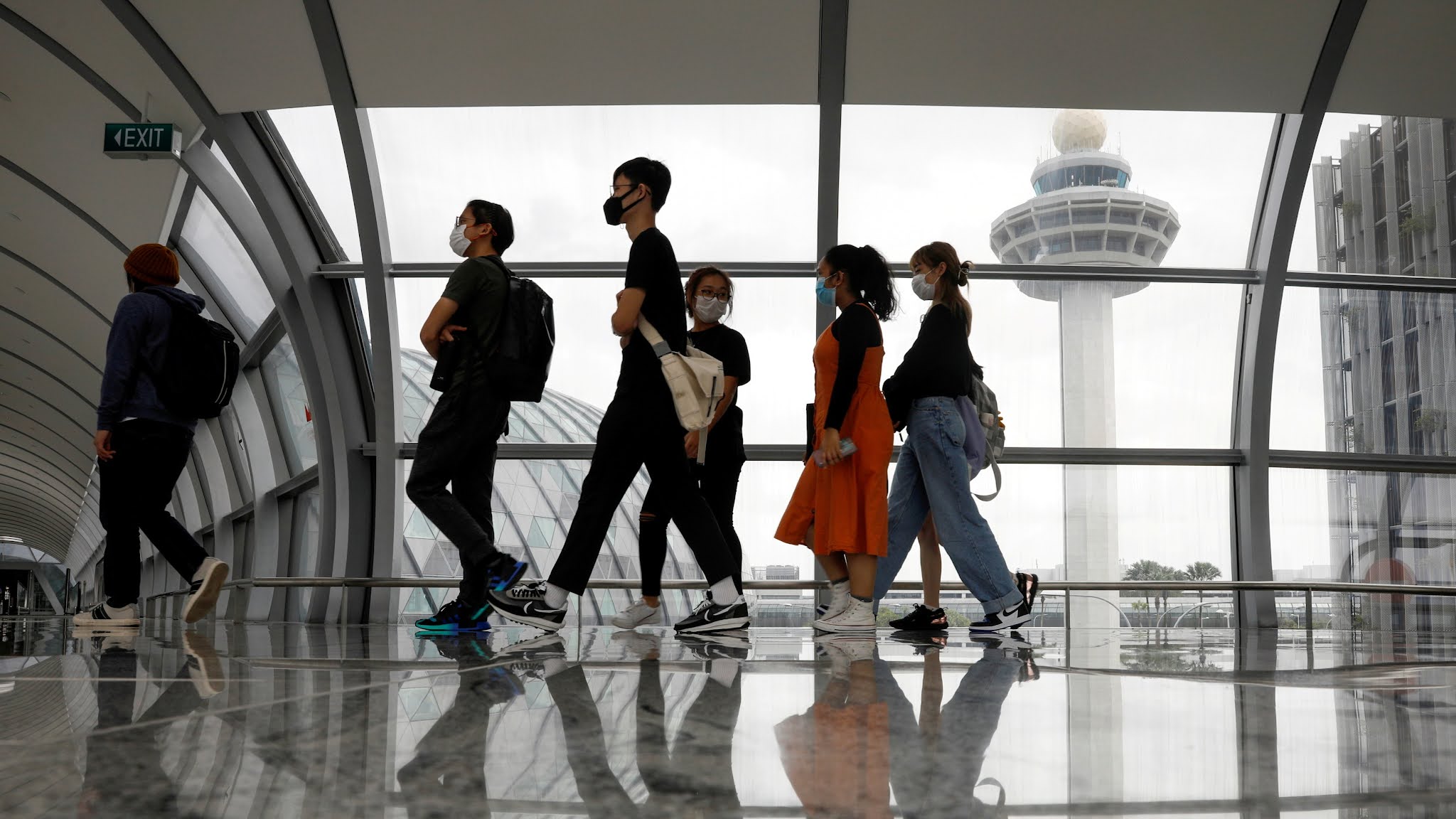
Singapore to curb arrivals from 7 African countries over variant

Singapore will restrict arrivals from seven African countries, health officials said Friday, after South Africa discovered a new Covid-19 variant with a large number of mutations.

All non-Singaporeans and people without permanent residency in the city-state who have recent travel history to the seven countries will be barred from entering or transiting through Singapore, the health ministry said. 

The new restrictions, which will take effect from Sunday, apply to South Africa, Botswana, Eswatini, Lesotho, Mozambique, Namibia, and Zimbabwe, the ministry said.

Singapore citizens and foreigners holding permanent resident status in the city-state of 5.5 million arriving from those countries can still enter, but will have to undergo a 10-day quarantine. 

Singapore currently has no cases of the new variant, but officials are seeking to "take the necessary precautions to reduce the risks" of it spreading to the country, the ministry said.

The city-state has had a mild outbreak of Covid-19, reporting almost 260,000 cases and 681 deaths.

Scientists in South Africa announced the discovery of the variant, which goes by the label B.1.1.529, on Thursday, and are blaming it for a surge in infections.

In response, Britain announced a ban on travel from six southern African countries. 

Agence France-Presse

Monday, April 19, 2021

Britain is investigating variant originating in India

LONDON—British health officials are investigating a COVID-19 variant originating in India but as yet they do not have enough evidence to classify it is as a variant of concern, Susan Hopkins of Public Health England (PHE) said on Sunday.

Speaking on the Andrew Marr Show on BBC television, Hopkins said: "We have not got enough data about this variant yet to be able to clarify whether it's a variant of concern. We have put it as a variant under investigation."

"To escalate it up the ranking we need to know that it's increased transmissibility, increased severity, or vaccine-evading, and we just don't have that yet, but we're looking at the data on a daily basis."

PHE has said it has identified 77 cases of the variant in Britain.

Earlier, environment minister George Eustice said Prime Minister Boris Johnson's trip to India later this month should go ahead despite rising cases in the country.

"It is important that business and the business of politics if you like does continue," he said, adding that an expert committee periodically reviews decisions about whether to permit travel to certain countries. (Reporting by Elizabeth Piper; editing by Emelia Sithole-Matarise)

-reuters