Showing posts with label China. Show all posts

Sunday, September 24, 2023

Biden aims to wrest influence from China in Pacific islands

WASHINGTON - President Joe Biden is set to host leaders of Pacific island nations with an aim of countering China's ever-growing influence, proffering goodies ranging from an American football experience to shiny new embassies.

The summit of leaders from the 18-member Pacific Islands Forum will take place Monday and Tuesday, one year after the first meeting, which was also in Washington.

According to senior administration officials, Biden will announce a more assertive US stance in the region, funding for infrastructure projects and strengthened maritime cooperation, in particular to fight against illegal fishing.

The forum brings together states and territories scattered across the Pacific Ocean, from Australia to sparsely populated micro-states and archipelagos.

There is "no question that there is some role that the PRC has played in all this," a senior White House official said on condition of anonymity, referring to China by the abbreviation of its formal name.

China's "assertiveness and influence, including in this region, has been a factor that requires us to sustain our strategic focus."

- Absence noted -

China's influence will be felt through the absence of the prime minister of the Solomon Islands, now closely aligned with Beijing.

Manasseh Sogavare, who was in New York this past week to attend the UN General Assembly, did not extend his stay in the United States.

"We're disappointed that he's chosen not to come to this very special summit," another White House official said.

Another goal of the meeting is to renegotiate "Compacts of Free Association" with the Marshall Islands before current terms expire Saturday.

The agreement, which Washington also has with Micronesia and the Palau archipelago -- other territories formerly under American administration -- allows the United States to have a military presence on the islands.

In exchange, Washington provides economic assistance and security guarantees, and inhabitants of the islands can live and work in the United States.

The Marshall Islands is demanding that any new agreement account for the effects of Washington's nuclear testing program there in the 1940s and '50s.

The Biden administration hopes to announce "very substantial progress" in the negotiations, the second White House official said.

- Enticements -

Biden had been due to follow up last year's inaugural summit with a meeting of Pacific leaders this May, in Papua New Guinea. But he cut short an Asia trip and returned stateside to address a debt-ceiling crisis.

For the Washington summit, Biden has prepared a full program, kicking off with an afternoon of American gridiron.

The leaders will travel by train on Sunday to Baltimore, where they will be guests of honor at an NFL game between the port city's Ravens and the Indianapolis Colts.

Monday's agenda features meetings and a lunch with Biden. On Tuesday, the leaders will meet with top officials on climate and the economy, and spend time with US lawmakers.

According to the administration officials, the United States will announce the establishment of diplomatic ties with the Cook Islands and Niue, a tiny territory with fewer than 2,000 inhabitants.

Washington has opened embassies in the Solomon Islands and Tonga, and wants to inaugurate one early next year in Vanuatu.

The Americans will also unveil millions in infrastructure aid, including funds for secure undersea telecommunications cables.

Finally, the White House intends to propose that the Pacific island states join the "Quad," a defense cooperation forum bringing together the US, Australia, India and Japan to cooperate on maritime surveillance, especially tracking down vessels engaged in illegal fishing.

Agence France-Presse

Monday, September 11, 2023

Biden: 'I don't want to contain China'

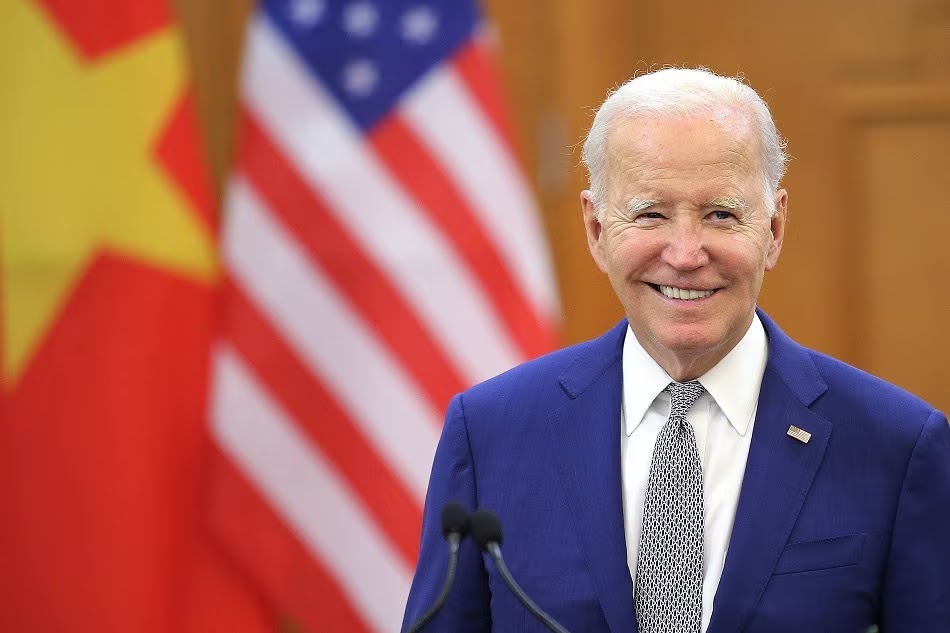
HANOI, Vietnam -- US President Joe Biden insisted Sunday he does not want to "contain" China, as the two powers face deepening divisions on trade, security and rights.

Biden said he had met Chinese Premier Li Qiang at the G20 summit in New Delhi -- a meeting the White House had not announced -- and discussed "stability".

The president revealed the encounter in Hanoi, where earlier in the day he agreed a deal to deepen ties with Vietnam as Washington looks to bolster its network of allies around Asia and the Pacific in the face of Beijing's rising influence.

Washington and Beijing are at loggerheads on a range of global issues, and Biden accused China of seeking to bend the international order to its will.

"One of the things that is going on now is China is beginning to change some of the rules of the game, in terms of trade and other issues," Biden told a news conference.

Washington has invested heavily in building alliances as part of its Indo-Pacific strategy, including the Quad security dialogue with India, Australia and Japan, and the AUKUS pact with Britain and Australia.

But he insisted the United States is not seeking to box China in, but rather to establish clear ground rules for relations.

"I don't want to contain China. I just want to make sure we have a relationship with China that is on the up and up, squared away, everybody knows what it's all about," he said.

Chinese President Xi Jinping skipped the G20 as Beijing and Delhi tussle over territorial and other issues.

Agence France-Presse

Sunday, September 3, 2023

Coach urges China to play smarter after missing Olympic basketball spot

China head coach Aleksandar Djordjevic said his team need to play smarter after missing out on an Olympic qualifying spot at the Basketball World Cup with a fourth defeat Saturday.

China slumped to a 96-75 loss to the Philippines in Manila to bring an end to a disastrous tournament for the basketball-obsessed nation.

By the time their game had ended, Japan had already claimed the one Asian qualifying spot for the Paris Games available at the World Cup.

Japan beat Cape Verde 80-71 in Okinawa for their third win to finish the tournament as Asia's highest-placed team.

China managed only one win from five games and Djordjevic said his team's "loss of focus and concentration" was to blame against the Philippines, after being outscored 34-11 in the third quarter.

"Once you're tired, once the difficulties start, you have to use your head -- our head was not used in the proper way tonight in the second half," he said.

"Basketball is a game for thinkers. You must think in every possession, you must understand what is happening on both sides of the floor."

Djordjevic said he would not quit as head coach and would lead the team at the Asian Games in Hangzhou later this month.

He said the team "must learn from this" and vowed to pick largely the same group of players.

"Everybody brings responsibility, the head coach is the first one," he said.

"That's how it happens. It's sport, we've got to try to get better every day, that's our job."

Four spots for the 12-team Paris Olympics will still be up for grabs at next year's qualifying tournament.

Agence France-Presse

Sunday, July 9, 2023

Yellen says Beijing visit helps put US-China ties on 'surer footing'

BEIJING — US Treasury Secretary Janet Yellen said Sunday that her talks with top Chinese officials have helped put ties on "surer footing", as she wrapped up a trip aimed at stabilizing fraught relations between the two biggest economies.

During her four-day trip -- which came on the heels of US Secretary of State Antony Blinken's visit -- Yellen stressed the need for healthy economic competition and improved communication, and urged cooperation on the "existential threat" posed by climate change.

"We believe that the world is big enough for both of our countries to thrive," she told journalists at the US embassy in Beijing on Sunday.

"Both nations have an obligation to responsibly manage this relationship: to find a way to live together and share in global prosperity," she added.

While it did not produce specific breakthroughs, Yellen's trip furthers a push by President Joe Biden's administration to steady ties with China.

Beijing's official Xinhua news agency said Saturday that Yellen's meeting with Vice Premier He Lifeng yielded an agreement to "strengthen communication and cooperation on addressing global challenges".

Both sides also agreed to continue exchanges, the readout added.

Yellen said Sunday that while there are "significant disagreements" between the countries, her talks had been "direct, substantive, and productive".

"My bilateral meetings –- which totaled about 10 hours over two days –- served as a step forward in our effort to put the US-China relationship on surer footing," she said.

"I feel confident that we will have more frequent and regular communication."

Sources of tension

Topping the laundry list of disagreements are Washington's trade curbs, which it says are crucial to safeguard national security.

On Sunday, Yellen said she had stressed that Washington's measures "are not used by us to gain economic advantage".

"These actions are motivated by straightforward national security considerations," she said.

And with the US mulling fresh curbs that could more strictly regulate American outbound investment to China, Yellen said any new moves would be implemented in "a transparent way".

"I emphasized that it would be highly targeted and clearly directed narrowly at a few sectors where we have specific national security concerns," she said.

"I want to allay their fears that we would do something that would have broad-based impacts on the Chinese economy.

"That's not the case, that's not the intention."

She also said she had raised "serious concerns" over "unfair economic practices" by Beijing.

She cited barriers to foreign firms entering the Chinese market as well as issues around the protection of intellectual property.

"I also expressed my worries about a recent uptick in coercive actions against American firms," she said, referring to a recent national security crackdown against US firms in China.

During a roundtable of experts on Saturday, Yellen also stressed the "critical" need for the two largest emitters of greenhouse gases to collaborate on climate financing.

"The United States and China must work together to address this existential threat," she said.

'Messaging' a key goal

Looking ahead, "any concrete key breakthroughs and major deliverables presumably will be reserved for the two top leaders to announce," said Yun Sun, director of the China program at the Washington-based Stimson Center.

"The two sides have not had this level of communications and consultations for a number of years," she told AFP.

Last month, Biden voiced confidence in meeting Chinese leader Xi Jinping soon.

Lindsay Gorman, senior fellow at the German Marshall Fund of the United States, added: "I think one underappreciated audience is really US allies and partners, both in the region and globally."

"The main goal for this trip is really a messaging goal," she told AFP.

Among the aims are communicating how Washington considers its economic relationship with China, and dispelling the notion that it might embrace "pure zero-sum competition" -- while signaling it targets a fairer playing field.

Overall, China's response towards Yellen's visit appears "more enthusiastic" than Blinken's trip, as he is considered more hawkish, said Wu Xinbo, director of the Center for American Studies at Fudan University.

"Yellen is seen as a professional in the eyes of the Chinese, and her attitude towards China-US economic and trade relations is relatively rational," said Wu.

Taylor Fravel, of the Massachusetts Institute of Technology, told AFP: "I don't think a single visit or interaction alone can achieve the goal of stabilizing relations."

But Yellen's visit and remarks convey support for continued US-China economic cooperation, "despite the political frictions in the relationship and competitive actions around limiting China's access to certain technologies such as semiconductors."

Agence France-Presse

Thursday, June 29, 2023

French luxury brand tycoon Bernard Arnault in China

BEIJING — French billionaire and luxury brand magnate Bernard Arnault is in China this week, social media posts showed, the latest visit by a foreign executive keen to reconnect to the world's second-largest economy.

The world's second-richest man after Elon Musk and chairman of LVMH group, Arnault was seen in Beijing visiting the upscale SKP mall and the Arnaulthe Sanlitun Taikoo Li shopping center Tuesday, posts widely circulated on Weibo showed.

He was then spotted in the southwestern city of Chengdu on Wednesday, where he toured the city's International Finance Center and other upscale stores, posts said.

Chinese state media also reported the visit was taking place, citing the social media videos.

Arnault is accompanied by two of his children -- Delphine, who heads the Dior perfume and fashion brand, and Jean, who is director of watch development and marketing at Louis Vuitton -- videos showed.

China is critical to the luxury market, and before the pandemic made up a third of all global luxury goods spending.

The pandemic hit the industry hard, with China's share of the market sinking to 17 percent in 2022, according to analysts at UBS, who have said that 2023 will be the "year of the Chinese consumer".

"The Chinese clientele is much more important than it was in 2019," LVMH's financial director Jean-Jacques Guiony recently told journalists.

Arnault's LVMH group -- which includes dozens of brands including Louis Vuitton, Givenchy, and Kenzo -- has continued to post strong revenue and profit growth despite global economic headwinds.

Arnault has said he is "optimistic about the Chinese market".

Agence France-Presse

Sunday, April 16, 2023

China's economy expected to rebound as zero-Covid era fades

BEIJING — China is expected to announce an economic rebound on Tuesday, when Beijing releases its first quarterly GDP figures since abolishing growth-sapping Covid restrictions late last year.

The Asian giant's virus containment policy -- an unstinting regime of strict quarantines, mass testing and travel curbs -- strongly constrained normal economic activity before it was abruptly ditched in December.

The disclosures on Tuesday will give the first snapshot since 2019 of a Chinese economy unencumbered by public health restrictions, with analysts polled by AFP expecting an average of 3.8 percent year-on-year growth in the period from January through March.

But the world's number two economy remains beset by a series of other crises, from a debt-laden property sector to flagging consumer confidence, global inflation and the threat of recession elsewhere.

"The recovery is real, but still in its early stage," said Larry Hu, chief China economist at the investment bank Macquarie.

Any rebound "will be gradual, largely due to the weak confidence" of consumers, which in turn makes companies "reluctant" to hire more staff, he said.

China's economy grew by just three percent in the whole of last year, one of its weakest performances in decades.

It posted a 4.8 percent expansion in the first quarter of 2022, though growth pulled back to just 2.9 percent in the final three months of the year.

PROPERTY PERILS

A creeping crisis in the property sector -- which together with construction accounts for around a quarter of China's GDP -- continues to "pose challenges to economic growth", said Rabobank analyst Teeuwe Mevissen.

Real estate was a key driver of China's recovery from the initial wave of the pandemic in 2020, when Beijing managed to stop the coronavirus from spreading widely.

But weak demand has since plagued a sector already afflicted by falling home prices and crippling debts that have left some developers struggling to survive.

The situation appears to have eased slightly in recent weeks as official support helped prices stabilize in March, according to figures released on Saturday by the National Bureau of Statistics.

Economists will also be watching keenly on Tuesday for March's retail data, the main indicator of household consumption.

Retail sales finally ticked up in January and February following four successive months of contraction, according to official figures.

But nearly 60 percent of urban households still prioritize saving money over investing or spending it, up from 45 percent before the pandemic, according to a survey by China's central bank.

Consumer confidence "remains well in negative territory" despite the heartening abolition of Beijing's Covid curbs, said Harry Murphy Cruise, a macroeconomist focusing on the Asia-Pacific region at the ratings agency Moody's.

"Households have long memories and will take time to forget the economic pain of recent years," he told AFP.

GLOBAL TENSIONS

Beijing has set a comparatively modest growth target of around five percent this year, a goal the country's Premier Li Qiang has warned could be hard to achieve.

While many experts tend to take China's official figures with a grain of salt, most expect Beijing to hit that mark.

An AFP analysts' poll predicted that the Chinese economy would grow by an average of 5.3 percent this year.

That is roughly in line with the International Monetary Fund's forecast of 5.2 percent.

Still, analysts warned that wider global trends could yet weigh on China's recovery.

They include geopolitical tensions with the United States, the threat of recession in other major economies and galloping global inflation.

Agence France-Presse

Tuesday, April 4, 2023

Australia bans TikTok on government devices

SYDNEY — Australia said Tuesday it will ban TikTok on government devices, joining a growing list of Western nations cracking down on the Chinese-owned app due to national security fears.

Attorney-General Mark Dreyfus said the decision followed advice from the country's intelligence agencies and would begin "as soon as practicable".

Australia is the last member of the secretive Five Eyes security alliance to pursue a government TikTok ban, joining its allies the United States, Britain, Canada and New Zealand.

France, the Netherlands and the European Commission have made similar moves.

Dreyfus said the government would approve some exemptions on a "case-by-case basis" with "appropriate security mitigations in place".

Cyber security experts have warned that the app -- which boasts more than one billion users -- could be used to hoover up data that is then shared with the Chinese government.

Fergus Ryan, an analyst with the Australian Strategic Policy Institute, said stripping TikTok from government devices was a "no-brainer".

"It's been clear for years that TikTok user data is accessible in China," Ryan told AFP.

"Banning the use of the app on government phones is a prudent decision given this fact."

Ryan said Beijing would likely "perceive it as unfair treatment of and discrimination against a Chinese company".

The security concerns are underpinned by a 2017 Chinese law that requires local firms to hand over personal data to the state if it is relevant to national security.

Beijing has denied these reforms pose a threat to ordinary users.

China "has never and will not require companies or individuals to collect or provide data located in a foreign country, in a way that violates local law", foreign ministry spokesperson Mao Ning said in March.

'ROOTED IN XENOPHOBIA' 

TikTok has said such bans were "rooted in xenophobia", while insisting that it is not owned or operated by the Chinese government.

The company's Australian spokesman Lee Hunter said it "would never" give data to the Chinese government.

"No one is working harder to make sure this would never be a possibility," he told Australia's Channel Seven.

But the firm acknowledged in November that some employees in China could access European user data, and in December it said employees had used the data to spy on journalists.

The app is used to share short, lighthearted videos and has exploded in popularity in recent years.

Many government departments were initially eager to use TikTok as a way to connect with a younger demographic that is harder to reach through traditional media channels.

New Zealand banned TikTok from government devices in March, saying the risks were "not acceptable in the current New Zealand Parliamentary environment".

Earlier this year, the Australian government announced it would be stripping Chinese-made CCTV cameras from politicians' offices due to security concerns.

Agence France-Presse

Wednesday, February 8, 2023

US says China balloon 'fleet' is global as NATO joins concern

WASHINGTON - The United States said Wednesday that suspected Chinese spy balloons like the one it shot down were part of a "fleet" that has spanned five continents, as NATO joined in voicing concern.

Pointing to global ramifications of the incident that has animated the United States, Secretary of State Antony Blinken said the United States was giving data to allies as it assesses the recovered debris.

"We already shared information with dozens of countries around the world, both from Washington and through our embassies," Blinken said.

"We're doing so because the United States was not the only target of this broader program, which has violated the sovereignty of countries across five continents," he told a joint news conference with NATO's visiting chief.

White House Press Secretary Karine Jean-Pierre, speaking separately to reporters on Air Force One, described the balloons as part of a "fleet" and said they had been spotted around the world for several years.

A huge white balloon carrying sophisticated equipment traversed the continental United States last week before President Joe Biden ordered the military to shoot it down just off the east coast in the Atlantic.

China insists that the balloon was merely conducting weather research, but the Pentagon described it as a high-tech spying operation. The balloon floated at an altitude far higher than most airplanes and crossed directly over at least one sensitive US military site.

'PATTERN BY CHINA'

NATO Secretary-General Jens Stoltenberg, whose visit to Washington followed a trip to Japan and South Korea, said the balloon showed the need for countries across the alliance to protect themselves.

"The Chinese balloon over the United States confirms a pattern of Chinese behavior where we see that China over the last years has invested heavily in new military capabilities," Stoltenberg said.

"We've also seen increased Chinese intelligence activities in Europe. They use satellites, they use cyber and, as we've seen over the United States, also balloons. So we just have to be vigilant," he said.

Stoltenberg also issued a new warning that China was drawing lessons from the war in Ukraine, which NATO countries have been supporting as it fights back Russian invaders.

"What happens in Europe today could happen in Asia tomorrow," Stoltenberg said, pointing to China's pressure on Taiwan, the self-governing democracy claimed by Beijing.

The Washington Post, quoting US officials, reported that the Chinese surveillance program has been run partly out of the southern island of Hainan.

Updating old technology, the balloons have been used to monitor the military assets of nearby rivals such as Japan, India and Taiwan, the newspaper said.

Biden, in his State of the Union address on Tuesday, said that his orders to shoot down the balloon showed that the United States would not hesitate to act when needed.

But he also stressed that the United States did not want conflict with China. The balloon episode led Blinken to postpone a trip to China in which he had hoped to work at easing tensions.

China, which voiced regret about the air intrusion but later denounced the US decision to down it, responded to Biden that it would also "firmly defend" its interests.

US officials said they took measures to prevent the balloon's instruments from collecting confidential information during its flight.

They say that the decision to wait until the balloon reached water was the only way to ensure the safety of people on the ground.

Biden's Republican rivals say he should have ordered the balloon to be destroyed as soon as it was identified.

Agence France-Presse

Thursday, April 21, 2022

Asian Games faces ‘possibility’ of postponement, says official

The 2022 Asian Games in China is facing the "possibility" of being postponed, a senior official told AFP on Thursday, after a rumor that it would be moved to next year.

The Olympic-sized event is scheduled to be held in September in Hangzhou near Shanghai, which is grappling with a major coronavirus emergency.

"No official decision has been taken by the committee until now, but there is a possibility that it will be postponed," said Kuwait's Husain Al-Musallam, director-general of the Olympic Council of Asia, the Games' governing body.

Most international sports events have been on hold in China since the COVID-19 pandemic, although Beijing hosted the Winter Olympics in a strict bio-bubble in February.

Shanghai, China's biggest city, has witnessed the country's worst COVID outbreak in two years, with weeks-long restrictions keeping most of its 25 million inhabitants confined to their homes.

All 56 competition venues for the Games have already been completed, Chinese organizers said this month, promising to publish a virus-control plan that takes its cue from the Winter Olympics.

"We're now just making a few final adjustments and improvements to the facilities," Lu Chunjiang, an official in charge of operations at Hangzhou Olympic Sports Centre, told state broadcaster CCTV.

Hangzhou, less than 200 kilometers from Shanghai, is scheduled to hold the Games from September 10 to 25, becoming the third Chinese host after Beijing in 1990 and Guangzhou in 2010.

Agence France-Presse

Friday, February 4, 2022

Olympics: With rings breaking from block of ice, Games ceremony begins

BEIJING - The opening ceremony of the 2022 Beijing Winter Olympics kicked off on Friday night, the culmination of preparations beset by the COVID-19 pandemic and criticism over human rights in China that led several countries to mount a diplomatic boycott.

Held on the first day of Spring by the Chinese calendar, it began with a performance by dancers waving glowing green stalks to convey the vitality of the season, followed by an explosion of white and green fireworks that spelled the word "Spring".

On a three-dimensional cube resembling a block of ice, lasers carved imagery from each of the previous 23 Winter Games. The block was then "broken" by ice hockey players, enabling the Olympic rings to emerge, all in white.

That was followed by the traditional "parade of nations", with each of the 91 delegations preceded by a women carrying a placard in the shape of a snowflake resembling a Chinese knot.

In keeping with Olympic tradition, the parade was led into the stadium by Greece with the rest ordered by stroke number in the first character of their Chinese name, which meant Turkey was second, followed by Malta, with host China set to go last.

The entrances for "Hong Kong, China", as well as for Russia, generated applause in the partially filled stadium.

Russian President Vladimir Putin, the highest profile foreign leader present for the Games, could be seen in the stadium without a mask. However, the athletes from his country were unable to carry its flag due to doping violations, marching instead under the standard of the Russian Olympic Committee.

RETURN TO BIRD'S NEST

Friday's ceremony began shortly after President Xi Jinping and International Olympic Committee Chairman Thomas Bach entered the iconic Bird's Nest stadium.

Soon after the start, the Chinese flag was passed among 56 people representing China's different ethnic groups before it was raised and the national anthem performed.

Directed by Zhang Yimou, reprising his role from Beijing's 2008 Summer Games triumph, the event was to feature 3,000 performers on a stage comprised of 11,600 square metres of high-definition LED screen resembling an ice surface.

All of the performers are ordinary people from Beijing and nearby Hebei province, with "the Story of a Snowflake" its central thread.

With temperatures of about -4C (25F) at the start, the show was set to be about half as long as the four-hour marathon that opened the 2008 Games, also at the Bird's Nest.

The crowd itself was pared down, with organisers deciding last month not to sell tickets to Olympic events to curtail the spread of COVID-19. A "closed loop" separates competitors and other personnel from the Chinese public throughout the Olympics.

MORE CONFIDENT CHINA

Though smaller in scale than the Summer Games, the Beijing Winter Olympics are being staged by a much more prosperous, powerful, confident and confrontational China under Xi.

China's hosting of the Winter Games has drawn criticism since the International Olympic Committee selected Beijing in 2015, and countries including the United States, Britain and Australia staged diplomatic boycotts, meaning they did not send government representatives to the Games.

Putin arrived on Friday for a meeting with Xi ahead of the opening ceremony, bringing a deal https://www.reuters.com/lifestyle/sports/russian-president-putin-arrives-beijing-winter-olympics-state-tv-2022-02-04 to increase natural gas supply to China amid rising tensions with the West and winning a pledge from Xi to deepen mutual cooperation.

Chinese state broadcaster CCTV noted that Putin, like China, expressed opposition to the "politicisation" of the Games.

Zhang, the director, said the ceremony takes into account the changed global backdrop, including the pandemic and what he said were hostile forces "suppressing and blackening" China.

"In this new and complex global situation, the Winter Olympics will show the confidence and pride of the Chinese people, the love of Chinese people, the affection of Chinese for the people of the world," he told state news agency Xinhua.

The official start of the Games will come as a relief to organisers navigating the extreme complexity of staging them during a pandemic while adhering to China's zero-COVID policy.

Organisers also hope it quietens a steady drumbeat of criticism from activists and governments over China's human rights record in its far western Xinjiang region and elsewhere - criticism that China rejects.

"I believe that at the instant in which the Olympic flame is lit, all of this so-called boycott banter https://www.reuters.com/lifestyle/sports/boycott-banter-be-doused-by-opening-says-games-organiser-2022-02-03 will be extinguished," Zhao Weidong, a spokesperson for the Beijing Games, told Reuters.

(Reporting by Tony Munroe, Muyu Xu and Gabrielle Tetrault-Farber; Editing by Lincoln Feast, Shri Navaratnam and Alex Richardson)

-reuters

Thursday, January 27, 2022

Apple's iPhone retakes top spot in China smartphone market: research

BEIJING - Apple reclaimed its position as the top smartphone seller in China after 6 years, clocking a record market share in the final quarter of 2021 as US sanctions hit rival Huawei, according to researchers. 

A surge in sales saw the iPhone maker account for 23 percent of the highly competitive market in October-December, industry analysis firm Counterpoint said in a report released Wednesday.

That put the US giant in pole position for the first time since the final three months of 2015, toppling China's Vivo.

Vivo and another local brand Oppo were not far behind, driven in part by their "strong offline penetration", Counterpoint said.

But smartphone sales in the country also dropped 9 percent on-year in the period.

"Apple's stellar performance was driven by a mix of its pricing strategy and gain from Huawei's premium base," said Counterpoint research analyst Mengmeng Zhang.

"Apple rose to first place in China right after the iPhone 13 was released in September," she added, noting it had a lower starting price than its rivals.

The shift comes as Chinese telecom giant Huawei was caught in the crosshairs of Beijing and Washington's trade and technology standoff. 

The United States has barred Huawei from buying crucial components such as microchips, and forced it to create its own operating system by cutting it off from using Google's Android operating system.

In December, Huawei said its annual revenue fell nearly a third from the previous year to 634 billion yuan ($99.5 billion).

China is a key market for Apple, with sales in the Greater China region -- including the mainland, Hong Kong and Taiwan -- surging 70 percent in the year to September.

Agence France-Presse

Monday, December 6, 2021

Didi departure from NYSE marks end of Wall Street romance with Chinese big tech

NEW YORK, United States - The Chinese ride-hailing giant Didi Chuxing's announcement that it will delist its shares from the New York Stock Exchange marks the end of a cushy relationship between Wall Street and Chinese tech giants, who are under siege from authorities in Beijing and regulators in America.

Only 5 months transpired between Didi's going public in New York in June and word Friday that it will prepare a Hong Kong listing. During that time its market value has fallen by 63 percent.

Didi's move comes in the wake of a sweeping Chinese regulatory crackdown in the past year that has clipped the wings of major internet firms wielding huge influence on consumers' lives -- including Alibaba and Tencent.

After Friday's announcement, heavyweight Chinese online retailers whose stocks are sold on the New York exchange, such as Alibaba, JD.com and Pinduoduo, dropped sharply.

Shares in Alibaba -- whose arrival on Wall Street in 2014 to a loud fanfare kicked off the parade of Chinese firms listing in the Big Apple -- fell to their lowest level in nearly five years as rumors circulated that, after Didi leaves, Alibaba might be next.

Technically, even as Didi Chuxing moves its listing to Hong Kong, holders of its shares in New York retain those stakes. Their investment does not simply vanish.

But "people are very fearful about regulations and the Chinese government," said Kevin Carter, portfolio manager at EMQQ. "And that has really, really affected sentiment. People are scared."

Coincidentally, on Thursday US market regulators announced the adoption of a rule allowing them to delist foreign companies if they fail to provide information to auditors.

The move is aimed primarily at Chinese firms, and requires them to disclose whether they are "owned or controlled" by a government.

"While more than 50 jurisdictions have worked... to allow the required inspections, two historically have not: China and Hong Kong," Securities and Exchange Commission chairman Gary Gensler said.

'Sensitive data' 

The Global Times, a newspaper close to the Chinese Communist Party, criticized the new US regulation in an opinion piece Friday.

"If the US sets unequal conditions on national security for competition between the two countries by demanding Chinese listed companies hand over audits for inspection so as to spy on China's internal situation and store huge amounts of sensitive data acquired by Chinese companies, China won't accept that," the unsigned piece said.

Many of these New York-listed shares are held not by private citizens but rather by institutional investors.

"Some funds can only have shares that are traded on US markets," said Gregori Volokhine, president of Meeschaert Financial Services. "This is what is putting pressure on shares."

And for many market watchers, Didi, described as China's answer to Uber, will not be the last Chinese tech giant to delist from New York.

"It is not specific to Didi because for months we have seen the communist party's grip on companies tighten," said Volokhine.

Shortly after Didi went public in New York, the reservation platform Full Truck Alliance and the job-search site Kanzhun were investigated by China's cybersecurity watchdog.

The Chinese government has also tightened regulations on companies that offer families private tutoring. This has hurt companies listed in New York.

According to figures in May from a US government agency, a total of 248 Chinese companies are listed in the United States, with a combined market capitalization of 2.1 trillion dollars.

"After an active start to the year, Chinese companies have largely stopped tapping the US IPO market since June, due to regulatory and policy roadblocks in both countries," said Matthew Kennedy, a strategist with Renaissance Capital.

This week Spark Education, a big Chinese online small-class teaching firm, withdrew its planned IPO in the US.

"The way things are, one can say there will be no more new Chinese IPOs and the ones in the pipeline will be withdrawn one by one," Volokhine said. Renaissance Capital says there are 35 companies in that pipeline.

In leaving the US market, Chinese companies are giving up an investor base like no other in the world -- with $52.5 trillion in assets under management, compared to $7.1 trillion in China, according to a study last year by McKinsey and Company, a management consulting firm.

Carter said this political pressure on Chinese companies creates an odd situation in which the stars of the Chinese tech world are plummeting on the stock market, but not because of their earnings reports.

"And these companies are still making profits. And then those profits are still growing," he said.

"The revenue growth for the year is over 30 percent. Not for every company, but a bit collectively. No matter where the stock is, no matter where the stocks trade, that's still the case," he said.

Agence France-Presse


Saturday, June 19, 2021

US triples vaccines for Taiwan with 2.5 million-dose shipment

WASHINGTON - The United States will ship 2.5 million COVID-19 vaccine doses to Taiwan on Saturday, a senior administration official told Reuters, more than tripling Washington's previous allocation of shots for the island, which has faced increasing political and military pressure from China.

Washington, competing with Beijing to deepen geopolitical clout through so-called "vaccine diplomacy," initially had promised to donate 750,000 doses to Taiwan but is increasing that number as President Joe Biden's administration advances its pledge to send 80 million US-made shots around the world.

China, which considers Taiwan an integral part of its territory, has repeatedly offered to send coronavirus vaccines to the island, which has been battling a spike in domestic infections. 

Taipei has expressed concern about the safety of Chinese shots.

The 2.5 million donated doses of the Moderna Inc vaccine will leave Memphis, Tennessee, on a flight belonging to Taiwan's China Airlines early on Saturday and arrive in Taipei on Sunday evening, the senior US administration official said, adding that the prompt delivery was due to experts from both sides being able to work out regulatory issues.

"We are not allocating these doses, or delivering these doses, based on political or economic conditions. We are donating these vaccines with the singular objective of saving lives," the official said.

"Our vaccines do not come with strings attached," the official said, adding Taiwan had "faced unfair challenges in its efforts to acquire vaccines on the global marketplace."

A deal for Taiwan to purchase vaccines from Germany's BioNTech SE fell through this year, with Taiwan's government blaming pressure from Beijing.

China has denied the accusation, saying Taiwan is free to obtain the vaccines through Shanghai Fosun Pharmaceutical Group Co Ltd, which has a contract to sell BioNTech's vaccine in China, Hong Kong, Macau and Taiwan.

"We believe that these attempts by China to block purchases, for political purposes, are reprehensible," the senior Biden administration official said.

The de facto US embassy, the American Institute in Taiwan, later confirmed the delivery.

"The donation reflects our commitment to Taiwan as a trusted friend, and a member of the international family of democracies," it said in a statement.

Taiwan is trying to speed up the arrival of the millions of vaccines it has on order, although infections remain comparatively low despite a rise in domestic cases. Only around 6% of Taiwan's 23.5 million people have received at least one shot of a vaccine regimen.

The US shipment comes at a time when Washington has been working with Taipei to create secure supply chains for strategic items such as computer chips, of which Taiwan is a key producer, that are vital for US automobile manufacturers and other industries.

It also comes after Taiwan announced on Friday that it will allow Terry Gou, the billionaire founder of Taiwan's Foxconn and semiconductor giant TSMC, to negotiate on its behalf for COVID-19 vaccines.

Taiwan Presidential Office spokesman Xavier Chang said Washington's assistance with vaccines confirmed the "rock-solid friendship between Taiwan and the United States."

Jonathan Fritz, a senior State Department official, said on Thursday that China had been "very aggressively using vaccine donations as a lever to induce more of Taiwan's diplomatic partners to switch recognition."

Beijing has steadily whittled down the number of Taiwan's diplomatic allies, which now stands at just 15 countries.

The United States, which like most countries has no formal diplomatic ties with Taiwan, has watched with alarm the stepped up tensions with Beijing, and Biden's administration has vowed to boost ties with the island, which it is required under US law to supply with the means of defense.

Earlier this week Taiwan reported the largest incursion yet by China's air force, including fighters and nuclear-capable bombers, into its air defense identification zone. 

(Reporting by Michael Martina, David Brunnstrom and Andrea Shalal in Washington; Additional reporting by Ben Blanchard in Taipei; Editing by Mary Milliken, Daniel Wallis and Steve Orlofsky)

-reuters

Thursday, April 8, 2021

China considers banning teachers from sexual relationships with young students

China is considering following Western countries in banning teachers from dating young students, according to a circular released to solicit public opinions.

The draft of School Protection Order for Juveniles was issued by the Ministry of Education on Tuesday and, if passed into law, requires primary and middle schools to prohibit teachers from dating students or having sex with them. The current age of consent in China is 14 years of age.

Other predatory behaviours that “hurt students’ physical and mental health” listed in the document include molesting students by groping or intentionally touching particular parts of their body, flirting, teasing, or making sexually suggestive comments.

Teachers are also banned from displaying or circulating messages, books, magazines, films, videos, or pictures that contain pornographic information to students.

The order also contains specific clauses on sexual harassment, by asking schools to establish safe management of dormitories, camera surveillance, and mechanisms for preventing, reporting, and dealing with sexual harassment incidents.

Among other regulations being proposed is a ban on schools revealing students’ rankings in tests and from publicising previous graduates who were enrolled by prestigious higher-level schools.

Teachers found violating the rules would receive disciplinary punishment and prevented from joining any award competitions for a period of one to three years. If the schools’ principal is responsible for an incident or found to have failed in their duty of care, they could be removed from their job for up to five years, the document said.

The public can send feedback about the order before April 23. It’s unclear if the order will be passed or when it would be put into effect.

Xiong Bingqi, director of the 21st Century Education Research Institute, said the latest order is to make clear to schools their duties as a way to support the country’s revised Law of the Protection of Juveniles that will be implemented in June.

A 2014 regulation governing teachers’ ethics has outlawed 10 specific activities, including sexual harassment or having an “inappropriate relationship” with students.

But regarding the definition of “inappropriate relationship”, different people have different ideas, Xiong told the South China Morning Post.

As a result of the absence of a clear definition of this term, it’s difficult for schools and the education department to deal with the case if the teacher involved is single, he said.

“In some cases, teachers accused of sexual harassment claimed this was an injustice by arguing the relationship had been consensual, Xiong said.

“Normally the teacher will be assigned to other schools, instead of being punished for an ethics error,” said Xiong.

“With the future implementation of the teacher-student dating ban, this kind of thorny issue will be treated smoothly since it’s not right for them to date in the first place,” he said.

Some people objected to the banning of teacher-student dating, arguing that dating is every person’s legal right.

“But they don’t understand that a teacher can use the power from his position to induce or force students to date with him or her. If a teacher is dating a student, he or she would often give privilege to the student. This is unfair for other students,” said Xiong. “So banning teacher-student dating is essentially to avoid interest exchanges.”

He urged the state authority to extend the ban to universities.

Maggie Yang, a Shenzhen mother of a 15-year-old girl, said she agreed with the teacher-student dating ban.

“I think dating is the business of adults. How can we tolerate that a teacher dates a minor student?” she asked. “This rule should have been made earlier.”

-South China Morning Post


Wednesday, February 17, 2021

TikTok hit with consumer law breaches complaints across Europe

BRUSSELS - Chinese-owned short video-sharing app TikTok was hit with multiple complaints from EU consumer groups on Tuesday for allegedly violating the bloc's consumer laws and for failing to protect children from hidden advertising and inappropriate content.

Owned by China's ByteDance, TikTok has been rapidly growing in popularity around the world, particularly among teenagers. It faces growing criticism about its privacy and safety policies following a number of incidents.

European consumer group BEUC cited several issues in its complaint, among them its terms of service.

"They are unclear, ambiguous and favor TikTok to the detriment of its users. Its copyright terms are equally unfair as they give TikTok an irrevocable right to use, distribute and reproduce the videos published by users, without remuneration," it said.

It said the company's virtual item policy where users can purchase coins to use for virtual gifts for TikTok celebrities whose performance they like, contains unfair terms and misleading practices.

"TikTok fails to protect children and teenagers from hidden advertising and potentially harmful content on its platform," BEUC said.

The company's practices for the processing of users' personal data are misleading, it said.

In addition to BEUC's complaint, consumer organizations in 15 countries have alerted their authorities and urged them to act.

"We're always open to hearing how we can improve, and we have contacted BEUC as we would welcome a meeting to listen to their concerns," a TikTok spokesman said.

The company said it has developed an in-app summary of its privacy policy to make it easier for teens to understand its stand on privacy. 

-reuters

Friday, September 18, 2020

US to ban TikTok downloads, WeChat use

WASHINGTON - The United States on Friday ordered a ban on downloads of popular Chinese-owned video app TikTok and use of the messaging and payment platform WeChat, saying they threaten national security.

The move, to be implemented Sunday, comes amid rising US-China tensions and efforts by the Trump administration to engineer a sale of TikTok to American investors.

"The Chinese Communist Party has demonstrated the means and motives to use these apps to threaten the national security, foreign policy, and the economy of the US," Commerce Secretary Wilbur Ross said in a statement.

The initiative would ban WeChat, an app with massive use among Chinese speakers, and TikTok from the online marketplaces operated by Apple and Google.

But while WeChat will effectively be shut down from Sunday in the US, existing TikTok user will be able to continue using the app until Nov. 12 -- when it would also face a full ban on its US operations.

But the Commerce Department said if national security concerns over TikTok were resolved before then, the order may be lifted.

TikTok's brand of brief, quirky videos made on users' cellphones has become hugely popular, especially among young people.

The plan follows through on a threat by President Donald Trump, who has claimed Chinese tech operations may be used for spying, and it ramps up the pressure on TikTok parent ByteDance to conclude a deal to sell all or part of TikTok to allay US security concerns.

A deal which appeared to be taking shape would allow Silicon Valley giant Oracle to become the tech partner for TikTok, but some US lawmakers have objected to allowing ByteDance to keep a stake.

The ban on WeChat, owned by Chinese giant Tencent, has the potential for disrupting the widely used social media and financial application.

US officials said in a recent court filing they would not target those using WeChat for ordinary personal communications.

Agence France-Presse

Saturday, June 20, 2020

Rare ‘ring of fire’ solar eclipse to dim Africa, Asia


Skywatchers along a narrow band from west Africa to the Arabian Peninsula, India and southern China will witness on Sunday the most dramatic “ring of fire” solar eclipse to shadow the Earth in years.

Annular eclipses occur when the Moon — passing between Earth and the Sun — is not quite close enough to our planet to completely obscure sunlight, leaving a thin ring of the solar disc visible.

They occur every year or two, and can only be seen from a narrow pathway across the planet.


Remarkably, the eclipse on Sunday arrives on the northern hemisphere’s longest day of the year — the summer solstice — when Earth’s north pole is tilted most directly towards the Sun.

The “ring of fire” will first be seen in northeastern Republic of Congo at 5:56 local time (04:56 Greenwich Mean Time Zone) just a few minutes after sunrise.

This is the point of maximum duration, with the blackout lasting 1 minute and 22 seconds.


Arcing eastward across Asia and Africa, it will reach “maximum eclipse” — with a perfect solar halo around the Moon — over Uttarakhand, India near the Sino-Indian border at 12:10 local time (6:40 Greenwich Mean Time Zone).


More spectacular, but less long-lived: the exact alignment of the Earth, Moon and Sun will be visible for only 38 seconds.

“The annular eclipse is visible from about 2% of Earth surface,” Florent Delefie, an astronomer and the Paris Observatory, told Agence France-Presse.

“It’s a bit like switching from a 500-watt to a 30-watt light bulb,” he added. “It’s a cold light, and you don’t see as well.”

Good weather key

Animals can get spooked — birds will sometimes go back to sleep, and cows will return to the barn.

The full eclipse will be visible somewhere on Earth during just under four hours, and one of the last places to see a partially hidden Sun is Taiwan before its path heads out into the Pacific.

People hundreds of kilometers on either side of the centreline across 14 countries will also see light drain from the day, but not the “ring of fire.”

Weather conditions are critical for viewing.

“Good weather is the key to successful eclipse viewing,” astrophysicist Fred Espenak, an expert on eclipse prediction, commented on the National Aeronautics and Space Administration (NASA) Eclipse website. “Better to see a shorter eclipse from clear sky than a longer eclipse under clouds.”

A solar eclipse always occurs about two weeks before or after a lunar eclipse, when the Moon moves into Earth’s shadow. Lunar eclipses are visible from about half of Earth’s surface.

There will be a second solar eclipse in 2020 on Dec. 14 over South America. Because the Moon will be a bit closer to Earth, it will block on the Sun’s light entirely.

It will take less than 100 minutes for the path of this eclipse to move across the continent.

Even if the day has darkened, looking at a solar eclipse with the naked eye is dangerous.

Sunglasses — which don’t filter out Ultraviolet rays — do not offer any protection, Delefie warned.

“The Sun is so bright that even when there’s only a tiny portion visible, it is still dangerous for the eyes,” he said.

Agence France-Presse

Wednesday, May 27, 2020

Stock markets mixed as China-US tensions return to fore


Equities were mixed Wednesday as profit-taking and worries about deteriorating China-US relations were weighed against optimism over the gradual reopening of economies around the world.

Hong Kong extended losses as police fired pepper-ball rounds as anti-China protesters took to the city's streets, with investors fearing the demonstrations could erupt into the worst unrest since last summer.

The broad trend across global markets has been upward for weeks as virus deaths and infections ease in most countries and governments begin to reopen their battered economies, fanning hopes for a recovery in the second half of the year.

Confidence has also come from mind-boggling amounts of stimulus and central bank pledges of support, with the latest coming from the eurozone, where European Commission President Ursula von der Leyen is due to unveil a trillion-euro revival plan for the bloc.

However, there was little fresh desire for risk assets with eyes on the simmering row between the world's top two economies, fuelled by Donald Trump's barracking of China over its role in the pandemic, and made worse this week by Beijing looking to tighten its grip on Hong Kong.

The financial hub was thrown back into the spotlight Friday when Chinese officials proposed a controversial security law that many fear could ring the death knell for the city.

And Trump appeared to agree, with his press secretary Kayleigh McEnany telling a briefing he had said it is "hard to see how Hong Kong can remain a financial hub if China takes over".

Washington has already said it could terminate its preferential trading status over the issue.

Markets are also fretting over reports that the US has warned it will impose sanctions on Chinese entities and officials if it goes ahead with the law.

While China and Hong Kong leader Carrie Lam have sought to ease worries about the extent of the law plans, Jeffrey Halley at OANDA warned that no matter how they try to dress it up "the passage of the security legislation from Beijing will have consequences for the beleaguered (city) and will further darken relations between the US and China."

Concerns about the growing crisis have weighed on the yuan, losing almost three percent this year, with observers suggesting it could hit a record low.

- Hong Kong protest worries -

Meanwhile, there are concerns about another flare-up in the city as lawmakers prepare to discuss a law that bans insulting China's national anthem.

Seven months of sometimes violent demonstrations last year hammered the local economy and raised questions about its future.

Hong Kong fell 0.4 percent, Shanghai lost 0.3 percent and Sydney fell 0.1 percent, while Kuala Lumpur dropped more than one percent as Malaysia struggled to contain its virus. There were also losses in Jakarta, Bangkok and Singapore.

But Tokyo, Mumbai, Manila, Seoul, Taipei and Wellington saw gains.

In early trade, London, Paris and Frankfurt were all higher. The gains in Paris as dealers brushed off a warning from officials that France's economy could contract 20 percent in the second quarter.

Still, National Australia Bank's Tapas Strickland, said in a note: "Risk sentiment continues to surge as activity lifts following the gradual easing of containment restrictions around the world, while vaccine hopes remain high with 10 different vaccines currently at the human trial stage."

He also cited comments from Federal Reserve official James Bullard that the third quarter "very likely, right behind the worst quarter, will be the best quarter of all time on the growth perspective".

Wall Street, where the New York Stock Exchange trading floor reopened after two months of closure, finished higher, with the Dow gaining 2.2 percent.

Oil markets slipped on China-US tensions, and after reports said Russia could begin easing up on its supply cuts in July.

Massive reductions by Moscow and other major producers including Saudi Arabia have helped fuel a surge in prices over the past month, with WTI doubling since the end of April.

But analysts said the commodity will likely continue to win support from the easing of lockdowns, which is expected to boost demand as people get back on the road.

- Key figures at around 0810 GMT -

Tokyo - Nikkei 225: UP 0.7 at 21,419.23 (close)

Hong Kong - Hang Seng: DOWN 0.4 percent at 23,301.36 (close)

Shanghai - Composite: DOWN 0.3 percent at 2,836.80 (close)

London - FTSE 100: UP 0.7 percent at 6,112.97

Euro/dollar: DOWN at $1.0954 from $1.0984 at 2040 GMT Friday

Dollar/yen: UP at 107.51 yen from 107.54 yen

Pound/dollar: DOWN at $1.2292 from $1.2335

Euro/pound: DOWN at 89.11 pence from 89.04 pence

West Texas Intermediate: DOWN 2.3 percent at $33.55 per barrel

Brent North Sea crude: DOWN 2.2 percent at $35.37 per barrel

New York - Dow: UP 2.2 percent at 24,995.11 (close)

Agence France-Presse

Monday, April 20, 2020

China: Dating apps turn hot during viral outbreak


BEIJING — Zhang Xiaojing is a 33-year-old accountant for a foreign trade company in Beijing who has been spending time scrolling through her dating apps since the novel coronavirus outbreak.

Bottom line, Zhang is looking to find a boyfriend and get married as soon as possible.


“I used to participate in some offline dating activities during the weekends, but almost all gatherings have been prohibited. Cinemas and bars were shut down to curb the spread of the deadly virus. I have to remain indoors to avoid getting infected.”

Zhang lives alone and feels very bored so she downloaded several online dating apps. They included Momo and Tantan in a bid to make new friends, and to give her some relief from the stress and loneliness.

She noted that Tantan’s way of finding dates, unlike traditional dating websites, is more interesting and simple.

“You just browse the profiles recommended to you based on your location, distance and gender preferences. Swipe right if you like someone, and swipe left to show you are not interested.”


“I chat only with the people that I am matched with, and can also choose to hide my contacts. The app adds other functionalities which people can use for free. For instance, I can play games, upload pictures or texts and share videos on it.”

For Zhang, online romance in the time of the contagion has become more than just finding love. It is also a source of comfort and connection.

Online dating apps have seen a significant increase in usage due to the COVID-19 outbreak.

Industry experts said the “cloud matchmaking” method, which includes livestreaming and short videos formats which comply with the habits of users and satisfy the needs of self-presentation, is gaining tractions among singles.

A report released by mobile dating app Tantan said the average time people spent on the app in early and mid February increased over 30 percent compared with the average usage during normal times. The number of users surged 60 percent during the peak hour which often runs from midnight to 1 am.


During the outbreak, those born after the period around 1995 and after 2000 have become the top users of Tantan. They recorded a more than 20 percent increase in messages sent and daily matches. Another notable fact is that the number of older users who came back rose by 25.9 percent compared with the level during normal times.

Founded in 2014, Tantan focuses on one-on-one interactions and targets students and white-collar workers. Women accounted for nearly half of the total users. So far, it has 10.5 million daily active users and 35 million monthly active users.

Data from iResearch Consulting Group showed the revenue of China’s online dating and matchmaking industry will increase from 4 billion yuan ($567 million) in 2017 to 5.3 billion yuan in 2020.

For singles, the pressure to get married usually increases when they return home during the Spring Festival holiday for family reunions. Their parents, grandparents and other relatives badger them about their personal lives to nosily inquire why they have not gotten married.

Zhenai.com, a popular matchmaking application website, said its active users reached 10 million during the Lunar New Year holiday (Jan 24-Feb 2), an increase of 39.3 percent compared with the same period of last year. More than 10,300 people found highly compatible matches on the app.

Wu Linguang, CEO of online matchmaking and dating platform Baihe Jiayuan Network Group Co, said video and livestreaming dating services have been launched to lure customers during the epidemic.

“Generally speaking, the emotional demand of singles reaches a peak on Valentine’s Day and lasts until the end of February,” Wu said.

Statistics from the company showed the time users spend on video dating rose 29.8 percent during the Spring Festival holiday, compared with the data from the festive season last year. The average usage time skyrocketed 93 percent versus the time from the same period a year ago.

Some 50 percent of single men and 33 percent of single women were lonely as they could not go out during the outbreak, it added.

Surfing the internet has become a major way to help ease their anxiety, with 30 percent of singles keen about making friends online. About 30 percent of men and 41 percent of women have switched from attending offline activities to online dating.


“The epidemic has given a big boost to the online dating apps, which are usually in the off season in the first quarter and gradually gain popularity after the Spring Festival,” said Yang Xin, an analyst with Beijing-based internet consultancy Analysys.

Yang believes that with rapidly increasing traffic, mobile app companies should think of how to hang onto their customers when the pandemic ends.

-China Daily

Sunday, April 5, 2020

Scared but desperate, Thai sex workers forced to the street


BANGKOK — A shutdown to contain the coronavirus has killed Thailand’s party scene and forced sex workers like Pim out of bars and onto desolate streets. She’s scared but desperately needs customers to pay her rent.

Red-light districts from Bangkok to Pattaya have gone quiet with night clubs and massage parlors closed and tourists blocked from entering the country.


That has left an estimated 300,000 sex workers out of a job, pressing some onto the streets where the risks are sharpened by the pandemic.

“I’m afraid of the virus but I need to find customers so I can pay for my room and food,” Pim, a 32-year-old transgender sex worker, told AFP in an area of Bangkok where previously bawdy neon-lit bars and brothels have gone dark.

Since Friday Thais have been under a 10 p.m. to 4 a.m. curfew. Bars and eat-in restaurants closed several days earlier.

Many of Bangkok’s sex workers had jobs in the relative safety of bars, working for tips and willing to go home with customers.

When their workplaces suddenly closed most returned home to wait out the crisis.

Others like Pim went to work on the streets.

The government said it is ready to enforce a 24-hour curfew if necessary to control a virus that has infected more than 2,000 people and killed 20, according to official figures.

Pim is paying a heavy price for the movement restrictions – she has not had a customer for 10 days and the bills are stacking up.

Her friend Alice, another transgender sex worker, has also been forced to move from a go-go bar to the roadside.

“I used to make decent money sometimes $300-600 a week,” Alice said.

“But when businesses shut down my income stopped too. We are doing this because we’re poor. If we can’t pay our hotel they will kick us out.”

High risk

The occasional tourist loiters near clusters of sex workers, before a furtive negotiation and a quick march to a nearby hotel, one of the few still open on Bangkok’s main tourist drag.

The already high risks of sex work have rocketed as the virus spreads.

Sex workers have flocked back to homes across the country in anticipation of several weeks of virtual lockdown before Thailand’s night economy comes back to life.

There were fears the malaise could last for months, yanking billions of tourist dollars from the economy and leaving those working in the informal sector destitute.

They include sex workers – an illegal but widely accepted part of Thailand’s nightlife.

There were concerns that a Thai government emergency scheme to give 5,000 baht ($150) to millions of newly jobless over the next three months will exclude sex workers because they cannot prove formal employment.

The Empower Foundation, an advocacy group for the kingdom’s sex workers, said entertainment venues make around $6.4 billion a year, many of them selling sex in some form.

Women are suffering the most from the virus measures, it said. Many are mothers and their family’s main income earner, forced into sex work by lack of opportunities or low graduate salaries.

The group has written an open letter to the government urging it to “find a way to provide assistance to all workers who have lost their earnings”.

As the 10 pm curfew looms, Pim and Alice prepared for a final forlorn patrol for customers.

“I think the government has been really slow. They don’t care about people like us who work in the sex industry,” Alice said.

“We’re more afraid of having nothing to eat than the virus.”

Agence France-Presse