Showing posts with label Mobile OS. Show all posts
Thursday, September 18, 2014
New Apple mobile software arrives Wednesday
SAN FRANCISCO–New-generation Apple software for powering its coveted mobile devices is set for release on Wednesday, two days ahead of the arrival of its latest iPhones.
The iOS 8 mobile operating system will be available free for download to many iPhone and iPad models and will be pre-installed on iPhone 6 and iPhone 6 Plus, which hit the market on Friday.
Apple unveiled iOS 8 at its annual developers’ conference in San Francisco in June.
The new operating software is tailored to deliver a seamless experience for users flitting between Apple mobile gadgets and popular Macintosh computers.
Alongside operating system updates, the California company unveiled HealthKit software to manage personal healthcare and HomeKit for home appliances. They are integrated into the latest system update.
HealthKit will provide a secure haven for data collected by devices such as fitness bands that track activity and sleep.
Apple also synched iOS 8 to HomeKit software that could let iPhones or iPads be used as a centralized control for Internet-linked gadgets such as door locks, lights, thermostats and security systems.
Apple came up with a common network protocol, so not only can an iPhone be used to open smart locks, but virtual assistant Siri can dim lights and lower thermostat settings when told, “Get ready for bed.”
Apple has also beefed up graphics and speed capabilities for games, which are consistently among the hottest applications on its mobile devices.
Capabilities woven into operating software include one called “Continuity,” which lets tasks started on one Apple gadget be automatically handed off to another one nearby.
Messages or calls can also be handed off between devices.
Apple last week announced that it is adding a smartwatch to its growing array of devices that will work together.
The Apple Watch will not be released until early next year.
source: technology.inquirer.net
Labels:
Apple Inc.,
Apple Watch,
Gadget,
Gadgets,
HomeKit Software,
iOS 8,
iPads,
iPhone 6,
iPhone 6 Plus,
iPhones,
Mobile OS,
Software,
Tech News,
Technology
Tuesday, November 12, 2013
Samsung makes quiet push for new mobile OS
SEOUL, South Korea—Most mobile phone users have never heard of Tizen. Neither have car owners or anyone with a fridge.
Samsung Electronics Co. wants to change that.
The South Korean electronics giant is in a quiet push to make its Tizen operating system a part of the technology lexicon as familiar as Google’s Android or Apple’s iOS. Its ambition doesn’t stop there. Samsung sees the software in your car, fridge and television too.
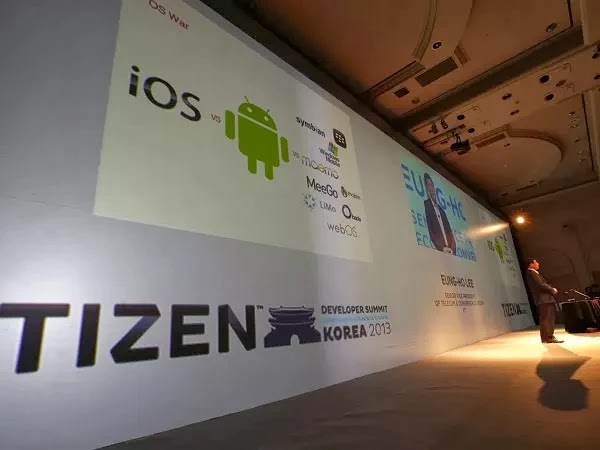
The first developer conference in Asia for Tizen wrapped up Tuesday after a two-day run, bringing together app developers and Tizen backers from Samsung, Intel and mobile operators.
Samsung did not announce a Tizen phone, but it made a pitch for developers to create apps for the mobile operating system that is yet to be seen in the market. Samsung promised to give out $4 million cash to the creators of the best Tizen apps.
Samsung supplied about one third of the smartphones sold worldwide in the third quarter, nearly all of them running on Google’s Android. Its early bet on Google’s free-of-charge operating system served Samsung well and the company’s rise to top smartphone seller also helped Android become the most used mobile platform in the world. According to Localytics, 63 percent of all Android mobile devices in use are made by Samsung.
But while Samsung was wildly successful with selling its Galaxy phones and tablets, it had little success in locking Galaxy device users into music, messaging and other Samsung services. Google, however, benefited from more people using its search service, Google Play app and other Google mobile applications on Galaxy smartphones. Owners of Galaxy devices remain for the most part a slave to Google’s Android update schedule and its rules.
About nine in every 10 smartphone users are tied to either Google’s Android or Apple’s iPhone ecosystems, generating profit for Google and Apple every time they purchase a game or application on their smartphone.
That is partly why Samsung wants to expand its control beyond hardware to software, by building its own mobile operating system.
“With only hardware, its influence is limited,” said Kang Yeen-kyu, an associate research fellow at state-run Korea Information Society Development Institute. “Samsung’s goal is to establish an ecosystem centered on Samsung.”
The consolidation of global technology companies in the last few years reflects such trends. Apple has always made its own operating system for the iPhone. Google Inc. acquired Motorola Mobility in 2011 and Microsoft Corp. announced in September its plan to buy Nokia Corp., leaving Samsung the only major player in the smartphone market that does not make its own operating system.
Samsung executives told analysts last week that the company plans to beef up its software competitiveness through acquisitions and splashing cash on the development of mobile content and services.
But Tizen’s start appears bumpy. Samsung said earlier this year the first Tizen phone would hit the market this fall but it has not materialized. Samsung declined to comment on release schedules.
Even though Choi Jong-deok, Samsung’s executive vice president overseeing Tizen, said a launch of Tizen phone or televisions will happen “very shortly,” analysts said Samsung is unlikely to reveal the first Tizen device until February of next year, when the company said it will announce winners of its Tizen app contest.
During the developer conference, Samsung gave more clues about how its first Tizen device would look and revealed that it has recently launched a Tizen-based camera in South Korea.
Tizen would work across a vast range of consumer electronics made by Samsung, encompassing mobile devices, televisions, fridges as well as wearable devices. The mobile operating system will also work with automobiles. Samsung and Intel said Toyota Motor Corp. and Jaguar Land Rover are working together to bring Tizen OS to vehicles.
“You can build an application once and relatively easily move from device to device,” Mark Skarpness, director of systems engineering at Intel Corp., told the conference.
Samsung and Intel are also aiming to capture a bigger share of business in emerging markets where demand for cheaper smartphones is growing. Skarpness said future versions of Tizen will support lower-end phones, the same direction that Google is taking with its latest version of Android, KitKat.
“I got an impression that Tizen was benchmarking Android,” said Park Minhyung, a developer who attended the conference. “Speakers at the sessions said that they adopted strong features from Android. But with Android’s place well established in the market, I wonder how Tizen would undermine the front runner.”
source: technology.inquirer.net
Tuesday, February 21, 2012
Why your computer is becoming more like your phone

(CNN) -- Apple released Mountain Lion to developers last week, a new operating system that will make your desktop computer work more like your phone than ever before.
The trend is clear: The desktop operating system will merge with the mobile OS in the coming years. The question is: Why?
Let's start with the trend itself. First off, Apple is integrating cloud services much more deeply in Mountain Lion than any previous operating system. That means your music, photos, calendars, contacts, emails and more can now stay in sync across your phone, tablet and Mac.
Apple has also unified your messages across your devices: The Message app (formerly iMessages) will replace iChat on the Mac.
That's not all: Mountain Lion also gets a notification center that works just like the notifications you receive on your phone. Games Center is coming to the Mac as well, allowing you to play games against your friends who own iPhones and iPads.
Apps like Reminders, Notes and Contacts are also all getting desktop versions -- and of course these sync with your mobile devices so your data is always up to date.
Most notable of all: Apple is now pushing software updates through the Mac App Store, hinting that the App Store may become the only way to get software on your Mac in the future.
So what are the advantages of your desktop computer merging with your phone's functionality? And are there any downsides?
Simplicity
The main reason Apple wants to make Macs work like the iPhone and iPad is simple. Or rather, simplicity.
Despite decades of innovation and the invention of the graphical user interface, computers remain too confusing and complex for the majority of people.
While more powerful software with complex functionality will continue to exist for highly technical users, most consumers want a device that's easy to use and intuitive.
The rise of the iPad and iPhone prove that there's huge demand for such simplicity, and that desktops too will need to become more streamlined.
The downside of simplicity? Simple systems are often less "open" and provide less freedom to try new things: Tasks are either easy to complete (because the developers thought of that use case) or not possible at all.
Security
Mobile operating systems could potentially be more secure than their desktop counterparts. In particular, if Apple makes the App Store the only way to download apps to your Mac, it would become more difficult for users to install malware (since Apple manually approves every app in the store).
What's more, mobile features like tracking the location of your devices or wiping them remotely will make consumer desktops more secure.
There are downsides to app stores, however.
Not only would devices become less open -- the makers of operating systems become gatekeepers -- but you could argue that Apple and its rivals simply want to force the use of app stores so that they make more money for themselves.
Syncing
Perhaps the most obvious benefit of making desktops work more like phones is unity between all your devices.
With a similar (or single) operating system on all your gadgets, syncing apps, contacts and calendars between them all becomes effortless.
There's a downside for users, however: Competing operating systems tend not to work well together, and using one operating system across all devices means uses are "locked in" more than ever before.
So there you have it: Your desktop computer is becoming more and more like your phone -- and in fact the line between the two will one day disappear.
If you think it's just Apple's devices that are headed toward a simpler operating system, however, you'd be mistaken -- Apple is merely in the news because Mountain Lion became available to developers last week.
In fact, Microsoft's Windows 8 takes its cues from Windows Phone, meaning that the two major desktop operating systems will mimic your mobile devices very soon.
article source: http://edition.cnn.com/2012/02/21/tech/mobile/cashmore-computer-like-phone/index.html
Subscribe to:
Posts (Atom)