Showing posts with label Gadget. Show all posts

Saturday, October 3, 2020

Google unveils new Pixel handsets with 5G wireless

Google on Wednesday unveiled two new smartphones with 5G wireless capability under its Pixel brand, which showcases the Android mobile system but has limited market share.

The new Pixel 5 will start at $699 (around P34,000) for United States customers and its reduced-price Pixel 4a with 5G at $499 (around P24,000), the California tech giant announced at a streamed event.

The phones will be available from Oct. 15 in the U.S. and other markets.

The new handsets are “packing more helpful Google features into phones backed by the power and speeds of 5G,” said Google vice president Brian Rakowski.

The announcement puts Google, for the moment, ahead of Apple in the 5G smartphone race, with a 5G iPhone widely expected to be unveiled in the coming weeks. It also positions Google with a competitively priced 5G device as consumers begin looking for upgrades.

Google’s Pixel handsets have won positive reviews for their powerful cameras and integrated artificial intelligence, but have failed to crack the top ranks of the smartphone market dominated by the likes of South Korea’s Samsung, Apple and China’s Huawei.


The Pixel devices nonetheless serve as a showcase for Google and Android, integrating hardware and software and the newest Google applications.

“Google has pivoted its Pixel line from competing at the highest price points to offering more value, but the competition has intensified in the mid-tier market as well,” said Avi Greengart of the consultancy Techsponential.

“That leaves the Pixel 5 again trying to differentiate itself on its camera and software.”

The launch comes with the global smartphone market struggling from the pandemic-induced economic crisis and with many consumers waiting for 5G devices.

Total smartphone sales were down 16% in the second quarter, according to research firm IDC, whose survey showed Huawei leading the market ahead of Samsung, Apple and Chinese firms Xiaomi and Oppo.

At Wednesday’s event, the company also announced a ramped-up version of its Google TV platform which competes against Roku and Amazon’s Fire TV.

“The new Google TV experience brings together movies, shows, live TV and more from across your apps and subscriptions and organizes them just for you,” said Google TV senior director Shalini Govilpai.

Also unveiled was a new Nest Audio smart speaker which is 75% louder and has 50% stronger bass than its original smart speaker with the Google Home brand, according to the company.

Agence France-Presse 

Friday, February 14, 2020

Smart opens pre-order for Samsung Galaxy S20 Series and Samsung Galaxy Z-Flip

Mobile services provider Smart Communications lets you take the giant leap in mobile innovation as it now accepts pre-orders for the Samsung Galaxy S20 Series and Samsung Galaxy Z-Flip at Smart Stores nationwide. Pre-order for the Samsung Galaxy S20 Series will run until Feb. 25, while the pre-order for the Samsung Galaxy Z-Flip will only be until Feb. 20.

Smart offers the Samsung Galaxy S20 Ultra at Php3,199 per month with a one-time cash out of Php15,020 for the device, and the Galaxy S20+ at Php2,899 per month (with a one-time cash out of Php9,900 for the device. The Galaxy S20, which will be exclusively available to telco operators, goes for Php2,699 per month with a one-time cash out of Php9,700 for the device.

On the other hand, Smart offers the Samsung Galaxy Z-Flip at Php3,499 per month (with a one-time cash out of Php15,310 for the device.

These are all under Signature Plan L, which comes with monthly 15GB data; unlimited texts to all networks; unlimited on-net calls; and 150 minutes of calls to all networks – under a 24-month contract.

As bonus, subscribers with approved pre-orders for Samsung Galaxy S20 Ultra and Samsung Galaxy S20+ will get FREE Galaxy Buds Plus worth P6,990. Moreover, Smart subscribers who are renewing their postpaid plans also enjoy discounts on their chosen plans.

Take the giant leap forward in innovation

Formally launched at the Samsung “Unpacked 2020” event in San Francisco, both devices push the boundaries of mobile technology with their breakthrough display, camera, design, and performance.

Perfect for multi-hyphenates who juggle work and play – and everything in between – on their device, the Samsung S20 Series features both performance and an immersive display to let users switch from one productivity app to another, browse social media updates, and enjoy a much richer multimedia experience on the go.

Samsung’s new generation of smartphones are also equipped with powerful cameras and features to take passion for photography to a whole new level. The Samsung Galaxy S20 Ultra – the most advanced in the series – offers a variety of perspectives in capturing precious moments on the fly with its powerful combination of cameras, including a 12MP Ultra Wide Lens, 108MP Wide Lens, 48MP Telephoto Lens and ToF Quad Camera with 100x Space Zoom at the back, and a 40MP front camera.


Meanwhile, the Samsung Galaxy S20 and Samsung Galaxy S20+ come with powerful triple and quad rear cameras, respectively, and a 10MP front camera – perfect for capturing stunning and share-worthy shots anytime and anywhere.

Level up with form and function in a flip

On the other hand, the sleek Samsung Galaxy Z-Flip is perfect for those who want a feature-packed foldable phone with a stylish, compact design.


It features an ultra-thin glass technology for its premium look and feel, and a revolutionary fold experience with its free-stop hinge, which allows users to conveniently take photos and videos hands-free.

Moreover, it offers a fluid and immersive viewing experience with its 6.7” Dynamic AMOLED Infinity Flex-O Display, and gives users a seamless experience on their favorite apps while flipping from the cover to the main display.

On top of all these groundbreaking features, all Samsung Galaxy S20 Series and Galaxy Z-Flip users also enjoy Samsung Concierge, which offers a dedicated hotline, service express lane, pre-appointment booking, and remote assistance for any device concerns.

Experience the country’s fastest LTE network

The best Samsung devices deserve the best network experience with Smart, the country’s undisputed fastest LTE network, as certified by Ookla, the global leader in internet testing and analysis.

Opensignal, another third-party network analytics firm, also recently cited Smart for providing the Best Video Experience, Download Speed Experience, Upload Speed Experience, Latency Experience, and 4G/LTE availability across the country.

Get hold of Samsung’s latest flagship smartphones by pre-ordering at Smart Stores now. For a firsthand experience of Samsung’s latest devices including the breakthrough Galaxy Fold, head to the Smart Stores in Rockwell Power Plant, SM Megamall, SM North Annex, Smart Tower in Makati, and Shangri-La Plaza.

To know more about Samsung Galaxy S20 series and the Samsung Galaxy Z-Flip, visit www.smart.com.ph/galaxys20 and www.smart.com.ph/galaxyzflip  respectively.
ADVT

source: technology.inquirer.net

Wednesday, October 23, 2019

Google’s Nest smart home devices get spooky updates for Halloween


For Halloween this year, Google has rolled out a handful of festively frightful features to their Nest home products, including letting owners swap out their doorbell chime for the sound of a cackling witch and asking the Assistant to “get spooky.”

On Monday, Google announced that users can look towards their Nest smart home devices for help getting festive (or scary) this Halloween.

As of Oct. 21 and through the beginning of November, owners of the Nest Hello video doorbell will have the option to make their chime sound like a cackling witch, ghost, vampire or monster to make your home the spookiest on the block — no decorations necessary.

When these tones are no longer available, Google has promised that winter-themed bells will roll out on Hello products, too.

While that’s the only brand-new feature coming to Google’s Nest smart home products, the company outlined a few additional ways the devices can be used to help owners prepare for the big day.

By saying “Hey Google, get spooky,” the Assistant will start playing a 60-minute playlist of “spooktacular” sounds and music.

Requesting the devices to “show me DIY Halloween costume videos” or “show me Halloween makeup videos on YouTube” will bring up content to help users get their looks ready ahead of fall parties and trick-or-treating outings.

All Halloween Nest features are available as of Oct. 21. Time to get your spook on! IB/JB

source: technology.inquirer.net

Sunday, October 13, 2019

Samsung Galaxy Fold available again in Korea, soon in Japan, China


SEOUL — Samsung was to begin taking orders for the foldable gadget on its homepage as well as some e-commerce platforms like 11st, eBay and Coupang at midnight on Sunday, according to the tech giant.

The exact volume of the third batch has not been revealed, but industry officials estimate around 10,000 units would be rolled out.

According to market forecasts, Samsung has released around 20,000 Galaxy Folds so far for the Korean market alone through the first and second rounds of preorder-based sales in September.

Despite the high price tag of 2.39 million won ($2,020), the available units sold out in just a few minutes for the two previous batches.

Now the third session is drawing public attention to the strictly controlled volume of limited-edition phones.

“It seems like Samsung is exploiting the value of rarity,” said an industry official. “Because of the limited volume, the phone’s value has been raised incredibly.”


The official predicted that Samsung Display has prepared a total of 100,000 foldable AMOLED display panels for the Fold, including a portion set aside for potential replacements for defective ones.

After being sold out not only in Korea but also in the United States, United Kingdom, Germany, Singapore and France, Samsung plans to debut the foldable device in challenging markets like Japan, Poland, Mexico and Switzerland later this month.

For the Japanese market, the Galaxy Fold will not have the Samsung logo on the hinge of the in-folding device, a strategy Samsung is employing in the market dominated by American rival Apple. The Fold’s Japan launch is slated for Oct. 25.

Samsung will also venture into the Chinese market again with the Fold on Nov. 1, which will see it compete against Huawei’s foldable Mate X.

The Korean company has suffered slumps in China sales in recent years, accounting for less than 1 percent in market share.

source: technology.inquirer.net

Wednesday, September 11, 2019

Apple cuts prices, ramps up services as iPhone 11 launches


CUPERTINO, United States — Apple unveiled its iPhone 11 models Tuesday with a price cut for the most basic models while also laying out plans for streaming and gaming services as it bids to weather the slump in the global smartphone market.

Price appeared to be a key consideration as the tech giant reduced the entry level price for the iPhone 11 to $699 (P36,438) and undercut rivals for its gaming and streaming television subscriptions.


Apple unveiled three versions of the iPhone 11 including “Pro” models with triple camera and other advanced features starting at $999 (P52,077) and $1,099 (P57,290), unchanged from last year’s prices, touting upgraded features including ultra-wide camera lenses.

The surprise from Apple was the reduction in the starting price at $699, down from $749 (P39,045) for the iPhone XR a year ago even as many premium devices are being priced around $1,000 (P52,130).

The new iPhones are “jam-packed with new capabilities and an incredible new design,” Apple chief executive Tim Cook told a launch event in Cupertino, California as the company set plans to sell the new handsets on September 20.

Content as ‘sweetener’

Apple’s announcements appeared to be aimed at emphasizing value as the company looks to shift its business model to reduce its dependence on smartphones and tie in digital content and other services to its devices.

“We got a stream of nonstop product launches, with content being used as a sweetener,” said Avi Greengart, analyst and consultant with Techsponential.

“I think the iPhone 11 is compelling and may convince people to upgrade earlier than they might have otherwise given the lower price and longer battery life, not just an improved camera.”

With the new devices and services, “I think there are more reasons to stay with Apple than to defect from Apple,” said Patrick Moorhead, analyst at Moor Insights & Strategy.

Streaming and gaming

Apple TV+ service will launch November 1 in more than 100 countries at $4.99 (P260) per month and will include a “powerful and inspiring lineup of original shows, movies and documentaries.”

While Apple’s streaming service will have limited content at first, its price is below the $6.99 (P364) for the forthcoming Disney+ service and the more expensive plans from Netflix.

“Clearly Cupertino is looking for market share coming out of the gates with these surprising price points that we loudly applaud,” said Daniel Ives of Wedbush Securities.

Apple is featuring scripted dramas, comedies and movies as well as children’s programs in the service, which will compete against streaming giants like Netflix and Amazon.

“With Apple TV+, we are presenting all-original stories from the best, brightest and most creative minds, and we know viewers will find their new favorite show or movie on our service,” said Zack Van Amburg, Apple’s head of video.

Apple said customers who purchase an iPhone, iPad, Apple TV, iPod touch or Mac will get the first year of the service for free.

The company’s online gaming subscription service, Apple Arcade, will launch next week, offering exclusive titles for mobile and desktop users.

The new service, which will also cost $4.99 per month, will include more than 100 game titles made for Apple devices and will be available in some 150 countries.

“You can’t find these games on any other mobile platform or subscription service. No game service ever launched as many games, and we can’t wait for you to play all of that,” product manager Ann Thai told the Apple media event.

Apple also unveiled updates to its iPad tablet and Apple Watch smartwatch, also emphasizing stable or lower prices with cuts to older versions.

“We think the lower iPhone 11 price point and trade-in program will help promote upgrades, specifically in China, while the Apple Arcade and TV+ offerings will help accelerate services growth,” CFRA Research analyst Angelo Zino said in a note about Apple.

Apple shares ended the formal trading day up slightly to $216.70, while streaming television rivals Netflix and Disney both finished down about two percent.

source: technology.inquirer.net

Thursday, August 8, 2019

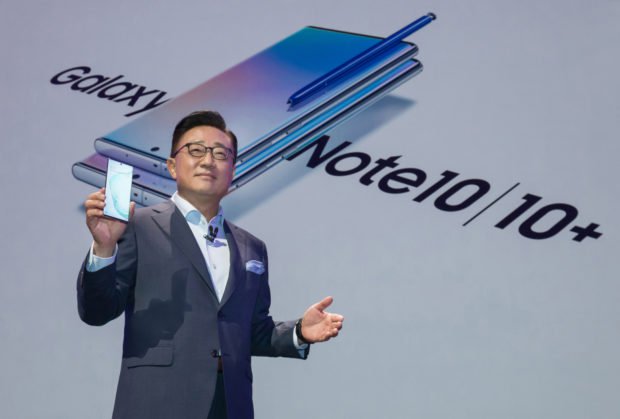
Samsung unveils largest-ever Note 10 with most compact version


SEOUL — Samsung Electronics unveiled two models of the 10th anniversary edition of its flagship premium Galaxy Note smartphone Wednesday, featuring a magic stick-like S Pen that is much more detachable from the main device.

Along with the enhanced S Pen with remote control technology, the South Korean tech giant for the first time, offered two size choices for the smartphone model during its Unpacked event at Barclays Center in New York, the US, which was attended by around 4,000 media and industry officials.

A smaller 6.3-inch Note 10 model — the most compact Note yet — highlights the functions of S Pen and improved efficiency and productivity of using the device for creative work, the firm explained.

Dubbed as “Air Actions,” the S Pen can control the Note 10 device remotely with some gestures in the users’ hands as it is supported by the Bluetooth Low Energy technology.

The low-power wireless technology enables the main device to recognize the pen’s movements.

In addition to the Bluetooth-based Note 9 S Pen that enabled shooting photos and videos with a single click of the pen, the Note 10 S Pen allows users to change the lens direction, shooting mode, zoom-in and zoom-out by personally adding customized gestures for particular actions.


One of the highly touted functions of the S Pen is converting handwritten notes into digital text and exporting them to different formats like Microsoft Word.


With the Samsung DeX platform and Link to Windows function, multimedia content created on the Note 10 and new text messages or call notices can automatically and directly be displayed on a PC running on Windows 10 without additional manual operations, according to Samsung.

Copying and pasting certain parts of a video clip and inserting captions are also now possible.

Meanwhile, the 6.8-inch Note 10+ model offers the largest Note display so far, featuring the Cinematic Infinity Display designed for immersive consumption of movies and gaming content.

The Note 10 also introduces entirely new features like AR Doodle and 3D Scanner.

Along with an Ultra Wide camera, it opens up an entirely new medium for creators. With AR Doodle, use the S Pen to personalize photos with dynamic drawings, effects, and animations that track to the image.

And with 3D Scanner, also the first-ever for the Note, the Galaxy Note10+’s DepthVision camera can take a scan of an object, and instantly turn it into a movable 3D rendering.

Both Note 10 and Note10+ phones are nearly bezel-less, having a small hole for the front-facing camera at the very center of the top part of the display.

The new features also include 30 minutes of charging for use that lasts for almost one day.

The Galaxy Note10 and Galaxy Note10+ are available in three colors: aura glow, aura white and aura black starting from Aug. 23 globally.

source: technology.inquirer.net

Tuesday, July 2, 2019

Trump move to ease Huawei sanctions sparks anger, confusion


WASHINGTON, United States — The US trade war truce with China which could ease sanctions on Huawei has prompted a backlash from lawmakers over national security concerns amid confusion over how the deal may impact the Chinese tech giant.

In the weekend agreement with his Chinese counterpart Xi Jinping to resume negotiations and hold off on new tariffs, US President Donald Trump suggested a potentially softer position on Huawei, a sticking point in the trade war.

White House economic advisor Larry Kudlow said Sunday there’s “a good chance” the deal will open the door to “new licenses” allowing more exports to the Chinese firm suspected of working with Beijing’s intelligence services to facilitate spying — a charge that the world’s number two smartphone supplier denies.

Last month the US government added Huawei to an “entity list” of companies barred from receiving US-made components without permission from Washington.

Some lawmakers accused Trump of selling out on national security.

“If President Trump has in fact bargained away the recent restrictions on #Huawei, then we will have to get those restrictions put back in place through legislation,” Republican Senator Marco Rubio tweeted.


Democratic Senator Chuck Schumer echoed those remarks, tweeting that “Huawei is one of (the) few potent levers we have to make China play fair on trade.”


Kudlow maintained that Huawei will remain on the Entity List.

Trump told reporters after the Osaka G20 meeting that US companies “can sell their equipment to Huawei” if there’s no great security problem attached.

“Huawei is a complicated situation” that would be discussed as part of a broader trade agreement, he said, adding: “We have a national security problem, which to me is paramount.”

Undercutting security claims

Republican Representative Jim Banks called the deal “extremely troubling” and said it would make it harder to negotiate with China.

“Why not keep #Huawei on our blacklist until China demonstrates a change in behavior?” Banks tweeted.
Michael McFaul, a Stanford professor and former ambassador to Russia, said Trump’s decision undercuts his argument about national security.

“When you tell the world one day Huawei is a security threat and then reverse that argument the next day, you undermine the veracity of the initial security claim,” McFaul wrote on Twitter.

It remained unclear, however, what the deal would mean for Huawei, which under US restrictions could be denied key software including much of the Google Android system and important hardware to allow it to keep making smartphones and other equipment.

Asked about the agreement, a Huawei spokesman said only: “We acknowledge President Trump’s comments related to Huawei over the weekend and have nothing further to add at this time.”

No long-term solution 

The deal “is unlikely to give Huawei the products it really needs and even if it did, it is quite possible that fatal damage has already been done to Huawei’s smartphone business,” technology analyst Richard Windsor said on his Radio Free Mobile blog.

James Lewis of the Center for Strategic and International Studies, said the truce in the trade war may not last long.

“Trump has a chokehold on Huawei — he and the Chinese know it — and he probably want to use it for leverage in the talks,” Lewis said.

Samm Sacks, a fellow at the New America foundation China Digital Economy project, said the United States faces a difficult task in trying to resolve the trade dispute while maintaining a hard line on Huawei’s national security risks.

“Trump has given a green light to national security hardliners whose end objective has not been to find a deal in the trade war, but to create a world free of Chinese telecom equipment,” Sacks said.

One possible compromise would be to ease restrictions on Huawei’s consumer business including smartphones and tablets while keeping sanctions on telecom infrastructure, which is seen as having a higher potential security risk, she said.

But Sacks noted the deal is unlikely to resolve the simmering tensions between the two economic powers over technology leadership.

“Over the longer-term, Beijing is not going to abandon its technological ambitions in artificial intelligence, internet of things, and 5G next generation networks in ways that will continue to create tension with the United States,” she said. /ee

source: technology.inquirer.net

Sunday, June 23, 2019

Vivo teases tech that can charge your phone to 100% in 13 minutes


A Vivo product manager, known on the Chinese social media platform Weibo as Golan V, has published a video last Thursday, June 20, teasing a new technology developed by the company that can charge a 4,000-milliamp-hour smartphone in 13 minutes.

No further details were revealed about the Super FlashCharge 120W technology, but if it makes it into a commercial product soon, such a solution would be the fastest on the market, tripling the charging speed of the fastest Vivo tech currently available.


In the same amount of time that Oppo’s Super VOOC Flash Charge — the fastest tech presently available — can fill a 3,400-milliamp-hour battery, Vivo’s Super FlashCharge 120W tech could have charged three 4,000-milliamp-hour handsets. Huawei’s Super Charge 2.0 system can charge a phone to 70% in 30 minutes, and Samsung’s Fast Charging equipment can only recharge designated devices to 50% in the same amount of time.

Within his responses to comments made about the video, Golan V stated that more details about the technology will be revealed during Mobile World Congress Shanghai which will kick off next week on June 26. RGA/JB

source: technology.inquirer.net

Tuesday, May 21, 2019

US tech firms to take hit from Huawei sanctions


WASHINGTON, United States — The tough sanctions imposed on Huawei by President Donald Trump could deal a blow to the many US firms that make up the Chinese tech giant’s supply chain.

American firms last year sold an estimated $11 billion worth of components to Huawei, which was put on a blacklist last week by Washington over national security concerns as trade frictions grow between the US and China.


Trump’s executive order could effectively ban makers of US hardware and software from selling to Huawei by requiring a special license from Washington.

The Commerce Department on Monday delayed the sanctions on Huawei for 90 days, saying the additional time was needed to allow for software updates and other contractual obligations.

The agency said it was granting Huawei a “temporary general license” through August 19 allowing for transactions “necessary to maintain and support existing and currently fully operational networks and equipment, including software updates and patches, subject to legally binding contracts and agreements” signed before May 16.

Hardware and software 

Bloomberg News reported that US-based chipmakers Intel, Qualcomm, Broadcom and Xilinx have indicated they would halt shipments to the Chinese firm which is the world’s number two smartphone maker and a leader in telecom infrastructure and super-fast 5G networks.

Google said it would comply with the US order, leaving Huawei without access to critical services for the Android operating system such as Gmail and Google Maps.

Microsoft, which supplies the Windows operating system for many Huawei devices, did not respond to an AFP query on how the order might impact the Redmond, Washington-based firm.

Bob O’Donnell of the consultancy Technalysis Research said any ban would almost certainly affect Microsoft.

“If it affects Google I don’t see why it wouldn’t affect Microsoft,” O’Donnell said.

“Any version of Windows comes from Microsoft, since there is no open-source version.”

Moving toward independence

Roger Kay, founder and analyst at Endpoint Technologies Associates, said the ban is likely to accelerate efforts by Huawei and other Chinese firms to develop their own sources of microprocessors and other components.

“The short-term effect on both American and Chinese companies are inevitably negative,” Kay said.

“The longer-term effect is that Huawei and other Chinese companies turn away more sharply from American suppliers.”

Neither Intel nor Qualcomm responded to queries on how they would respond to the order on Huawei.

Avi Greengart, founder of the research firm Techsponential, said a ban on sales to Huawei could hit a wide range of large and small US firms including Corning, which makes the popular Gorilla Glass for smartphones, and Dolby, a producer of video and audio software for handsets.

“When you think about all the software and hardware components you get a pretty big list,” Greengart said.

“The US is a big part of the global supply chain.”

Few firms offered public comments on their response to the Huawei executive order.

But one, California-based Lumentum Holdings, a maker of optical and laser applications, said it would comply with the executive order and that Huawei accounted for 15 percent of its revenue so far in the current fiscal year.

Risks to Apple

Greengart said Apple could also suffer from any protracted crisis over Huawei, estimating the iPhone maker gets about 17 percent of its revenues from China.

Even though Apple might benefit in the premium smartphone market in Europe, “I think the risks are higher than the rewards for Apple,” Greengart said.

“If there is a backlash against Apple in China, that could have damaging long-term effects.”
Greengart said that Google might not see a major impact for the moment.

“Ironically (the ban) won’t affect Google much because Google doesn’t make money selling Android.”

Patrick Moorhead, of Moor Insights & Strategy, said he sees a limited impact on US firms in the short run.

“The impact to the US companies depends on the length of the ban but also how indexed they are in sales to Huawei,” Moorhead said.

“Neither Intel, Google or Nvidia do more than three percent of their business with Huawei, so short-term, it shouldn’t be an issue.”

O’Donnell said a bigger risk is that Huawei and other Chinese firms step up efforts to develop software and hardware that allows them to break free from Silicon Valley.

“The longer-term question is: does this drive Huawei to develop a third mobile platform?” O’Donnell said.

“China is already developing its own technology infrastructure, and this plays into the whole notion of a separate internet in China, which would be a big deal.”  /ee

source: technology.inquirer.net

Monday, May 20, 2019

Google says services on Huawei phones will still function


BEIJING — Google is assuring users of Huawei smartphones the American company’s services still will work on them following U.S. government restrictions on doing business with the Chinese tech giant.

Google said Monday it is complying with and “reviewing the implications” of an order that requires export licenses for technology sales to Huawei Technologies Ltd.

Last week’s order follows U.S. government accusations that Huawei is a security risk and might help Beijing spy abroad.

Huawei, which uses Google’s Android operating system, is the No. 2 global smartphone brand by number of handsets sold, behind South Korea’s Samsung Electronics.

Google said on Twitter, “We assure you while we are complying with all US gov’t requirements, services like Google Play & security from Google Play Protect will keep functioning on your existing Huawei device.”


source: technology.inquirer.net

Sunday, March 24, 2019

Samsung A90 mid-range phone could go notchless


As first spotted by GalaxyClub, Samsung has updated their Galaxy A site page revealing telltale details about the upcoming A90 smartphone’s design, a couple weeks before its official release.

Galaxy smartphone-and-tablet-focused blog GalaxyClub discovered on Thursday that Samsung’s Galaxy A website page had been updated with feature descriptions that do not fit any A model on the market right now; the best explanation is that these discrepancies can be accounted for with the upcoming model, the A90, whose launch is slated for Apr. 10.


It has been known that the model will top the mid-range A line, but what the latest update suggests is that it will feature an AMOLED “Notchless Infinity Screen” described as “all screen and no bezel.”
This supports notable tech leaker Ice Universe’s claim that was made back in February that “there is no notch, there is no hole.” The tweeter also predicted that the A90 will be the company’s first phone with a pop-up front camera—which would explain how they managed to omit any and all bezels.


Back in 2018 at the Samsung Developer Conference, the company unveiled four sketches of potential upcoming smartphone display designs. Samsung fans have seen the Infinity O screen design materialize on the A8S and Galaxy S10, the Infinity U has made its way to the A30 and A50 and the Infinity V display is featured on the A20. The only one that remains unaccounted for is the New Infinity Display which has no visible notch whatsoever.

Considering that Samsung promises that the A90 will come with “all screen and no bezel,” this model could finally make the fourth display format a reality.


 — Samsung Mobile (@SamsungMobile) March 18, 2019

The Galaxy A90 and its possible pop-up camera will debut on Apr. 10. CE/JB

source: technology.inquirer.net


Sunday, January 6, 2019

A show of force for 5G at CES 2019


The coming year will be a pivotal one for 5G, the fifth generation mobile communications standard which will set new bandwidth records. Mobile network operators and mobile phone manufacturers at the Consumer Electronics Show (CES) in Las Vegas, running Jan. 8 to 11, will be unveiling a host of new smart solutions for homes, companies, cars and entertainment, which make use of this new technology.

Smart cities already figured large in discussions at the 2018 CES. This year’s show is expected to be marked by the emergence of practical applications in a range of areas: the internet of things, home automation, corporate environment automation, self-driving cars, entertainment, as well as virtual and augmented reality.


A number of 5G infrastructure projects will be unveiled at Las Vegas, with others expected for the end of February at the Mobile World Congress in Barcelona, Spain. At a time when AT&T has only recently launched its network, which for the moment is limited to a dozen cities, Verizon and other competing operators may take advantage of the show to publicize their new offers.

With regard to the first 5G-compatible smartphones, these are also expected to be released in the first quarter of 2019. Hot on the heels of Qualcomm’s presentation of its latest 5G-compatible Snapdragon 855 processor, Chinese manufacturers OnePlus and Xiaomi are already embroiled in a telecom war over who will be the first to bring out a phone featuring this new 5G chip.

The arrival of 5G is set to pave the way for download speeds that are up to 100 times faster than those that are possible under 4G as well as game-changing developments in electronics markets such as very high definition streaming, the widespread adoption of the Internet of things, and the launch of self-driving smart vehicles. JB

source: technology.inquirer.net

Sunday, November 4, 2018

World’s first foldable smartphone introduced by Royole


Royole beat Samsung and Huawei to the punch by releasing the first-ever commercially available smartphone-tablet hybrid on Nov. 1.

California-based start-up Royole may not be so little-known for much longer. The world has been on the edge of its seat waiting for Samsung or Huawei to unveil the world’s first foldable smartphone-tablet, but Royole has beaten to them to it by unveiling its own FlexPai.

Similar to what Samsung has been teasing about its model, this next-generation smartphone can be used either folded or unfolded, “giving it the portability of a smartphone plus the screen size of a high-definition tablet.”

Certainly, Samsung’s thunder has been stolen. Though Royole has a much smaller development team, the device has an impressive array of features to help it compete with mobile giants across the globe.

The 7.8-inch AMOLED screen supports split screens and multi-tasking; you can even drag and drop just like on your computer. The screen automatically adjusts the display size to adapt to your movie or video game.

When the FlexPai is folded, both screens on the front and back can work together or independently, depending on what you’re doing. The side edge where the hinge is can display notifications much like a typical smartphone notification bar, as well as manage calls, messages and “other notices that may disturb the primary and secondary screen usage.”

That hinge is sturdy. It can reportedly withstand 200,000 folds and even twists. The device can be folded at different angles, which the operating system, Royole’s own Water OS, will conform to.

The FlexPai uses Qualcomm Snapdragon 8 series SoC, which brings impressive and industry-leading AI to the device. The dual-camera setup is on par with other smartphone leaders with its 20-megapixel telephoto and 16-megapixel wide-angle lenses, as well as stereo speakers and a fingerprint ID, features that define smartphones nowadays.

Royole has made its mark with the world’s first commercially-available folding smartphone-tablet hybrid, a feat massive and established mobile phone manufacturers have been racing towards for years. Will the device be able to hold its ground when Samsung releases its own bendy mobile device at the Developers Conference next week? The race has officially begun.

The developer model of the FlexPai is available now for €1,388 (almost $1,600 or P84,000) on the Royole site. The consumer model is also available for the Chinese market now with order fulfillment from late December. JB

source: technology.inquirer.net

Wednesday, September 12, 2018

Apple customers may pay price of trade tension


BEIJING — Apple Inc is likely to suffer greatly from the ongoing China-US trade tension, as experts said moving production of its iPhones from China to the United States could lead to a price rise of as much as 20 percent.

The comments came after US President Donald Trump asked the iPhone maker to relocate its plants to its home turf, in order to avoid his proposed tariff on Chinese imports.

Wamsi Mohan, an analyst at Bank of America Merrill Lynch, said in a research note that Apple may give in to Trump’s request by asking its partners to bring some iPhone assembly operations to the US, which will lead to the higher prices.

“If Apple shifts 50 per cent or 100 percent of iPhone assembly to the US, it would increase iPhone prices by 14 percent and 20 percent, respectively,” Mohan said.

Currently, most of Apple’s manufacturing operations are located in China. And in the quarter ended in June, the US tech giant posted a revenue of $9.55 billion from the country, marking a 19 percent year-on-year growth and representing 18 per cent of its total sales.

With such strong ties to China, it was inevitable that Apple would feel the pinch of the mounting trade disputes, especially after Trump said on Friday that he had tariffs planned for an additional $267 billion worth of Chinese goods. That would be on top of $50 billion of goods already hit by 25 percent duties and another $200 billion on which Washington is poised to raise tariffs.

On Monday, Apple fell 1.34 percent to $218.33 on the Nasdaq. CEO Tim Cook is expected to unveil new iPhones and product updates on Wednesday.

Last week, Apple filed a letter with US officials, saying Trump’s proposed tariffs on $200 billion worth of imported Chinese goods would affect a wide range of Apple products, including the Apple Watch, AirPods, Mac Minis and Apple Pencils.

Xiang Ligang, CEO of telecoms industry website Cctime, said Apple’s dilemma highlights how US aggressive tariff policies will disrupt the global electronics industry chain.

“Apple chose to produce most of its iPhones in China, because this is the most cost-effective choice in terms of labour cost and industrial aggregation effects. That is the result of decades of market playing a decisive role in allocating resources,” Xiang said.

But the additional tariffs the US plans to levy on Chinese imports are damaging the industrial layout and in fact, would hurt US companies more than Chinese enterprises, he added.

China, as the world’s largest smartphone market, has been contributing to a big share of profits of US tech heavyweights including Apple and Qualcomm Inc in recent years.

“iPhone is the cash cow of Apple. Any increases in cost would either be passed on to customers, resulting in lower sales, or be absorbed by Apple, eroding its bottom line,” Xiang said.

On Tuesday, Chuck Robbins, chairman and CEO of Cisco, told CNBC that the US tech company might have to deal with the fallout from US-China trade tensions by passing on higher prices to its customers.

source: technology.inquirer.net

Monday, September 3, 2018

Bezel-less smartphones, hidden cameras — starring Xiaomi, Honor, Oppo and Vivo


In less than a year, four different Chinese tech giants have revealed bezel-less smartphones with hidden cameras. Two are already on the market, two are on their way.

Smartphone bezels have been slimming down dramatically in recent years, in turn bringing bigger displays and controversial notches; but it’s either that or no selfie cam.

The Vivo Apex concept phone, shown at this year’s Mobile World Congress in Barcelona, got things rolling, with bezel-less reality following shortly after when both Vivo and Oppo released devices with pop-up cameras (otherwise hidden inside) this summer: Vivo with the NEX and Oppo with the Find X.


Now two more Chinese manufacturers, Xiaomi and Honor, are jumping on the sliding camera bandwagon.

At IFA 2018, Huawei’s sub-brand Honor teased its own take on the hidden camera when it announced the upcoming Magic 2, a successor to the 2016 Magic phone. Featuring a “FullView Display,” this almost bezel-less device has found a different way to “pop up” the camera.

Honor’s president George Zhao stood on stage at the Berlin event and then slid the smartphone, manually pushing up the camera, rather than relying on an automated mechanism. For anyone that remembers their phone from a decade ago, there’s a good chance it did just that, though revealing a keyboard instead.

The device will be powered by newly announced Huawei Kirin 980 processor, which will rival the Snapdragon 845 and feature in phones such as the Huawei P20 Pro.

It’s not sure when the Magic 2 will be released, or where, as the original Magic was a limited edition in China.

Not one to be left out, Chinese tech giant Xiaomi’s president Lin Bin posted a render of the much-anticipated Mi Mix 3, with the same sort of manual sliding mechanism as the Honor Magic 2. The post doesn’t reveal much except that the phone might be released around October. JB

source: technology.inquirer.net

Tuesday, August 21, 2018

LG announces new ‘neckbud’ models featuring ‘OK Google’ button, external speaker


LG’s premium line of wireless “neckbuds” is getting new models with Google features and external mono speakers. LG announced two new special additions to its TONE series, the Platinum SE and the TONE Ultra SE.

The LG TONE series consists of four models (Platinum, Infinim, Ultra and Pro) and are what the tech world has dubbed “neckbuds,” bluetooth earbuds that can be worn around the neck. LG’s U-shaped bands rest around the bottom of the users neck and house two earbuds that can be pulled out and inserted into the ears.


Now, a special edition will make the Platinum the most tech-savvy bluetooth headset of the bunch, featuring the ability to trigger Google Assistant without the need to say anything first.

The announcement states that this will “offer Google Translate and other AI features at the press of a button.”

As long as the user has set Google Assistant to unlock their phone, they’ll be able to simply click the dedicated button and ask “How do you say ‘thank you’ in Japanese?” or ‘Where is the nearest gas stations?” The feature is set to appeal to users on the move who may not want to get their phone out every time they have a question.

As for Tone Ultra SE, an external speaker will provide users the chance to play music or take calls without having to insert the earbuds and therefore potentially blocking out sound. This has become a growing trend in audio wearables as people are required to be aware of sounds such as transport announcements, traffic or simply someone trying to talk to them.

Both models feature a dual MEMS microphone for optimized audio clarity and support for the Tone & Talk app for smartphones.

The brand’s latest wearable audio products will be unveiled and displayed at IFA in Berlin from Aug. 31 to Sept. 5. Sold in black, blue and gold, prices will be announced locally when they become available in each region. JB

source: technology.inquirer.net

Saturday, July 21, 2018

OPPO A3 4G LTE-Enabled Android 8.1 Smartphone


OPPO has launched a new 4G LTE-enabled Android 8.1 smartphone ‘A3’ in China. Measuring 7.8mm thick and weighing 159g, this mid-range smartphone packs a 6.2-inch 2280 x 1080 Full HD+ 19:9 IPS display, an Octa-Core MediaTek Helio P60 (MT6771) 12nm processor, an 800MHz ARM Mali-G72 MP3 GPU, a 4GB RAM and a 128GB of expandable internal storage (up to 256GB).
Coming with dual SIM card slots, the handset sports an 8MP front-facing camera, a 16MP rear-facing camera with LED flash, Face Unlock function, a 3.5mm audio jack and a 3400mAh battery.
Running on Android 8.1 Oreo OS w/ ColorOS 5.0 on top, the A3 provides 4G VoLTE, dual-band WiFi 802.11ac, Bluetooth 4.2 and GPS for connectivity. The OPPO A3 is priced at 2,099 Yuan (about $336). [Product Page]
source: techfresh.net

Wednesday, June 27, 2018

Trading up? Go for the Vivo X21

Visit us on Instagram To be You;  Facebook: To be You; e-mail inq.tobeyou@gmail.com


You’ve had your entry-level smartphone for years, and even though it feels like a part of you by now, you’re ready to move on to greater things—larger internal storage, more megapixels on a camera, high-tech features not found on just any phone. It’s time to trade up.


A worthy successor to your old reliable phone, the Vivo X21 is huge in many ways—from its physical dimensions (154.50 x 74.80 x 7.40 mm) to its internal memory (128 GB, expandable to up to 256 GB via micro SD card) and its generous touch screen (nearly 100 percent screen-to-body ratio). But at 156 g, this lightweight sliver of a phone with a glossy finish fits nicely on the palm of your hand as well as the pocket of your jeans or a slim purse.

If you’re used to operating other brands, the X21 might take some getting used to at first. Still, it’s pretty user-friendly, with tips that pop up on the screen to help make fiddling with the phone a hassle-free experience. These tips come in handy for Face Access and In-Display Fingerprint Scanning Technology, two state-of-the-art cellphone features that give you added security and make each use of the X21 fun. And speaking of fun, get a kick out of Live Wallpaper, which surprises you with a different crisp and color-rich image each time you unlock your phone.

While the X21’s cameras don’t boast the highest megapixels in the market (12MP front and rear), they certainly do not disappoint, yielding sharp, crystal-clear, and colorful pictures through a range of shooting options and the 24 million photographic units of its Dual Pixel Sensors. AI technology beefs up the cameras’ capabilities, meaning you can expect precise, high-definition selfies as well as wacky group shots.

AI has also improved the Game Mode feature, allowing hardcore gamers to enjoy uninterrupted hours of playing even while taking in phone calls or when someone accidentally touches the screen.
It even has music lovers covered. An AK4376A Hi-Fi audio chip and voice-enhancing Deepfield Technology complement the phone’s superior visual quality.
Perhaps the most amazing thing about the X21 is how it redefines the meaning of smartphone. While attempting to sign up on Facebook, the X21 was steps ahead, correctly identifying the user before she even typed her name. We think this is you, read the caption with the name of the user. Cool.

The Vivo X21 comes with a clear protective case, charger, headset with microphone, and SIM ejector pin. It was launched to the media on June 21 at the Grand Ballroom of Okada Manila.

source: lifestyle.inquirer.net

Monday, March 12, 2018

OPPO A71 2018 raises the bar in entry-level smartphone experience


OPPO Philippines strengthens its entry-level smartphone offering with the new OPPO A71 2018, carrying a mid-range class processor and includes OPPO’s A.I. Beauty Technology for Php7,990. Equipped with a Qualcomm Snapdragon 450 octa-core processor found in smartphones at the mid-range level, the A71 2018 elevates the standard of speed and battery efficiency in its price point.

Selfies will never be the same with the A.I. Beauty Technology infused in the 5MP front camera, for this allows more personalized selfie experience by analyzing the subject’s face in more than 220 facial points. Similar with the OPPO F5, the A71 2018 can also detect the skin tone, age and race for a natural looking selfie.

Along with a 13MP rear camera, capturing moments will be fun and easy with multiple modes such as time-lapse, panorama and even expert mode for ultra-HD 42MP shots. All these features are seen through the 5.2” HD display and compact shell body that is easy to hold and carry around.

In addition to value for money, the OPPO A71 2018 comes with a free pre-installed screen protector and transparent protection case. The smartphone also has all-around connectivity with dedicated dual-sim slot and microSD storage for expansion. This gesture is a standard in OPPO smartphones, ensuring that customer experience is on-top of mind in every aspect.

Running on Color OS 3.2 under Android 7.1.1, the A71 2018 runs smooth with premium features like O-Share to transfer files from other OPPO smartphones in lightning speeds. Plus, with its battery efficient processor, the 3,000mAh battery can last for more than 12 hours.

“We keep on pushing the industry by coming up with the best smartphone in every price point. We believe the A71 2018’s Qualcomm Snapdragon 450 processor and A.I. Beauty Technology will elevate the smartphone experience in the entry-level arena,” said Eason de Guzman, Public Relations Manager of OPPO Philippines.

The OPPO A71 2018 will be available in all concept stores nationwide starting tomorrow. For more information, customers may visit https://www.oppo.com/ph/. They can also follow OPPO on Facebook via https://www.facebook.com/OPPOPH/ to see the latest updates and events from the brand.

ADVT

source: technology.inquirer.net

Monday, February 26, 2018

AI and 5G in focus at top mobile fair


Phone makers will seek to entice new buyers with better cameras and bigger screens at the world’s biggest mobile fair starting Monday in Spain after a year of flat smartphone sales.

But with no major innovations awaited in handsets, analysts expect the four-day Mobile World Congress in Barcelona to focus on new uses for artificial intelligence (AI) and the looming deployment of super-fast 5G wireless networks.

Smartphone giants Huawei, LG or HTC are not expected to launch a new flagship device at the annual show, so Samsung will have the opportunity to grab the spotlight when it unveils its S9 and S9+ phones on Sunday on the eve of the fair.

The teasers suggest major changes to the camera, which will reportedly allow for “super slow-motion” videos and a new camera lens that improves low-light photos: features some of its rivals already offer.

The camera “seems to have become a major source of differentiation for the latest generation of smartphones,” said mobile phone analyst Ben Wood of CCS Insight.

Samsung suffered a humiliating recall of its Galaxy Note 7 device in 2016 after several devices exploded but its Galaxy 8 smartphone was a consumer and critical success.

The company remained the world’s biggest seller of smartphones in 2017 with a 21.6 percent market share, up from 21.1 percent in the previous year, according to research firm IDC.

Apple, which as usual will not be present at the show, was the second biggest vendor at 14.7 percent.

‘Sea of sameness’

Overall global smartphone sales for 2017 were virtually flat — down 0.1 percent at 1.47 billion units — as phone makers struggled to come up with innovations that encourage customers to upgrade their devices.

“The sea of sameness continues to erode the impact that new models have on the market,” said Wood.

In addition to better cameras, phone makers will focus on introducing bigger screens in mid-market devices, not just flagship ones, to try to boost their sales said Ian Fogg, senior director of mobile and telecom at IHS Markit.

“They are all really struggling to find good differentiation points to drive that upgrade cycle. They are not just competing with each other, they are competing with the phone that consumers already own that they may consider good enough.”

The sector is hoping the introduction of blazing fast 5G mobile internet service — which is is about 1,000 times faster than the 4G widely available in the developed world — will trigger a wave of growth in equipment sales and mobile services.

The first deployment of 5G wireless networks, which are quick enough to download a full length film in less than a second, are expected in key markets like the United States, Japan and South Korea at the end of the year.

“We are in a phase of acceleration….as much for 5G as for artificial intelligence,” said Jacques Moulin, the director general of IDATE, a French think tank on the digital economy.

The tech industry in December agreed on most universal standards for 5G, clearing the way for future wireless connections to support functions such as driverless cars and traffic systems.

“We will hear much more pragmatic discussion around 5G, around commercial trials, around what initial 5G networks will deliver. It is transitioning 5G from a future technology that has many possibilities into more of a business as usual approach,” said Fogg. AB

source: technology.inquirer.net