Showing posts with label Shares. Show all posts

Wednesday, August 2, 2023

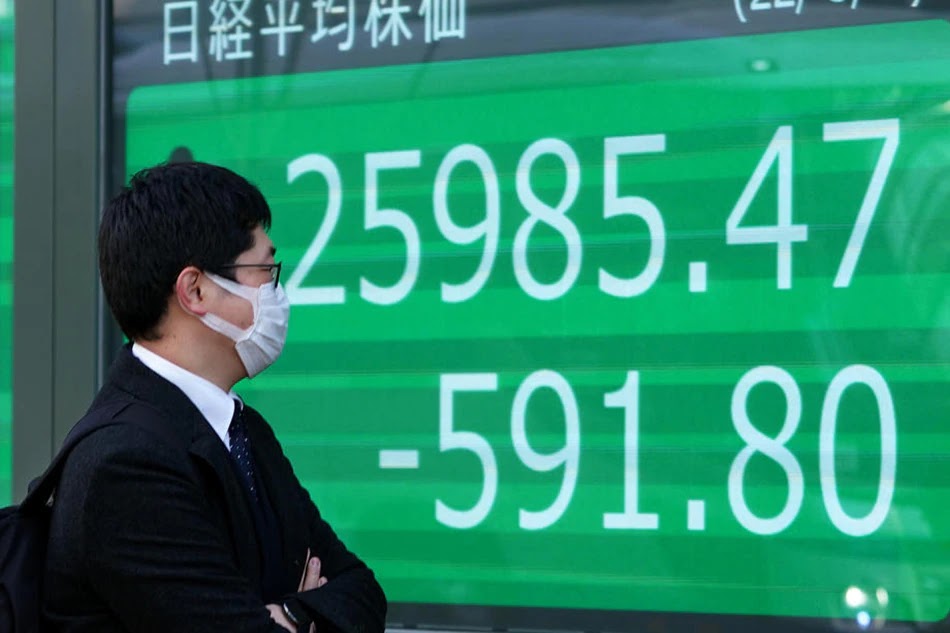
Tokyo stocks open lower on weak tech shares

TOKYO -- Tokyo stocks opened lower Wednesday, dragged down by technology shares that tracked an overnight decline of U.S. counterparts.

In the first 15 minutes of trading, the 225-issue Nikkei Stock Average fell 518.06 points, or 1.55 percent, from Tuesday to 32,958.52. The broader Topix index was down 26.29 points, or 1.12 percent, at 2,311.07.

On the top-tier Prime Market, decliners included securities house, insurance, and electric power and gas issues.

At 9 a.m., the dollar fetched 142.95-98 yen compared with 143.29-39 yen in New York and 142.71-73 yen in Tokyo at 5 p.m. Tuesday.

The euro was quoted at $1.1006-1010 and 157.33-42 yen against $1.0979-0989 and 157.40-50 yen in New York, and $1.0979-0980 and 156.69-73 yen in Tokyo late Tuesday afternoon.

Agence France-Presse

Monday, November 28, 2022

Tokyo shares softer in early trade

TOKYO - Tokyo shares drifted lower Monday morning as the global high-tech sector faces pressure.

The benchmark Nikkei 225 index eased 0.31 percent, or 86.81 points, to 28,196.22, while the broader Topix index fell 0.16 percent, or 3.17 points, to 2,014.83.

Agence France-Presse

Friday, February 14, 2020

US stocks edge mostly lower after China virus cases spike

Stocks closed lower on Wall Street Thursday as investors turned cautious following a surge in cases of a new virus in China that threatens to crimp economic growth and hurt businesses worldwide.


The modest losses snapped a three-day streak of record highs for the S&P 500 and Nasdaq composite. The selling marked only the second day this month that the market has declined.

Investors largely set aside worries about the economic impact of the virus outbreak the past two weeks. Markets rallied this week partly due to reports that the number of new cases of the new virus in China had declined.

Hopes that the spread of the virus had peaked were dashed Thursday, when China reported a sharp rise in cases and deaths after the hardest-hit province of Hubei took a new approach to classifying and diagnosing the virus.

“We’re in a data-dearth period in the sense that we’re not really going to know fully the effects of the impact of that on Asian and Chinese growth, as well as global growth, for at least several weeks,” said Lisa Erickson, head of traditional investments at U.S. Bank Wealth Management. “You’re just going to see some back-and-forth movement (in the market) until that time.”

The S&P 500 index dropped 5.51 points, or 0.2%, to 3,373.94. The Dow Jones Industrial Average slid 128.11 points, or 0.4%, to 29,423.31. It was down as much as 205 points earlier.

The Nasdaq fell 13.99 points, or 0.1%, to 9,711.97. The Russell 2000 index of smaller company stocks rose 4.36 points, or 0.3%, to 1,693.74.

Markets in Europe and Asia finished mostly lower. The yield on the 10-year Treasury held steady at 1.62%.

The major U.S. indexes wobbled for much of the day as investors weighed company earnings reports and the latest news on the virus outbreak in China.

The change in how Hubei determines and reports cases of the new virus pushed the number of cases worldwide to more than 60,000.

The spike came after two days in which the number of new cases dropped, complicating efforts to understand the trajectory of the outbreak.


Businesses have already been hurting due to the outbreak and more of them are warning that the effects will linger through the year. Organizers of the world’s biggest mobile technology fair cancelled the event, set to take place in Spain, because of health and safety concerns over the outbreak.

Travel-related companies fell broadly Thursday, shedding some of their gains from earlier in the week. Airlines helped pull industrial sector stocks lower. United Airlines fell 1.5%.

MGM Resorts International, which gets about 20% of its revenue from the gambling haven of Macau, pulled its profit forecast for 2020. The stock lost 5.5%. Cruise line operator Carnival slid 2%.

Technology and health care stocks were among the biggest decliners, along with companies that rely on consumer spending. Cisco Systems fell 5.2%, Mylan slid 2.3% and Hanesbrands dropped 2.6%.

Household goods makers, utilities, real estate companies and communication services stocks notched gains.

Fashion company Ralph Lauren warned that the viral outbreak cut into fourth-quarter sales by an estimated $55 million to $70 million. The stock fell 0.6%.

Alaska Air Group bucked the trend, adding 1.5% after the airline said it will cooperate more closely with American Airlines on West Coast service. The airlines asked for government permission to expand revenue-sharing to cover international flights in Seattle and Los Angeles.

Benchmark crude oil rose 25 cents to settle at $51.42 a barrel. Brent crude oil, the international standard, gained 55 cents to close at $56.34 a barrel. Wholesale gasoline was unchanged at $1.58 per gallon. Heating oil was also unchanged at $1.68 per gallon. Natural gas fell 1 cent to $1.83 per 1,000 cubic feet.

Gold rose $7.70 to $1,575.10 per ounce, silver rose 12 cents to $17.60 per ounce and copper rose 1 cent to $2.62 per pound.
The dollar fell to 109.79 Japanese yen from 110.08 yen on Wednesday. The euro weakened to $1.0843 from $1.086.

source: business.inquirer.net

Tuesday, October 1, 2019

Stocks climb as markets cap turbulent quarter with calm end


NEW YORK – U.S. stocks climbed on Monday and gave one last nudge to ensure the S&P 500 emerged from yet another tumultuous quarter with a modest gain.

As has been the case throughout the quarter, movements in President Donald Trump’s trade war with China helped drive the market on Monday. Investors found encouragement after China said that its top trade negotiator will lead talks with the United States that are expected to take place next week. The Trump administration also calmed some worries that it may limit U.S. investment in Chinese companies.

The developments helped push technology stocks higher in particular. Those companies often move along with news about trade because of how reliant they are on China as both a customer and a supplier. The S&P 500 climbed 14.95 points, or

0.5%, to 2,976.74.

The Dow Jones Industrial Average rose 96.58, or 0.4%, to 26,916.83, and the Nasdaq composite added 59.71, or 0.8%, to 7,999.34.

The moves left the S&P 500 with a 1.2% gain for the quarter. While that was its smallest quarterly gain this year, the index had been on track for a much worse performance just a month ago.


Trump shocked markets in August when he said he’d raise tariffs on Chinese goods, and the announcement sent stocks and bond yields reeling. The S&P 500 dropped more than 6% in the weeks following July 26, when it set its last record. But stocks began climbing again in September as both sides made conciliatory moves to ease tensions.

Yields, meanwhile, remained lower for the quarter after the Federal Reserve cut short-term rates twice. They were the first rate cuts for the Fed since the financial crisis was swamping the economy in 2008. Across the Atlantic, the European Central Bank was likewise working to keep rates low in hopes of shoring up a slowing global economy.

The yield on the 10-year Treasury dipped to 1.65% from 1.67% late Friday. At the end of the last quarter, it was at 2%.

Like the S&P 500, the Dow also ended the quarter with a gain of 1.2%. The technology-heavy Nasdaq was a touch lower, with a loss of 0.1%.

Small companies took on more damage, as they typically do when investors are worried about the threat of a recession. The Russell 2000 lost 2.8% during the quarter.

Don’t expect the tumult to end with the close of the quarter.

Aside from the U.S.-China talks, the next three months have plenty of events on the schedule to keep markets on edge. Beyond the United Kingdom’s pending exit from the European Union, investors are also waiting to see whether Germany will enter a recession and how the new incoming head of the European Central Bank performs.

Closer to home, the impeachment inquiry into Trump could create even more uncertainty. That puts more pressure on the consumer, the bulwark of the U.S. economy recently, particularly when businesses have become reluctant to spend due to the trade war.

“The consumer’s been enough to keep the economy moving, but things like consumer confidence seem to be plateauing,” said Emily Roland, co-chief investment strategist at John Hancock Investment Management.

In the next few weeks, companies are scheduled to tell investors how much profit they made during the third quarter. Expectations are generally low again, with analysts forecasting a drop of nearly 4% from a year ago. The results, plus what CEOs say about their spending and revenue forecasts, should give a better picture of the economy’s potential direction.

“We need that earnings engine to kick in to drive markets higher,” Roland said.

Last year, the S&P 500 slumped 14% in the fourth quarter for its worst performance in seven years when fear spiked that the Federal Reserve’s plans to keep raising interest rates and a slowing global economy would knock the United States into a recession.

This time around, the Federal Reserve has shifted gears, and many investors expect the central bank to cut rates at least one more time this year. That could help support markets, even with all the potential flashpoints on the calendar.

Benchmark U.S. crude fell $1.84 to settle at $54.07 per barrel Monday. Brent crude, the international standard, fell $1.13 to $60.78 a barrel.

Natural gas dropped 7 cents to $2.33 per 1,000 cubic feet, heating oil lost 4 cents to $1.91 per gallon and wholesale gasoline fell 5 cents to $1.60 per gallon.


Gold fell $33.40 to $1,465.70 per ounce, silver fell 65 cents to $16.90 per ounce and copper fell 2 cents to $2.56 per pound.

Stock markets around the world were mixed during the quarter, as European growth remained stubbornly weak and Hong Kong saw increasingly violent political protests. In Europe, France’s CAC 40 finished with a 2.5% gain for the quarter. Germany’s DAX rose 0.2%, and the FTSE 100 lost 0.2%.

In Asia, Japan’s Nikkei 225 index rose 2.3% for the quarter, while South Korea’s Kospi fell 3.2% and the Hang Seng in Hong Kong lost 8.6%.

The dollar rose to 108.07 Japanese yen from 107.81 yen on Friday. The euro weakened to $1.0902 from $1.0941. /gsg

source: business.inquirer.net

Friday, September 27, 2019

Asian stocks decline as traders mull Trump inquiry


BEIJING  — Asian stocks fell Friday as traders weighed data showing slower U.S. economic growth and also the possible impact of an impeachment inquiry of President Donald Trump.

The congressional inquiry into Trump is throwing more volatility into a market that already was nervous over U.S.-Chinese trade tension.

“The impeachment of Trump will now become a drawn-out saga that feels like annoying supermarket music,” Jeffrey Halley of Oanda said in a report.

Also Thursday, the Commerce Department reported the U.S. economy grew at a modest 2% in the second quarter, sharply lower than the past year’s 3%-plus growth rates.

The Shanghai Composite Index advanced 0.2% to 2,933.47 on the last day of trading before Chinese markets close for a weeklong holiday.

Tokyo’s Nikkei 225 lost 1.4% to 21,747.82 as a long-dreaded Oct. 1 hike in Japan’s sales tax to 10% from the current 8% loomed. The Hang Seng in Hong Kong shed 0.3% to 25,982.54 and Seoul’s Kospi dropped 1.2% to 2,048.86.

Sydney’s S&P-ASX 200 gained 0.4% to 6,703.70. Markets in Taiwan, New Zealand and Southeast Asia retreated.

Traders were encouraged by a Chinese Commerce Ministry announcement that importers had agreed to buy U.S. soybeans as the two sides make conciliatory gestures ahead of trade talks. That followed an earlier decision to list punitive tariffs on soybeans, the biggest Chinese import from the United States.

Plans to go ahead with negotiations next month have helped to ease market jitters but there has been no sign of progress toward resolving the bruising tariff war over trade and technology.

On Wall Street, the Standard & Poor’s 500 index fell 0.2% to 2,977.62 and the Dow Jones Industrial Average slid 0.3% to 26,891.12. The Nasdaq dropped 0.6% to 8,030.66.

While many analysts say the Trump probe isn’t likely to affect the market significantly, it does add a degree of uncertainty and could complicate the White House’s efforts to resolve trade disputes with China and other nations.

ENERGY: Benchmark U.S. crude lost 29 cents to $56.12 per barrel in electronic trading on the New York Mercantile Exchange. The contract gave up 8 cents to $56.41 on Thursday. Brent crude, used to price international oils, fell 56 cents to $61.18 per barrel in London. It retreated 31 cents the previous session to $61.74.

CURRENCY: The dollar declined to 107.72 yen from Thursday’s 107.83 yen. The euro rose to $1.0925 from $1.0920./gsg

source: business.inquirer.net

Tuesday, June 25, 2019

Asian stocks lower ahead of Trump-Xi meeting at G-20 summit


BEIJING – Major Asian stock markets declined Tuesday as traders looked ahead to a meeting between the American and Chinese presidents amid hopes for renewed trade talks.

Benchmarks in Tokyo, Shanghai and Hong Kong declined. Seoul and Sydney were little-changed.

Investors were encouraged by the announcement that top U.S. and Chinese negotiators, Trade Representative Robert Lighthizer and Vice Premier Liu He, talked Monday by phone. No details were released.

Traders looked ahead to a planned meeting between Presidents Donald Trump and Xi Jinping at this week’s Group of 20 meeting of major economies in Japan.

Forecasters expect the leaders to reassure financial markets by agreeing to revive trade talks without a timeline or committing to any details.

The conflict over Beijing’s technology ambitions and trade surplus was weighed on global trade and fed fears it will depress global growth.

Tensions have worsened after Washington tightened sanctions on Chinese tech giant Huawei.

“Both presidents have a very low bar of merely agreeing to resume trade talks, without having to iron out any of the sticking points at the G20,” said Chang Wei Liang of Mizuho Bank in a report.

The realities of achieving a settlement “will probably be relegated to the backseat as the ‘feel good’ factor of the G20 displaces caution,” Chang said.

The Shanghai Composite Index lost 1.1% to 2,974.69 and Tokyo’s Nikkei 225 shed 0.2% to 21,241.28. Hong Kong’s Hang Seng retreated 0.9% to 28,268.14.

Seoul’s Kospi added one point to 2,128.00 while Sydney’s S&P-ASX 200 gained three points to 6,667.40. Taiwan also declined while markets in Southeast Asia and New Zealand advanced.

On Wall Street, smaller company stocks had their worst day since May, helping to erase some of last week’s gains after the benchmark Standard & Poor’s 500 index closed at an all-time high.

The S&P 500 index slipped 0.2% to 2,945.35. The Dow Jones Industrial Average rose less than 0.1% to 26,727.54. The Nasdaq composite dropped 0.3% to 8,005.70.

The Russell 2000 index of smaller companies slid 1.3% to 1,530.08, its biggest single-day loss since May 31.

Investors have been reassured by statements from the Federal Reserve this month that suggest the central bank is prepared to cut interest rates in response to a slowing global economy. Even so, traders remain concerned that corporate profits might suffer should the kind of economic slowdown that would prompt the Fed to cut rates take hold.

The U.S.-Chinese standoff was triggered by complaints Beijing steals or pressures companies to hand over technology.

Lighthizer and Liu wrapped up their latest round of talks in May with no date to meet again. China laid out conditions for a settlement in early June, saying it must be “balanced,” reflecting complaints Washington is pushing for a one-sided deal and to retain punitive tariffs on Chinese goods.

ENERGY: Benchmark U.S. crude fell 50 cents to $57.40 per barrel in electronic trading on the New York Mercantile Exchange. The contract gained 47 cents on Monday to close at $57.90. Brent crude, used to price international oils, lost 51 cents to $63.67 per barrel in London. It shed 27 cents the previous session to $64.18.

CURRENCY: The dollar declined to 107.05 yen from Monday’s 107.29 yen. The euro edged up to $1.1403 from $1.1400. /gsg

source: business.inquirer.net