Showing posts with label Tokyo. Show all posts

Monday, August 7, 2023

Tokyo shares open lower after Wall Street loss

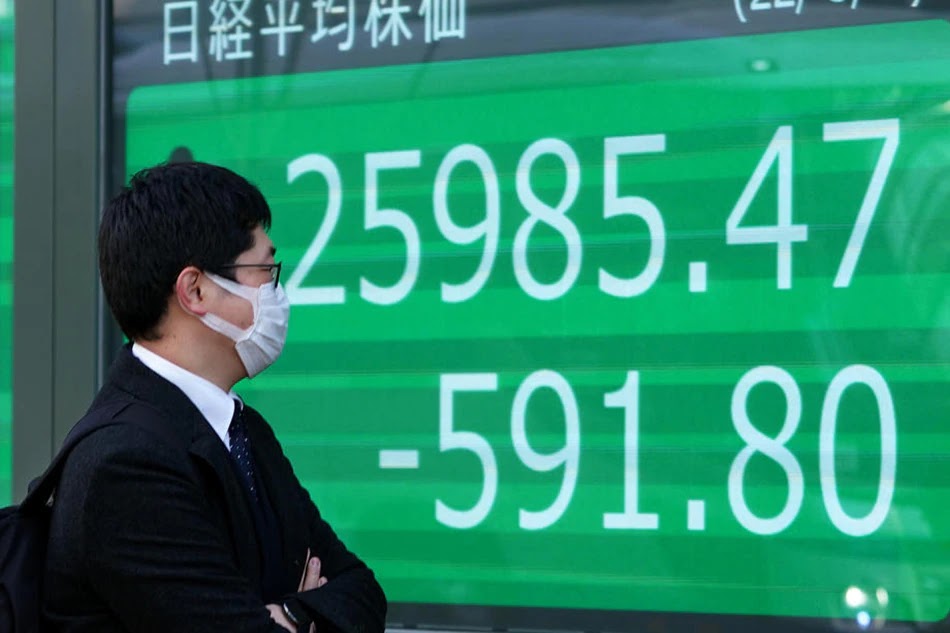
TOKYO — Tokyo stocks opened down Monday after Wall Street slipped on weaker-than-expected US labour market data.

The benchmark Nikkei 225 index fell 0.97 percent, or 313.17 points, to 31,879.58 in early trade, while the broader Topix index lost 0.57 percent, or 12.88 points, to 2,261.75.

"The market is expected to start under pressure after the fall of US shares," online brokerage Monex said in a note.

Rapid, recent gains of Tokyo shares and the rise of the bond yields are also cause for concern, Rakuten Securities said.

New York shares ended lower on Friday after data showed that the United States added 187,000 jobs last month, below the market's expectation for 200,000.

But US unemployment fell, while hourly wages rose more than the market's expectations.

Global investors will turn their focus to inflation data, particularly of the United States, to gauge future moves on US interest rates, Stephen Innes of SPI Asset Management said.

"This week's intensively watched inflation data, particularly the US CPI, will need to show that the previous month's drop was not a one-time event; otherwise, more Fed action might be needed to control it," he wrote in a note.

The dollar stood at 141.65 yen, compared with 141.77 yen seen Friday in New York.

Among major shares, heavily weighted Fast Retailing lost 2.56 percent to 33,160 yen. Toyota gave up earlier gains and fell 0.43 percent to 2,427 yen. Sony Group lost 1.01 percent to 12,795 yen.

Advantest, a major producer of tests for chips, lost 4.04 percent to 18,185 yen.

High-tech investor SoftBank, which is due to release results this week along with a slew of other blue chips, fell 2.98 percent to 6,771 yen.

Leading steelmaker Nippon Steel rose 2.39 percent to 3,347 yen after it upgraded its earnings forecast. Gamemaker Nintendo rose 0.55 percent to 6,206 yen.

Agence France-Presse

Wednesday, August 2, 2023

Tokyo stocks open lower on weak tech shares

TOKYO -- Tokyo stocks opened lower Wednesday, dragged down by technology shares that tracked an overnight decline of U.S. counterparts.

In the first 15 minutes of trading, the 225-issue Nikkei Stock Average fell 518.06 points, or 1.55 percent, from Tuesday to 32,958.52. The broader Topix index was down 26.29 points, or 1.12 percent, at 2,311.07.

On the top-tier Prime Market, decliners included securities house, insurance, and electric power and gas issues.

At 9 a.m., the dollar fetched 142.95-98 yen compared with 143.29-39 yen in New York and 142.71-73 yen in Tokyo at 5 p.m. Tuesday.

The euro was quoted at $1.1006-1010 and 157.33-42 yen against $1.0979-0989 and 157.40-50 yen in New York, and $1.0979-0980 and 156.69-73 yen in Tokyo late Tuesday afternoon.

Agence France-Presse

Monday, November 28, 2022

Tokyo shares softer in early trade

TOKYO - Tokyo shares drifted lower Monday morning as the global high-tech sector faces pressure.

The benchmark Nikkei 225 index eased 0.31 percent, or 86.81 points, to 28,196.22, while the broader Topix index fell 0.16 percent, or 3.17 points, to 2,014.83.

Agence France-Presse

Friday, November 11, 2016

Japanese brand is more than just makeup base


Japanese skincare and makeup brand Kanebo is all set to launch a brand new look and marketing campaign to mark its 80th anniversary this year. At the sneak preview in Tokyo last May, company officials discussed its three-pronged approach to market its skincare line consisting of products that “transcend function alone by appealing to the senses.”

First, Kanebo will encourage women to “enjoy their beauty” by accepting their differences. Next, beauty consultants are trained to provide personalized counseling based on a woman’s daily, weekly, monthly and yearlong needs—a new development the company calls “Chrono Beauty,” where the changing needs of women as they mature are addressed using the corresponding product.

Lastly, it promises to provide women a total sensory experience with products that smell good and are easy to apply. A bonus is the sleek, tactile containers that call to mind flowing water and were designed by Gwenael Nicolas.

The eight-item skincare range includes a day cream with SPF 15, night lipid wear, “The First Serum,” two types of lotion, two types of emulsion, a cleansing cream, cleansing oil and creamy wash.

Brand manager Robby da Silva said that Kanebo is focusing on the line’s day cream, night lipid wear and First Serum.

“The last is a unique item that draws the moisture from subsequent products which is essential in increasing skin moisture,” he said.

Last collection

Lunasol, the skincare brand from Kanebo, will eventually be phased out—the last collection is the current autumn range. In its place, a Kanebo-branded range consisting of 16 items and 34 SKU (stock keeping units) will be introduced.

Makeup fans can look forward to everything from Full Radiance foundation, Glow Primer and eyeshadows to Moisture Rouge, dual eyeliners and eyebrow pencils.

Long-time customers who had the chance to check out the products in a private selling event, however, zeroed in on the base products: foundation, primer and loose powder. For them, Kanebo has always been synonymous to foundation that provides perfectly sheer or full coverage.

Fronting the company’s new look and marketing campaign is American model Arizona Muse, whose easygoing beauty is hoped to attract a younger market.

The new skincare and makeup from Kanebo will be available this month at Rustans Makati, Shangri-La Plaza and Cebu.

source: lifestyle.inquirer.net

Friday, November 1, 2013

Slight headwinds as iPad Air takes off


TOKYO–For one Japanese man, being at the front of a Tokyo queue as the new iPad debuted around the world Friday was his way of saying “thank you” to Apple after a year that turned his life around.

Takaaki Sasaki was one of hundreds who poured into Apple’s flagship store in the glitzy Ginza district as the doors opened on the latest tablet offering from the sector’s agenda-setter.

The launch had little of the razzmatazz of previous iPads or iPhones, with potential customers perhaps swayed by a critical reception that was largely positive but dominated by the theme that the iPad Air was no game-changer.

The worldwide rollout kicked off Down Under, with Apple in Australia saying there were queues outside its stores when the doors opened, with several hundred people reportedly lining up outside its flagship Sydney outlet.

At the sprawling, three-storey Apple shop in downtown Beijing — the largest Apple store in Asia — each customer was greeted with cheers and applause from around 25 employees in bright blue shirts, with another dozen workers standing ready to give a second round of applause at the cash registers downstairs.

In Singapore, Edmond Ong, a spokesman for retailer Epicenter, said sales were muted compared with last year’s iPad launch.

“We are not too worried as we still see a steady stream of customers coming in to get the iPad this morning,” he said.

The new iPad Air is thinner than the version it replaces, weighs around 450 grams (one pound), and is “screaming fast,” Apple vice president Phil Schiller said at the unveiling in San Francisco on October 23.

Apple also unveiled an upgraded iPad Mini, which has a vividly rich retina display along with faster computing power and graphics.

Both new iPads feature the Apple-designed A7 chip with 64-bit “desktop-class architecture”, the company said. The Mini will go on sale later in the month.

Reviewers have generally been positive about the upgrades, with website TechCrunch labelling them “a huge improvement”, while Time said the Air was “so much svelter”.

Damon Darlin in the New York Times summed up the feelings of many with a review that lauded the Air’s lower weight, thinner profile and souped up operating system.

But, he said: “I can’t really tell you to replace your old iPad; the improvements on the new one are incremental, not revolutionary.”

However, in Japan, home to perhaps some of Apple’s most enthusiastic fans, the launch had its usual fanfare and tales of people queueing for days.

Kodai Taguchi, a 20-year-old university student, said he has more than a dozen Apple products after “queuing every time a new version is released”.

“As soon as I held the box, I could already tell how light it is,” he said. “I think I like this the most among all my Apples.”

For queue leader Sasaki, the open-air vigil had all been worth it.

“So many miracles have happened to me this year thanks to my Apple products,” he said.

Tears filled his eyes as he held his iPad Air, surrounded by a clutch of Japanese journalists.

Unemployed Sasaki, who travelled from northern Iwate, said after years of drifting Apple had brought him a run of luck, when he wrote a hit app.

The app — a searchable version of Japan’s constitution — was voted as the best in App Store’s business category and its sudden rise to prominence became fodder for a book he authored in August.

“I wanted to show my gratitude to Apple by being first in line,” he said.

source: technology.inquirer.net

Sunday, March 11, 2012

Japan falls silent for tsunami victims


TOKYO — Japan fell silent on Sunday to honor the 19,000 people killed a year ago when a huge earthquake sent a tsunami barreling into the coast, sparking a nuclear crisis at Fukushima.

Tearful families gathered in the still shell-shocked towns and villages across the country’s northeast to remember those lost when the towering tsunami smashed ashore.

At 2.46 p.m., much of the nation paused to mark the moment nature’s fury was visited on Japan, when the 9.0-magnitude quake set off a catastrophic chain of events.

At a national ceremony of remembrance at the National Theater in Tokyo, Japan’s mournful national anthem rang out before the prime minister and the emperor led silent prayers for those who lost their lives in the country’s worst post-war disaster.

The emperor and Prime Minister Yoshihiko Noda were joined by around 1,200 people at the national theatre in Tokyo.

A single pillar symbolizing the souls of those who died stood in the middle of the stage, decorated with white chrysanthemums and lilies.

The emperor, who three weeks ago underwent heart bypass surgery, said Japan would “never forget” the tragedy and spoke of the importance of “kizuna,” or human bonds, in the wake of the disaster.

“Many difficulties lie ahead in the reconstruction of the disaster-affected areas,” he said. “I hope that each and every member of the public will join their hearts with the people affected by the disasters, and continue to help them to improve their lives.”

Noda pledged Japan would recover from its tragedy.

“Our forebears, who led our country to prosperity, stood up with brave resolution in times of crisis,” he said.

“While offering our support for the daily struggles of those people in the disaster-affected regions, we will join hands as we seek to fulfill our historic mission of “the rebirth of Japan through reconstruction.”

Small rural towns along the coast that were turned to matchwood when the tsunami rolled in, wrecking whole neighborhoods and wiping out communities, held their own emotional ceremonies.

In Ishinomaki, home to fully a fifth of those who died in the disaster, tsunami warning sirens wailed to mark the moment the quake hit, sending a wall of water into the city where it claimed the lives of nearly 4,000 people.

Residents, who held small community ceremonies all over the wrecked city, had been warned on Saturday that the sirens would be raised.

In the badly-hit Watanoha district, around 80 tearful people gathered including Hitomi Oikawa, 37, who lost her father in the disaster.

“It’s been a year since my father died. I am going to pray that I can get over my grief and that my children can feel better,” she told AFP.

In Okuma, home to the crippled Fukushima nuclear plant, displaced residents arrived by bus to pay their respects to lost loved ones.

Television footage showed sobbing relatives wrapped up against the radiation in protective suits, gloves and shoe covers, holding a ceremony for those who perished in the town.

An elderly woman, whose grandchild is still listed as missing, wept as she laid flowers at a makeshift alter.

“I want my grandchild to be found,” she told reporters.

In the nearby city of Koriyama, monks banged drums and offered prayers ahead of an anti-nuclear protest rally, where numbers overwhelmed the seating available at a baseball stadium.

Organizers opened up parts of the stadium that have not yet been cleansed of radioactive fallout, asking participants with small children not to use the area, an AFP journalist said.

“We demand all children are evacuated from Fukushima now,” said organizer Setsuko Kuroda.

“Some experts say one third of children in Fukushima were affected by radiation,” she said. “Leaving the situation like this is like they are committing a murder every day.”

Among those demonstrating were some of the nuclear refugees forced to flee their homes in the shadow of Fukushima Daiichi as it began venting toxic radiation over homes and farmland.

The government and plant operator Tokyo Electric Power (TEPCO) announced in December “a state of cold shutdown” for three runaway reactors that went into meltdown when their cooling systems were swamped by the tsunami.

But with radiation having leaked from the crippled plant for months, many parts of a 20-kilometer exclusion zone around it are likely to remain uninhabitable for years—perhaps decades—to come, scientists warn.

article source: japantoday.com

Tuesday, February 7, 2012

Toyota Q3 jumps, raises FY outlook on cost cuts, incentives

TOKYO — Toyota Motor Corp. reported a stronger-than-expected quarterly operating profit, shrugging off a firm yen and the damaging impact of flooding in Thailand, and raised its annual forecast, helped by cost cuts and Japanese government subsidies.

Widespread floods in Thailand late last year battered Toyota just as it was recovering from production lost to the earthquake in Japan in March. The floods cost Toyota 240,000 vehicles in lost output worldwide, dragging 2011 global sales down by 6 percent and allowing General Motors Co. and Volkswagen AG to overtake it in global vehicle sales.

The yen's prolonged strength is also weighing on Toyota, which last year built 2.76 million cars in Japan, one third of Japan's total vehicle production. It exported 57 percent of that output, much of it at a loss.

Toyota raised its forecast for operating profit — earnings from its core operations — for the year to end-March to ¥270 billion ($3.52 billion) from a previous ¥200 billion. Consensus forecasts from 23 analysts surveyed by Thomson Reuters are for ¥330.8 billion.

The company, which has a market value of $135 billion — more than rivals Honda Motor Co. Ltd., Nissan Motor Co. Ltd. and Suzuki Motor Corp. combined — now sees annual net profit, which includes earnings made in China, of ¥200 billion, up from the ¥180 billion it projected in early December, before Tokyo announced fresh consumer incentives to buy fuel-efficient cars.

Toyota should benefit significantly from the re-instatement of cash-for-clunkers subsidies and the extension of tax incentives on fuel-efficient cars, especially on hybrids and other cars that use new technologies. Its newest Aqua hybrid received orders equivalent to 10 times the sales target in its first month.

Toyota has forecast a 21 percent jump in sales this calendar year to a record 9.58 million vehicles, including subsidiaries Daihatsu Motor Co. and Hino Motors Ltd. All its production plants, bar Thailand, are back in action.

"It's premature to talk about any (sales) trends by looking only at our performance from last year when we had all those natural disasters," Toyota president Akio Toyoda told reporters last week. "I would want Toyota to be measured on how we do this year, provided it's a peaceful one."

Yen weighs

October-December operating profit jumped 51.1 percent to ¥149.7 billion ($1.95 billion) from a year earlier, well ahead of the average estimate of a small decline to ¥93.9 billion in a poll of nine analysts by Reuters.

Quarterly net profit slipped 13.5 percent to ¥80.9 billion.

Last week, Honda said its profits fell sharply, hit in part by a ¥6 fall in the dollar for the quarter. Nissan, Japan's No.2 automaker, reports on Wednesday.

With the dollar trading at ¥76-¥77, Toyota's Achilles' heel remains its heavy exposure to Japan. It is scrambling to make its domestic factories more efficient to keep its promise of building at least 3 million vehicles a year at home.

A plan to return its Japan-based parent operations to break-even assumes a dollar rate of ¥85. — Reuters

source: gmanetwork.com

Monday, December 5, 2011

Tokyo stocks open up 0.63 percent

TOKYO – Tokyo stocks opened 0.63 percent higher on Monday as investors awaited developments on the European debt crisis ahead of crucial talks by the region’s leaders.

The benchmark Nikkei index at the Tokyo Stock Exchange opened up 54.03 points at 8,697.78.

The Nikkei will likely struggle for a clear direction before a series of important meetings in Europe this week, said Hiroichi Nishi, general manager of equity division at SMBC Nikko Securities.

“Investors are likely to wait to assess development(s) at many important meetings in Europe,” Nishi told Dow Jones Newswires.

German Chancellor Angela Merkel and French President Nicolas Sarkozy are due to meet later Monday. European Union summit talks are planned for Thursday and Friday.

Italy on Sunday unveiled a draconian austerity programme worth 20 billion euros ($27 billion) in an effort to avoid bankruptcy for the eurozone’s third largest economy but warned a new recession was looming.

The euro bought $1.3417 and 104.73 yen in early Asian trade Monday, up from $1.3403 and 104.56 yen in New York late Friday. The dollar was almost unchanged, trading at 78.05 yen.

Nishi said some sense of overheating had emerged in the Nikkei index over the past few sessions with eased concerns over the European sovereign debt crisis and the US economy.

Closely watched US jobs data showed Friday that the unemployment rate sank to a 32-month low of 8.6 percent in November. The blue-chip Dow Jones Industrial Average rose 0.01 percent to end at 12,019.42.


source: http://business.inquirer.net/33561/tokyo-stocks-open-up-0-63-percent