Showing posts with label Japan. Show all posts

Tuesday, March 21, 2023

Ohtani stars as Japan beat Mexico to reach World Baseball Classic final

MIAMI -- Japan came from behind twice to defeat Mexico 6-5 on Monday and set up a World Baseball Classic final showdown with the United States.

Munetaka Murakami drove in a walk-off two-run double in the bottom of the ninth inning after Japan superstar Shohei Ohtani launched a late rally that capped a thrilling duel at Miami's LoanDepot Park.

Japan, who had trailed 3-0 and 5-3 during Monday's semi, now advance to a mouthwatering final against the star-studded USA in Miami on Tuesday.

Japan manager Hideki Kuriyama said after the win he had always believed in his players to dig themselves out of trouble. 

"I know the more important the game it is, I think the last players become the more critical," Kuriyama said of the ninth inning rally.

"I always believed there's always the chance at the end, no matter how the game plays out."

Mexico counterpart Benji Gil meanwhile saluted the Japanese.

"We have to take off our hats to the Japanese team," Gil said. 

"Neither team deserved to lose, but someone had to win. Both teams had a great performance. I think that Japan moves on, but the world of baseball won today."

Japan are chasing a record third World Baseball Classic crown after winning the tournament in 2006 and 2009.

The Asian powerhouses have been the most consistent side in this year's tournament, averaging more than nine runs per game en route to Monday's semi-final.

But for long periods it looked as if Mexico were ready to score an upset.

A superb pitching performance from the Los Angeles Angels' Patrick Sandoval stymied Japan's vaunted offensive power through the first four innings.

Mexico meanwhile broke the game wide open in the fourth.

After bagging two outs, Japan prodigy Roki Sasaki gave up singles to Rowdy Tellez and Isaac Paredes on successive pitches before Luis Urias blasted a homer to left centerfield to put Mexico ahead 3-0.

The Houston Astros' Jose Urquidy replaced Sandoval in the fifth and navigated a bases-loaded jam to keep Japan scoreless. 

Urquidy emerged unscathed from another bases-loaded situation in the sixth to frustrate Japan again.

But Mexico's resistance finally broke in the bottom of the seventh.

Boston Red Sox new signing Masataka Yoshida smashed a three-run shot to tie it up at 3-3 and Japan were back in it.

Yet Mexico responded well to start the eighth. Randy Arozarena doubled to lead off and then scored when Alex Verdugo doubled.

A Paredes single put Mexico up 5-3 and Japan were again chasing the game.

Hotaka Yamakawa's sac-fly to left field scored Takumu Nakano to trim the deficit to 5-4 heading to the ninth.

After Mexico went scoreless in the top of the inning it was left to Japan's golden boy Ohtani to start the fightback.

Ohtani doubled off Giovanny Gallegos to keep Japan alive and then the pressure piled on the Mexican pitcher as Yoshida walked, and was replaced by pinch-runner Ukyo Shuto.

Murakami then stepped up to crush a double to centerfield, and Ohtani and Shuto sprinted home for a stunning walkoff win.

Agence France-Presse

Monday, November 28, 2022

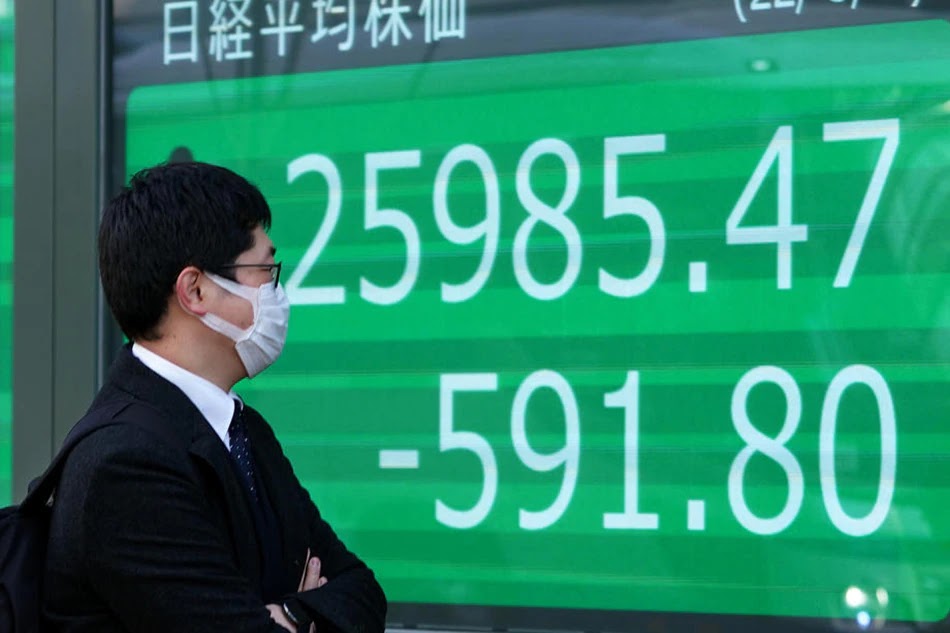
Tokyo shares softer in early trade

TOKYO - Tokyo shares drifted lower Monday morning as the global high-tech sector faces pressure.

The benchmark Nikkei 225 index eased 0.31 percent, or 86.81 points, to 28,196.22, while the broader Topix index fell 0.16 percent, or 3.17 points, to 2,014.83.

Agence France-Presse

Thursday, September 1, 2022

Toyota to spend $5.3 billion expanding Japan, US battery output

TOKYO - Toyota said it will ramp up the production of batteries for electric vehicles in Japan and the United States through an investment of up to 730 billion yen ($5.3 billion).

Part of the cash is included in a huge two-trillion budget for the development and production of auto batteries that was announced by the Japanese giant in December, a spokesman told AFP.

Automakers are speeding up the transition to electric as pressure grows from governments to move away from cars with combustion engines, and also thanks to the success of Elon Musk's Tesla.

Toyota is the world's top-selling carmaker, and has championed hybrid motors and pioneered hydrogen as a fuel of the future.

But until recently it has been slow to embrace battery-powered electric vehicles, seen as a key to reducing carbon emissions.

"With this investment, Toyota intends to increase its combined battery production capacity in Japan and the United States by up to 40 GWh (Gigawatt Hours)," the company said in a statement.

Toyota said it aims to begin producing cells for battery-powered vehicles in the two countries between 2024 and 2026.

News of Toyota's investment follows US President Joe Biden's signing of his hallmark Inflation Reduction Act earlier this month, which the White House touted as the biggest commitment to mitigating climate change in US history.

"Today's announcement from Toyota is another sign that the president's economic plan is ushering in a new era of American manufacturing and economic competitiveness," said Brian Deese, director of the White House's National Economic Council.

Around 400 billion yen will be spent in Japan and around 325 billion yen in the United States, said the company, which expects a new battery-making plant in North Carolina to come online in 2025.

The announcement comes after Honda unveiled a joint venture on Monday with South Korea's LG Energy Solution to invest $4.4 billion in a new US electric car battery plant.

And last month, Japanese electronics giant and Tesla supplier Panasonic announced its own $4 billion investment to build a new battery factory in the United States for electric vehicles.

Agence France-Presse

Wednesday, March 10, 2021

Japan to give $41 million aid to Asian nations over vaccine supply

TOKYO - Japan will provide 4.5 billion yen ($41 million) grant aid through an international organization to 25 countries in Asia and the Pacific Islands region to help them build a cold-chain distribution network for COVID-19 vaccines, the Foreign Ministry said Tuesday.

The grant aid will be used to secure cold-storage facilities, transport vehicles and other equipment necessary for the stable delivery of vaccines in those countries, including Indonesia, the Philippines and Thailand, according to the ministry.

Japan aims to help ensure the delivery of vaccines "to each and every person in the all corners of developing countries" with the hope of containing the coronavirus pandemic as quickly as possible, it said, adding the aid will be delivered through the United Nations Children's Fund.

The other recipient countries are Bhutan, Brunei, Cambodia, the Cook Islands, East Timor, Fiji, Laos, Malaysia, Maldives, Micronesia, Myanmar, Nepal, Niue, Pakistan, Papua New Guinea, Samoa, Sri Lanka, the Solomon Islands, Tonga, Tuvalu, Vanuatu and Vietnam.

Japan has also pledged $200 million to the COVAX facility, an international vaccine distribution platform set up to ensure equitable access to shots for developing countries.

The COVAX initiative aims to deliver 2 billion doses of coronavirus vaccines across the world by the end of 2021.

-Kyodo News

Wednesday, June 10, 2020

Japan's debt mountain: How is it sustainable?


Already the global leader in accumulating debt, Japan is adding nearly $2 trillion to its mountain this fiscal year with record stimulus packages to cushion the impact of coronavirus.

With debt levels around two and a half times the size of its economy, Japan manages to keep government bond yields ultra low and investor confidence high that it can avoid default.

- How did we get here? -

Whichever way you look at it, Japan's debt is unfathomably large. According to the Bank of Japan (BoJ), at the end of 2019, it stood at 1,328,000,000,000,000 yen.

This is equivalent to around $12.2 trillion, just over half the total amount of US debt in absolute terms but by far the biggest pile when measured against the size of even Japan's mighty economy (around 240 percent of gross domestic product).

Japan's debt began to swell in the 1990s when its finance and real estate bubble burst to disastrous effect.

With stimulus packages and a rapidly ageing population that pushes up healthcare and social security costs, Japan's debt first breached the 100-percent-of-GDP mark at the end of the 1990s.

It hit 200 percent in 2010 and is now around 240 percent of GDP, according to the International Monetary Fund.

On Wednesday, Japan's parliament agreed anti-coronavirus measures worth 117 trillion yen -- which is likely to push the GDP ratio well above 250 percent.

- Isn't this a problem? -

To finance this debt, the Japanese government issues bonds known as JGBs.

These are snapped up in enormous volumes by the BoJ, the country's central bank that is officially independent but in practice closely co-ordinates economic policy with the government.

As part of anti-virus measures, the bank has removed its self-imposed ceiling on buying JGBs, giving itself unlimited purchasing firepower. It holds more than half of all JGBs.

These purchases support the price of the JGBs in the debt market and keep the yield on the bonds low (prices and yields move in opposite directions).

This means that in effect, the government is being financed by the central bank at an ultra-low (or even negative) interest rate, making it more sustainable.

"The ultra-low rate conditions created by very much accommodative monetary policy by BoJ can be one of the reasons" that Japan's mountain is less problematic than for other high-debt countries around the world, said Takashi Miwa, an economist at Nomura bank.

- Who else buys Japan's debt? -

Risk-averse private and institutional investors also have a healthy appetite for JGBs because they see them as a safe place to put their money, burned by a history of stock market bubbles.

"A large portion of wealth is held by seniors who lack financial literacy and prioritise stability rather than return," said Shigeto Nagai, from Oxford Economics.

"With limited investment and lending opportunities domestically, banks, insurance companies and pension funds still need the JGB to place their vast amount of excess savings," Nagai told AFP.

The bonds are denominated in yen, still seen as a safe haven in troubled economic times and the proportion held by foreign institutions is very low -- making Japan less vulnerable to external pressure.

In fact, 90 percent of the debt is held by Japanese investors.

Another thing that keeps market confidence high: Japan is the world's biggest creditor, holding more than $3 trillion in net assets in foreign currency reserves and direct investment abroad.

- How high can you go? -

The growing mountain of debt means that, even with ultra-low interest rates, the amount Japan's government pays for repayments is its second-largest budget line.

The only way to avoid adding to the pile is to reduce budget deficits by boosting taxes or cutting public spending -- but this threatens to throttle growth in Japan's already recession-hit economy.

One drastic step could be to write off the debt held by the BoJ -- a step that would be an "accounting trick" with "no consequence" on the real economy, said Frederic Burguiere, an economist specialising in Asia.

"But this does not take into account the moral dimension of economic mechanisms... if we allow states not to repay their debts, what becomes the rules for private investors and the state itself?" asked Burguiere.

Agence France-Presse 

Friday, January 24, 2020

Japanese shop draws flak for ban on Chinese tourists amid coronavirus fears


A candy store in Hakone, Kanagawa Prefecture, in Japan drew flak after putting up a sign banning Chinese tourists amid fears over the novel coronavirus, which originated in Wuhan, China.

The owner of the shop, who was unidentified, put up the sign using a translation app, so he would not be infected by the novel coronavirus, as per the Asahi Shimbun on Jan. 22. The sign, which was put up on Jan. 17, reads, “Chinese people are banned from entering this store” and “I don’t want them to spread the virus.”


“Ill-mannered Chinese tourists have caused trouble in my store,” the owner was quoted as saying. “I want to protect myself against the coronavirus. I don’t want Chinese tourists to enter.”

Japan confirmed its first case of the coronavirus on Jan. 16—a Chinese national living in Kanagawa Prefecture who returned from a trip to Wuhan on Jan. 6. The man tested positive after showing symptoms of coronavirus on Jan. 10, but has since recovered and been discharged from the hospital.

Japan just confirmed its second case of the virus today, Jan. 24, also in a man who recently traveled to Wuhan, as per Japan Times on the same day. The traveler, who is in his 40s, suffered from a fever while in China on Jan. 14 and arrived in Japan on Jan. 19. He is now hospitalized in Tokyo.

The shop owner’s sign was denounced by Chinese netizens after it made the rounds online, and the shop owner also received messages calling for his apology. Following the backlash, the shop owner said he would change his sign.

“I’ll rewrite the sign and refrain from using expressions that may cause controversy,” he said, as per the report, but made it clear that he would still not allow Chinese people inside his shop.

Meanwhile, the Philippine bureau of the World Health Organization said on Jan. 21 that there is no confirmed case of the coronavirus in the country yet. Cases of coronavirus, however, have been reported in the United States, Thailand, Japan, South Korea, Taiwan and Singapore.  Cody Cepeda /ra

source: newsinfo.inquirer.net

Wednesday, October 17, 2018

US sets new trade talks with EU, Japan, Britain


WASHINGTON, United States – US officials announced Tuesday negotiations for separate trade agreements with Britain, the European Union and Japan as part of efforts by President Donald Trump’s administration to rebalance global commerce.

US Trade Representative Robert Lighthizer said the administration notified Congress of its intent to negotiate the three separate trade agreements.


“We are committed to concluding these negotiations with timely and substantive results for American workers, farmers, ranchers and businesses,” Lighthizer said in a statement.

The move follows the Trump administration’s renegotiation of the North American Free Trade Agreement with Canada and Mexico and its push to correct what Trump maintains is an unbalanced trade picture.

In the notifications to Congress on Japan and the EU, Lighthizer cited “chronic US trade imbalances” and said that US exporters have been long “challenged” by tariff and non-tariff barriers in Japan and in Europe.

The goal, he said, is to achieve “fairer, more balanced” trade with the US trading partners.

Lighthizer said the US would seek a trade agreement with Britain as soon as it exits the European Union in 2019.

The letter to Congress said Washington would seek to address tariff and non-tariff barriers and achieve “free, fair and reciprocal trade” with the United Kingdom.

Playing hardball
Trump has been playing hardball with US trading partners, using tariffs and threats in an effort to boost US exports and curb the longstanding deficit in merchandise trade, despite warnings from many US lawmakers and the International Monetary Fund.

Trump in May had ordered Commerce to investigate the possibility of imposing tariffs of up to 25 percent on foreign autos and auto parts, a prospect that alarmed the industry and could have serious repercussions for Japan and Europe.

“We need to work together to de-escalate and resolve the current trade disputes,” IMF chief Christine Lagarde said at an IMF and World Bank gathering in Bali last week.


In this May 21, 2018, file photo container ships are unloaded at the Port of Oakland in Oakland, California.  AP FILE

WASHINGTON, United States – US officials announced Tuesday negotiations for separate trade agreements with Britain, the European Union and Japan as part of efforts by President Donald Trump’s administration to rebalance global commerce.

US Trade Representative Robert Lighthizer said the administration notified Congress of its intent to negotiate the three separate trade agreements.


“We are committed to concluding these negotiations with timely and substantive results for American workers, farmers, ranchers and businesses,” Lighthizer said in a statement.

The move follows the Trump administration’s renegotiation of the North American Free Trade Agreement with Canada and Mexico and its push to correct what Trump maintains is an unbalanced trade picture.

In the notifications to Congress on Japan and the EU, Lighthizer cited “chronic US trade imbalances” and said that US exporters have been long “challenged” by tariff and non-tariff barriers in Japan and in Europe.

The goal, he said, is to achieve “fairer, more balanced” trade with the US trading partners.

Lighthizer said the US would seek a trade agreement with Britain as soon as it exits the European Union in 2019.

The letter to Congress said Washington would seek to address tariff and non-tariff barriers and achieve “free, fair and reciprocal trade” with the United Kingdom.

Playing hardball
Trump has been playing hardball with US trading partners, using tariffs and threats in an effort to boost US exports and curb the longstanding deficit in merchandise trade, despite warnings from many US lawmakers and the International Monetary Fund.

Trump in May had ordered Commerce to investigate the possibility of imposing tariffs of up to 25 percent on foreign autos and auto parts, a prospect that alarmed the industry and could have serious repercussions for Japan and Europe.

“We need to work together to de-escalate and resolve the current trade disputes,” IMF chief Christine Lagarde said at an IMF and World Bank gathering in Bali last week.


Trump has levied or threatened tariffs on goods from economies around the world, notably China, but also on traditional allies such as the European Union.

More tariffs and their countermeasures “could lead to a broader tightening of financial conditions, with negative implications for the global economy and financial stability,” the fund warned.

The new talks, if successful, would address trade with Europe and Japan but leaves the thornier challenge of China, which accounts for more than half the US trade deficit.

The US trade deficit ballooned in August to its highest level in six months, according to government figures showing American consumers snapped up more imported cars and mobile phones.

The total US trade deficit rose 6.4 percent over July to $53.2 billion, overshooting analyst forecasts.

Despite Trump’s efforts to attack the trade deficit, so far this year it has risen 8.6 percent over the same period in 2017.

The gap in goods trade with China rose to $38.6 billion for August and with Mexico hit $8.7 billion — both the highest monthly totals ever.

The August figures suggested retaliatory tariffs imposed by China continued to whipsaw American farmers, whose rural counties Trump’s Republican Party traditionally counts on for political support. /cbb

source: business.inquirer.net

Monday, July 9, 2018

Japan says death toll from floods climbs to 100


HIROSHIMA, Japan – The Japanese government said at least 100 people have died or are presumed dead from the heavy rains, floods and mudslides that have struck western Japan.

Chief Cabinet Secretary Yoshihide Suga told a news conference on Monday that 68 people were unaccounted for, many of them in the hardest-hit Hiroshima area.

Suga said 87 people were confirmed dead and 13 others had no vital signs when they were found as of early Monday.


People are preparing for risky search and cleanup efforts in southwestern Japan, where several days of heavy rainfall had set off flooding and landslides in a widespread area.

Some residents in Hiroshima prefecture said they were caught off guard in a region not used to torrents of rainfall, which began Friday and worsened through the weekend. Rivers overflowed, turning towns into lakes and leaving dozens of people stranded on rooftops. Military paddleboats and helicopters were bringing people to dry land.

The assessment of casualties has been difficult because of the widespread area affected. Authorities warned that landslides could strike even after rain subsides as the calamity shaped up to be potentially the worst in decades. /kga

source: newsinfo.inquirer.net

Thursday, June 22, 2017

Permanent residency in Japan to be easier for foreigners with anime-related jobs


While life in Japan as depicted in anime is not always true, and though fans are aware of this, a lot of them still dream of working and living in the land of the rising sun.

The Immigration Bureau of Japan has taken notice of this trend and announced upcoming changes to their regulations. The changes would be implemented in 2018 and it will loosen the requirements for permanent residency for people working in anime-related fields, according to a report in Nihon Keizai Shimbun via SoraNews24.

These changes also extend to professionals who work in the field of fashion and other pop culture sectors of the economy. Apparently, the goal is to help promote Japanese culture to the international community through Japan-based foreigners.

This announcement has led some to call the people working in the said industries as “Cool Japan human resources,” in reference to the “Cool Japan” strategy which aims to promote Japanese culture throughout the world.

Earlier in the year, the bureau unveiled a new points-based system that gave highly skilled foreign workers better opportunities to become permanent residents. Through various criteria such as educational attainment, experience in their chosen field and specialization, foreign workers would be awarded points that will be tallied.

The number of points accumulated will then determine what requirement a foreign worker would need to accomplish permanent residency. A highly-skilled individual who scores 80 points will only need to stay in Japan for a year to become eligible for permanent residency, while 70 points will require three years, and so on.

But before any excitement, one year of working in Japan is still a prerequisite before applying for permanent residency. On the other hand, this should be an easy obstacle for a determined and skilled anime fan to overcome. Alfred Bayle/JB/rga

source: newsinfo.inquirer.net

Monday, March 27, 2017

Paul McCartney working on new music


The legendary songsmith Paul McCartney has a new album in the works.

The ex-Beatle is teaming up with producer Greg Kurstin on the new and as yet unnamed record, Billboard reports. He told BBC Radio 6 during an interview: “Greg is musical and he’s great to work with.”

2017 is shaping up to be a busy year for the superstar, who reissued his 1989 solo album “Flowers in the Dirt” on March 24 to include previously unheard demo tracks.

McCartney is also set to play several live concert dates in Japan throughout the month of April. Meanwhile, the upcoming album does not yet have a launch date. JB

source: entertainment.inquirer.net

Friday, December 9, 2016

Ronaldo no dummy as he targets world treble


Cristiano Ronaldo will have little time for “cyber clones” or facial keepy-uppy when the Real Madrid superstar arrives in Japan next week for the Club World Cup.

The Portuguese pin-up met a life-size silicon Ronaldo complete with ripped abs, greased-back hair and twitching eyebrows on a commercial visit last year.

The world’s highest-paid athlete has also appeared in a Japanese commercial to promote a bizarre face-stretching gadget designed to enhance the user’s smile.

But Ronaldo, who rakes in nearly $90 million in salary and endorsements yearly according to Forbes, insisted he would be in Japan on a different kind of business as European champs Real chase a second Club World Cup in three years.

“It is a big tournament and I have been lucky enough to win it twice before,” he told Japan’s Nippon TV, referring to the 2014 tournament and his first personal triumph with previous club Manchester United in 2008.

“Of course I want to win it for a third time,” added the 31-year-old. “We are not going to Japan for a holiday. We go there with the sole aim of winning the title and to be crowned the best team in the world.”

Ronaldo, who touches down in Japan on Monday, has legions of female fans who swoon over his chiseled looks and muscular physique, which he regularly flaunts by removing his shirt to celebrate goals.

There is similar reaction when Ronaldo is wheeled out for Japanese television on his money-making trips as studio guests giddily poke and prod his stomach.

Cyber clone

Japanese scientists unveiled a cyber clone of the player last year to promote an electric muscle stimulator for sculpting a washboard stomach, a device being advertised again during commercial breaks at this year’s Club World Cup.

Ronaldo, tipped to win his third Ballon d’Or trophy on Monday, gave the doppelganger the thumbs-up but drew the line at modeling the propeller-like face stretcher, which requires the user to nod excitedly while biting on a ball in the middle.

Zinedine Zidane’s table-topping Real face either Mexico’s Club America or South Korea’s Jeonbuk Hyundai Motors in the competition’s second semi-final in Yokohama next Thursday.

Barring an major upsets, the Spanish giants will face Libertadores Cup holders Atletico Nacional in the competition final on December 18.

The Colombians will have the hopes of a grieving continent on their shoulders after Copa Sudamericana final opponents Chapecoense were all but wiped out in a plane crash on November 29 that claimed the lives of 71 people.

Real will be without Gareth Bale as the Welshman recovers from ankle surgery, but have been boosted by the return of Toni Kroos after a metatarsal fracture.

“Lifting the title for a third time would be special for me,” said Kroos, who won the 2013 Club World Cup with Bayern Munich.

“It’s a long trip and it won’t be easy to acclimatize,” he added. “We have a lot of matches at this time of year and it will be tough but it’s a tournament that we take very seriously.”

source: sports.inquirer.net

Friday, March 20, 2015

Burger King has cologne for hamburger lovers in Japan


TOKYO — For hamburger aficionados who can’t get enough of it, Burger King has an answer: a grilled burger-scented fragrance.

Burger King said Friday that the limited “Whopper” grilled beef burger-scented cologne will be sold only one day on April 1, and only in Japan.

Sounds too good to be true? But it’s not an April Fools’ Day joke. The date marks the “Whopper” burger day for the company.

The limited “Flame Grilled” fragrance can be purchased at 5,000 yen ($40) per purchase of the burger that comes with flame-grilled beef. There will be only 1,000 of them.

Burger King said it hoped the scent would also seduce new grill-beef burger fans.

source: newsinfo.inquirer.net

Saturday, February 14, 2015

In Japan, women buy sweets for men on Valentine’s Day


TOKYO — Perusing the Valentine’s Day chocolate selection during my lunch break made me stand out in the crowd in Tokyo: I was the only male in the Godiva store.

In Japan, women buy chocolates for men on Valentine’s Day, not vice versa. And not just for their boyfriend or partner, but also for co-workers, friends of both sexes and even themselves these days. It’s a big business: the Godiva store had shelves of specially boxed assortments rising to its high ceiling, while competing chocolate makers went head-to-head at temporary counters set up at a commuter rail station.

Two female co-workers brightened our office Friday by handing out chocolates to everyone else: a handful of Hershey kisses from one, a minibag of M&Ms from the other.

Women get their “desserts” just one month later. Marketers have created “White Day” on March 14, when men are supposed to reciprocate with gifts for women.

source: lifestyle.inquirer.net

Sunday, October 5, 2014

Kei Nishikori wins Japan Open


TOKYO — Kei Nishikori won the Japan Open title for the second time in three years on Sunday as he defeated Milos Raonic 7-6 (7/5), 4-6, 6-4 in the final.

US Open finalist Nishikori added the trophy to one he also took over the Canadian in 2012 at the Ariake Colosseum. Play was held under the closed roof of the venue as rains from an approaching typhoon fell.

The title was the second is as many weeks for top Japanese player Nishikori, who also won in Kuala Lumpur last weekend.

It was the fourth time this season the pair have played, with Nishikori winning three of the encounters.

source: sports.inquirer.net

Friday, December 6, 2013

Japan agency offers travel for your teddy bear


TOKYO–Unable to get to that must-see tourist site but can’t bear for your teddy to miss out? Then Japan has just the thing for you — a travel agency that takes stuffed toys on package tours and even provides the holiday snaps to prove it.

Tokyo-based Unagi (Eel) Travel has a range of offers to suit every cuddly companion’s purse.

For instance, a day trip around sightseeing spots in the Japanese capital is $45, plus travel — by parcel post — from and to the toy’s home address.

The more adventurous bear might like to see some of the grand temples and shrines of the ancient capital of Kyoto for $95, or unwind in the hot spring baths that dot volcanic Japan — a snip at $55.

“Some clients join tours simply because it seems fun but there are also people who want to send stuffed animals as their proxies since they can’t travel by themselves, because they are in hospital, handicapped or too busy,” tour operator Sonoe Azuma told AFP.

“A client asked me to take her companion up some stairs and walk through narrow streets she can’t go into with her wheelchair.

“Another client wanted her animal to get a lot of sunshine as she can’t go outside because of a skin disease.”

A form sent to teddy owners ahead of the trip asks for the tourist’s name, if they are prone to car-sickness or sea-sickness, and if they are allergic to a particular food.

Owners are invited to give a bit of background about the participant’s character, such as what their hobbies are and why they are joining the tour.

On a recent tour of Tokyo, to which an AFP team was invited, a menagerie of creatures were entrusted to Azuma’s care.

The group included a tiger from Osaka, a shark from Kanagawa, a rather well-loved Hello Kitty from Hyogo and a small version of Sesame Street’s Big Bird from Hokkaido. They were escorted around Tokyo by the agency’s resident tour guide, eel girl Unasha.

After an early morning briefing on what to expect, participants were gently packed up and taken to the expansive Meiji Jingu Shrine before heading for the Imperial Palace gardens, where Azuma carefully spread out a towel for the gang to sit on as they posed for one of many group photos of the day.

‘Taking care of other people’s children’

While it may sound a little far-fetched, 39-year-old Azuma, who used to work in finance, takes her task very seriously and objects to the idea that she is just firing off snaps at famous locations.

“Anyone could do it if it was simply about taking pictures of stuffed animals… You must do this with the belief that ‘I’m taking care of other people’s children’,” she said.

Azuma, who has been running Unagi Travel for three years, live-blogs her tours, uploading pictures on Facebook and Twitter (https://www.facebook.com/unagitravel, https://twitter.com/unagitravel).

Each photo is captioned with comments from tour participants, ranging from the simple “yummy!” when sampling food to a more considered “Always important to look at things from a different perspective” as they stand in front of a tall building.

Azuma even prepares tiny costumes for her pint-sized charges that match tour locations — such as kimonos for a sleepover at a Japanese-style inn. She says this helps to add a little surprise to owners who are monitoring the trip online.

And she uses the photos she takes to map out a story that chimes with the background each owner has provided.

On one tour, a Tokyoite bunny carried a frog from a provincial town on her back through the din of the capital city because the frog was not used to crowded places.

And her human clients seem to appreciate the personal attention.

One woman said she had never seen her rabbit looking so happy as in a photo of it eating at a restaurant with other stuffed toys, Azuma said.

A satisfied customer in her 40s told AFP she did not think it was strange at all to send two cuddly companions on a mystery tour.

“I enjoyed the scenery or the food through their eyes, even if I was not physically there,” said the woman, who did not want to be named.

With digital photography, mocking up a picture of your bear at a tourist spot would be easy, concedes the woman, but that rather misses the point.

“I think it is very different when they go there physically by themselves and take pictures,” she said. “They must have their own fond memories of the travel.”

She acknowledges that to many non-Japanese people, the practice may seem a little strange.

“I would be a little more (circumspect) if a non-Japanese friend asks me if I would be interested in the service. But if I talk with my Japanese friends, it’s a very natural thing,” she said.

source: newsinfo.inquirer.net

Friday, November 1, 2013

Slight headwinds as iPad Air takes off


TOKYO–For one Japanese man, being at the front of a Tokyo queue as the new iPad debuted around the world Friday was his way of saying “thank you” to Apple after a year that turned his life around.

Takaaki Sasaki was one of hundreds who poured into Apple’s flagship store in the glitzy Ginza district as the doors opened on the latest tablet offering from the sector’s agenda-setter.

The launch had little of the razzmatazz of previous iPads or iPhones, with potential customers perhaps swayed by a critical reception that was largely positive but dominated by the theme that the iPad Air was no game-changer.

The worldwide rollout kicked off Down Under, with Apple in Australia saying there were queues outside its stores when the doors opened, with several hundred people reportedly lining up outside its flagship Sydney outlet.

At the sprawling, three-storey Apple shop in downtown Beijing — the largest Apple store in Asia — each customer was greeted with cheers and applause from around 25 employees in bright blue shirts, with another dozen workers standing ready to give a second round of applause at the cash registers downstairs.

In Singapore, Edmond Ong, a spokesman for retailer Epicenter, said sales were muted compared with last year’s iPad launch.

“We are not too worried as we still see a steady stream of customers coming in to get the iPad this morning,” he said.

The new iPad Air is thinner than the version it replaces, weighs around 450 grams (one pound), and is “screaming fast,” Apple vice president Phil Schiller said at the unveiling in San Francisco on October 23.

Apple also unveiled an upgraded iPad Mini, which has a vividly rich retina display along with faster computing power and graphics.

Both new iPads feature the Apple-designed A7 chip with 64-bit “desktop-class architecture”, the company said. The Mini will go on sale later in the month.

Reviewers have generally been positive about the upgrades, with website TechCrunch labelling them “a huge improvement”, while Time said the Air was “so much svelter”.

Damon Darlin in the New York Times summed up the feelings of many with a review that lauded the Air’s lower weight, thinner profile and souped up operating system.

But, he said: “I can’t really tell you to replace your old iPad; the improvements on the new one are incremental, not revolutionary.”

However, in Japan, home to perhaps some of Apple’s most enthusiastic fans, the launch had its usual fanfare and tales of people queueing for days.

Kodai Taguchi, a 20-year-old university student, said he has more than a dozen Apple products after “queuing every time a new version is released”.

“As soon as I held the box, I could already tell how light it is,” he said. “I think I like this the most among all my Apples.”

For queue leader Sasaki, the open-air vigil had all been worth it.

“So many miracles have happened to me this year thanks to my Apple products,” he said.

Tears filled his eyes as he held his iPad Air, surrounded by a clutch of Japanese journalists.

Unemployed Sasaki, who travelled from northern Iwate, said after years of drifting Apple had brought him a run of luck, when he wrote a hit app.

The app — a searchable version of Japan’s constitution — was voted as the best in App Store’s business category and its sudden rise to prominence became fodder for a book he authored in August.

“I wanted to show my gratitude to Apple by being first in line,” he said.

source: technology.inquirer.net

Wednesday, October 16, 2013

Asia’s animators draw inspiration from Japan’s Miyazaki


BUSAN – As Oscar-winning animator Hayao Miyazaki heads into retirement, industry watchers say the next generation of Asian filmmakers stepping out of his shadow will struggle to match the Japanese master’s box office domination.

“The view here is that there will be no ‘second Miyazaki,’” Tokyo-based author and film critic Mark Schilling told AFP.

The market for Asian animation is dominated by children’s films, Schilling said, and not the more adult-themed productions Miyazaki became famous for, such as his Oscar-winning “Spirited Away” in 2002.

The 72-year-old director last month shocked the industry – and his legions of fans – by announcing he was walking away from directing.

The decision was made even as Miyazaki’s latest production “The Wind Rises” – a look at the life of the man who invented Japan’s Mitsubishi Zero fighter airplane – continues to dominate the box office in Japan. It has collected an estimated $115 million in takings since its July release.

That success follows impressive global totals from Miyazaki’s “Spirited Away” ($274.9 million), 2004′s “Howl’s Moving Castle” ($235.2 million) and 2008′s “Ponyo” ($201.8 million). “The Wind Rises” is scheduled to begin hitting screens in Europe and the United States from January next year.

Schilling – who translated the Miyazaki-themed book “Princess Mononoke: The Art and Making of Japan’s Most Popular Film of All Time” – said audience figures for many animators working in a similar hand-drawn style would inevitably fade.

“None of their films have scaled the Miyazaki-like box-office heights and it’s hard to see how they can in the future.”

Small market

The small marketplace has not deterred 35-year-old Yeon Sang-Ho, whose second feature “The Fake” was a hit with critics at the Busan International Film Festival held earlier this month.

“Animated films for adults are actually rare,” he told AFP, on the sidelines of the festival. “So even when a film gets money invested in it, it’s still difficult to get it released.

“Animators like me will just have to make people become more familiar with animation by making more films.”

Despite being lauded by critics – and picking up three awards at Busan in 2011 – Yeon’s debut “The King of Pigs” did not recoup its $150,000 budget from box office takings.

Undeterred, Yeon has infused his latest production with a similar brand of savage and profane social comment as he explores the story of a man locked into battle with an unscrupulous church leader.

The director, while acknowledging that the market for more mature-themed animation in Asia was small, said the reaction to his first feature and the inspiration he drew from the likes of Miyazaki and the manga artist Minoru Furuya (“Himizu”) had made him fiercely determined to continue developing his own style.

His films are noted for their ultra-realistic mix of computer-generated and hand-drawn images.

Creative control

Also capturing the attention of both critics and the audience in Busan was 23-year-old Korean Han Yeo-ul, whose “The Child Who Draws an Octopus” was the only piece of animation in the running for the festival’s major prize for Korean short films.

Han’s production uses a very child-like cut-out style which belies the weighty issues it conveys.

“Animation allows me to capture the innocence of childhood,” she said. “You can capture how the world looks through a child’s eyes but still look at serious issues.”

While Han also acknowledged the market was small, she said it gave her freedom to communicate more directly with her audience.

“You can express yourself more [in animation] than in other films. It is a very personal thing.”

source: entertainment.inquirer.net

Thursday, July 25, 2013

Mitsubishi recalls 650,000 Japan cars on fire risk


TOKYO—Mitsubishi Motors on Thursday recalled more than 650,000 small cars sold in Japan over a possible fire risk.

The recall covers three models, including the popular Minica brand, manufactured between September 1998 and May 2011, the automaker said.

Just 70 of the vehicles were sold overseas, mostly in Singapore, a company spokeswoman said.

Mitsubishi said an air intake could become detached and fall on the heated engine, starting a fire.

Two dozen cases—including 11 incidents involving serious fires in which the car was destroyed — have been reported but with no injuries, Japan’s transport ministry said.

source: business.inquirer.net

Saturday, May 19, 2012

Japan ready to help in euro crisis at G8 talks


WASHINGTON — Japan said that it stood ready to extend help in stemming the eurozone’s debt crisis as the Group of Eight major industrialized nations opened crisis talks.

Japan, the world’s third largest economy and only Asian power in the elite G8 club, has already been a major contributor to an IMF firewall aimed at holding back Europe’s woes with a $60 billion commitment unveiled last month.

Japan’s Prime Minister Yoshihiko Noda will argue in the talks that Europeans hold foremost responsibility in addressing the crisis, foreign ministry spokeswoman Naoko Saiki told reporters on Friday.

“At the same time, in order to help the Europeans solve the European debt crisis, Japan is ready to extend its assistance,” Saiki said.

“The European sovereign debt crisis may endanger the health of the world economy, so we would like to encourage the Europeans to cope with the matter appropriately as soon as possible,” she said.

Further assistance by Japan could include support for the International Monetary Fund or efforts to increase the safety net in Asia, she said.

The G8 talks at the US presidential retreat of Camp David look set to pit President Barack Obama and newly elected President Francois Hollande, both advocates of pro-growth policies, against German Chancellor Angela Merkel who has championed austerity measures.

Japan straddles both positions in the G8. It has sought to stimulate its economy after last year’s tsunami tragedy but Noda is championing a politically risky plan to double sales tax to rein in a giant public debt.

Noda will hold his first meeting with Hollande on Saturday aimed at part at discussing a proposal to launch talks on an ambitious free trade agreement between Japan and the European Union, Japanese officials said.

source: japantoday.com


Saturday, April 21, 2012

'The Wolverine' to be filmed in Australia after Japan misses out due to tsunami


SYDNEY — The latest instalment of the X-Men franchise, “The Wolverine,” starring Hugh Jackman, will be shot in Australia, it was announced Friday.

The potential blockbuster was due to be filmed in Japan last year but the devastation from the tsunami and earthquake that hit in March put production on hold.

Sydney-born Jackman, who will reprise the role of the metal-clawed, muscled-up mutant, said he could not be more excited.

“It will be great to work with the highly talented crew and to provide employment opportunities to so many people across all levels of the industry,” he said in a statement.

“Not to mention, Deb and I will get to spend some time with the family back in Australia,” he added, referring to his wife.

“X-Men Origins: Wolverine,” the fourth film in the franchise and a prequel to the original trilogy, was also filmed in Australia in 2008.

Other large-scale productions to have been made Down Under recently include “The Great Gatsby” and “Happy Feet 2.”

Prime Minister Julia Gillard said the movie would result in over A$80 million of investment in Australia and create more than 2,000 jobs.

“This new chapter in the Wolverine series will help develop the skills and experience of our film sector—jobs that we want to keep here in Australia, not overseas,” she said.

“A healthy Australian film sector is essential if we are to produce and see Australian content at the cinema, on our TV screens and online into the future.”

source: japantoday.com