Showing posts with label EU. Show all posts

Monday, August 8, 2022

EU plan to cut gas use by 15 percent comes into effect

BRUSSELS - An EU plan to cut gas consumption across the bloc by 15 percent to cope with an energy price crisis spurred by Russia's war in Ukraine comes into effect on Tuesday.

The EU regulation enshrining the plan agreed two weeks ago by the 27-nation bloc was published Monday in the European Union's official administrative gazette, with the stipulation it would take force from Tuesday.

"Considering the imminent danger to the security of gas supply brought about by the Russian military aggression against Ukraine, this regulation should enter into force as a matter of urgency," it said.

The aim is for the EU to be able to bolster its reserves of gas in time for what is likely to be a very tough winter. European households and businesses are being squeezed by skyrocketing energy prices and reduced Russian gas that several member states are dependent on.

The regulation said that EU countries "shall use their best efforts" to cut gas consumption by "at least 15 percent" between August this year and March next year, based on how much they used on average over the previous five years.

Some EU countries, though, had carve-outs from strictly following the rule, which was in any case termed a "voluntary demand reduction".

These were countries not fully connected to the European electricity grid or with gas pipelines to other parts of the EU or unable to free up enough pipeline gas to help other member states.

Hungary, which relies on gas piped in directly from Russia, had demanded the exception. 

Germany, the EU's economic powerhouse, took a major share of the 40 percent of EU gas imports that came from Russia last year. 

Should the European Commission see a "severe gas supply shortage" or exceptionally high gas demand emerging, it can ask EU countries to declare an alert for the bloc. That would make gas cuts binding and limit exceptions.

While the EU has not included Russian gas in its sanctions on Moscow for the war in Ukraine, the Kremlin has drastically cut supplies anyway in what Brussels seems as an attempt to strongarm Europe.

Agence France-Presse

Tuesday, November 24, 2020

EU secures 160 million doses of Moderna's COVID-19 vaccine

BRUSSELS - The European Union has struck a deal for up to 160 million doses of U.S. firm Moderna's COVID-19 vaccine candidate, the head of the European Commission said on Tuesday, taking the EU's potential stock of COVID-19 shots to nearly 2 billion.

Last week, Moderna said its experimental vaccine was 94.5% effective in preventing COVID-19, based on interim data from a late-stage clinical trial.

"I am happy to announce that tomorrow we will approve a new contract to secure another COVID-19 vaccine," Ursula von der Leyen said, adding the deal "allows us to buy up to 160 million doses of a vaccine produced by Moderna."

Actual purchases will be carried out by EU governments if the vaccine is approved by the EU's drug regulator.

The delivery timeline is unknown. The doses would be enough to vaccinate 80 million people as the vaccine is expected to be administered in two doses.

In August the EU's executive Commission, which co-leads talks with vaccine makers on behalf of member states, said it had held preliminary talks with Moderna over a deal for 80 million doses and an option for 80 million more.

The terms of the contract have not been disclosed.

An EU official involved in the talks told Reuters last week the EU was seeking a price below $25 per dose for Moderna's vaccine..

But Moderna Chief Executive Stephane Bancel said on Sunday the company would charge governments between $25 and $37 per dose, depending on the amount ordered.

A spokesman for the Commission declined to comment on pricing.

It is the sixth supply deal the EU has negotiated with COVID-19 vaccine makers and takes the total number of doses secured by the bloc to 1.96 billion for its population of around 450 million.

Brussels has already struck deals with AstraZeneca, Pfizer-BioNTech, Sanofi-GSK, Johnson & Johnson and CureVac.

It is also in talks to buy U.S. firm Novavax's potential COVID-19 vaccine. 

-reuters-

Saturday, February 1, 2020

Dating apps leak personal data, Norwegian group says


LONDON — Dating apps including Grindr, OkCupid and Tinder leak personal information to advertising tech companies in possible violation of European data privacy laws, a Norwegian consumer group said in a report Tuesday.

The Norwegian Consumer Council said it found “serious privacy infringements” in its analysis of how shadowy online ad companies track and profile smartphone users.


The council, a government-funded nonprofit group, commissioned cybersecurity company Mnemonic to study 10 Android mobile apps. It found that the apps sent user data to at least 135 different third party services involved in advertising or behavioral profiling.

“The situation is completely out of control,” the council said, urging European regulators to enforce the continent’s strict General Data Privacy Regulation, or GDPR. It said the majority of the apps did not present users with legally-compliant consent mechanisms.

The council took action against some of the companies it examined, filing formal complaints with Norway’s data protection authority against Grindr, Twitter-owned mobile app advertising platform MoPub and four ad tech companies. Grindr sent data including users’ GPS location, age and gender to the other companies, the council said.

Twitter said it disabled Grindr’s MoPub account and is investigating the issue “to understand the sufficiency of Grindr’s consent mechanism.”


Period tracker app MyDays and virtual makeup app Perfect 365 were also among the apps sharing personal data with ad services, the report said.

Match Group, owner of Tinder and OkCupid, said the company shares information with third parties only when it is “deemed necessary to operate its platform” with third party apps. The company said it considers the practice in line with all European and U.S. regulations.

The U.S. doesn’t have federal regulation like the GDPR, although some states, notably California, have enacted their own laws. Nine civil rights groups, including the American Civil Liberties Union of California, the Electronic Privacy Information Center, Public Citizen and U.S. PIRG sent a letter to the Federal Trade Commission, Congress and state attorneys general of California, Texas and Oregon asking them to investigate the apps named in the report.

“Congress should use the findings of the report as a road map for a new law that ensures that such flagrant violations of privacy found in the EU are not acceptable in the U.S.,” the groups said in a statement.

The FTC confirmed it received the letter but declined to comment further. The creators of the MyDays, Perfect 365 and Grindr apps did not immediately respond to requests for comment.

source: technology.inquirer.net

Sunday, January 27, 2019

EU nations give ultimatum to Venezuela’s Maduro


PARÍS, France – The European Union and several of its member governments gave embattled Venezuelan leader Nicolas Maduro an ultimatum on Saturday, saying they would recognize opposition leader Juan Guaido as president unless he calls elections within eight days.

But Venezuela’s foreign minister rejected the warnings, saying “nobody is going to give us deadlines or tell us if there are elections or not”.

The coordinated announcements are the most explicit yet from EU countries as the 28-member bloc struggles to draft a joint statement with regards to its position on the crisis in Venezuela.

Here is a roundup of European statements after the United States, Canada and major South American governments recognized Guaido, who proclaimed himself acting president in a challenge to Maduro.

European Union

The European Union “will take further actions” if new elections are not called in Venezuela in the coming days, EU diplomatic chief Federica Mogherini said. This would include “the issue of recognition of the country’s leadership”.

Spain

Prime Minister Pedro Sanchez, was the first EU leader to issue an ultimatum, saying that “if within eight days there are no fair, free and transparent elections called in Venezuela, Spain will recognize Juan Guaido as Venezuelan president”.

Spain is closely linked to Venezuela, a former colony, as some 200,000 of its nationals live there.

Spain was “not looking to impose or remove governments in Venezuela, we want democracy and free elections in Venezuela”, Sanchez said.

Germany and France

Germany and France quickly followed, backing the eight-day ultimatum.

French President Emmanuel Macron said in a tweet that “the Venezuelan people must be able to freely decide on their future”.

Also on Twitter, German government spokeswoman Martina Fietz used nearly identical language, adding “complete security” as a necessary condition for elections.

Britain

British Foreign Secretary Jeremy Hunt said that “after banning opposition candidates, ballot box stuffing and counting irregularities in a deeply flawed election, it is clear (president) Nicolas Maduro is not the legitimate leader of Venezuela”.

“@jguaido is the right person to take Venezuela forward,” he said in a tweet.

“If there are not fresh & fair elections announced within eight days, UK will recognize him as interim president to take forward the political process towards democracy.

“Time for a new start for the suffering ppl (people) of Venezuela.”

The Netherlands

The Netherlands is closely following developments in Venezuela as several of the Dutch kingdom’s Caribbean territories such as Aruba, Curacao and Bonaire are just off the coast of the troubled South American country.

“The Venezuelan people must have the right to determine themselves what their future will look like,” Foreign Minister Stef Blok said, calling for “free, transparent and democratic elections”.

Portugal

Portugal joined its fellow EU members’ call, saying that one week was “an appropriate timeframe” for Maduro to announce fresh elections.

“In our opinion, it is impossible to end the political deadlock and the very serious social crisis in Venezuela without free, transparent and credible elections,” said Foreign Minister Augusto Santos Silva.

Italy

Italy’s Foreign Minister Enzo Moavero Milanesi called for “a rapid return to democratic legitimacy, guaranteed by new free and transparent elections” in Venezuela, although his statement contained no mention of a timeframe.

“With heartfelt thoughts for the Venezuelan people and the many with Italian origins, we express our closeness to the families of the victims in the face of the dramatic events taking place,” he said.

Austria, Greece

Austria and Greece have been reluctant to join other EU members’ initiatives to put pressure on Maduro.

Greece’s ruling party Syriza has publicly backed him, with party secretary Panos Skourletis voicing “full support and solidarity” to what to he called “the legal president.” /cbb

source: newsinfo.inquirer.net

Wednesday, October 17, 2018

US sets new trade talks with EU, Japan, Britain


WASHINGTON, United States – US officials announced Tuesday negotiations for separate trade agreements with Britain, the European Union and Japan as part of efforts by President Donald Trump’s administration to rebalance global commerce.

US Trade Representative Robert Lighthizer said the administration notified Congress of its intent to negotiate the three separate trade agreements.


“We are committed to concluding these negotiations with timely and substantive results for American workers, farmers, ranchers and businesses,” Lighthizer said in a statement.

The move follows the Trump administration’s renegotiation of the North American Free Trade Agreement with Canada and Mexico and its push to correct what Trump maintains is an unbalanced trade picture.

In the notifications to Congress on Japan and the EU, Lighthizer cited “chronic US trade imbalances” and said that US exporters have been long “challenged” by tariff and non-tariff barriers in Japan and in Europe.

The goal, he said, is to achieve “fairer, more balanced” trade with the US trading partners.

Lighthizer said the US would seek a trade agreement with Britain as soon as it exits the European Union in 2019.

The letter to Congress said Washington would seek to address tariff and non-tariff barriers and achieve “free, fair and reciprocal trade” with the United Kingdom.

Playing hardball
Trump has been playing hardball with US trading partners, using tariffs and threats in an effort to boost US exports and curb the longstanding deficit in merchandise trade, despite warnings from many US lawmakers and the International Monetary Fund.

Trump in May had ordered Commerce to investigate the possibility of imposing tariffs of up to 25 percent on foreign autos and auto parts, a prospect that alarmed the industry and could have serious repercussions for Japan and Europe.

“We need to work together to de-escalate and resolve the current trade disputes,” IMF chief Christine Lagarde said at an IMF and World Bank gathering in Bali last week.


In this May 21, 2018, file photo container ships are unloaded at the Port of Oakland in Oakland, California.  AP FILE

WASHINGTON, United States – US officials announced Tuesday negotiations for separate trade agreements with Britain, the European Union and Japan as part of efforts by President Donald Trump’s administration to rebalance global commerce.

US Trade Representative Robert Lighthizer said the administration notified Congress of its intent to negotiate the three separate trade agreements.


“We are committed to concluding these negotiations with timely and substantive results for American workers, farmers, ranchers and businesses,” Lighthizer said in a statement.

The move follows the Trump administration’s renegotiation of the North American Free Trade Agreement with Canada and Mexico and its push to correct what Trump maintains is an unbalanced trade picture.

In the notifications to Congress on Japan and the EU, Lighthizer cited “chronic US trade imbalances” and said that US exporters have been long “challenged” by tariff and non-tariff barriers in Japan and in Europe.

The goal, he said, is to achieve “fairer, more balanced” trade with the US trading partners.

Lighthizer said the US would seek a trade agreement with Britain as soon as it exits the European Union in 2019.

The letter to Congress said Washington would seek to address tariff and non-tariff barriers and achieve “free, fair and reciprocal trade” with the United Kingdom.

Playing hardball
Trump has been playing hardball with US trading partners, using tariffs and threats in an effort to boost US exports and curb the longstanding deficit in merchandise trade, despite warnings from many US lawmakers and the International Monetary Fund.

Trump in May had ordered Commerce to investigate the possibility of imposing tariffs of up to 25 percent on foreign autos and auto parts, a prospect that alarmed the industry and could have serious repercussions for Japan and Europe.

“We need to work together to de-escalate and resolve the current trade disputes,” IMF chief Christine Lagarde said at an IMF and World Bank gathering in Bali last week.


Trump has levied or threatened tariffs on goods from economies around the world, notably China, but also on traditional allies such as the European Union.

More tariffs and their countermeasures “could lead to a broader tightening of financial conditions, with negative implications for the global economy and financial stability,” the fund warned.

The new talks, if successful, would address trade with Europe and Japan but leaves the thornier challenge of China, which accounts for more than half the US trade deficit.

The US trade deficit ballooned in August to its highest level in six months, according to government figures showing American consumers snapped up more imported cars and mobile phones.

The total US trade deficit rose 6.4 percent over July to $53.2 billion, overshooting analyst forecasts.

Despite Trump’s efforts to attack the trade deficit, so far this year it has risen 8.6 percent over the same period in 2017.

The gap in goods trade with China rose to $38.6 billion for August and with Mexico hit $8.7 billion — both the highest monthly totals ever.

The August figures suggested retaliatory tariffs imposed by China continued to whipsaw American farmers, whose rural counties Trump’s Republican Party traditionally counts on for political support. /cbb

source: business.inquirer.net

Saturday, November 19, 2016

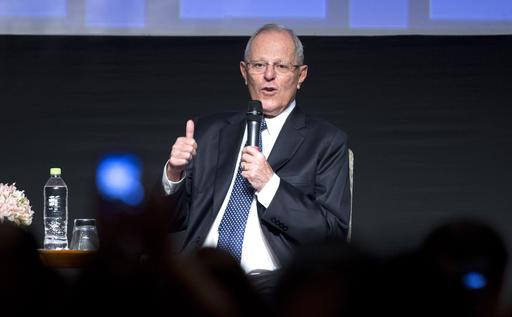
Peru president, Apec host, warns of threats to free trade


LIMA, Peru  — The U.S. presidential election is a sign of growing hostility to free trade that threatens the global economy, the president of Peru warned Friday as he opened an Asian-Pacific summit hosted by his nation.

President Pedro Pablo Kuczynski told delegates gathering in Lima for the Asia Pacific Economic Cooperation Forum that global trade already stopped growing in the last two years and would get much worse if nations close off their economies.

“It is fundamental that world trade grow again and that protectionism be defeated,” Kuczynski said.

The Peruvian president cited the recent U.S. election, though he did not specifically mention U.S. President-elect Donald Trump, who pledged to overhaul the country’s trade policy and tear up trade agreements such as NAFTA or the proposed Trans-Pacific Partnership.

Kuczynski, a U.S.-trained economist and former investment fund manager who took office this year, also cited the vote in June by Britain to leave the European Union as evidence that “protectionist tendencies are taking over” in the world.

“And for anyone who wants to promote protection I suggest they read an economic history of the 1930s,” he said, a reference to the Great Depression that many argue was aggravated by protectionist policies.

APEC has brought more than 1,000 delegates from 21 countries, representing nearly 40 percent of the world’s population, to Lima for a forum aimed at easing global commerce. U.S. President Barack Obama was expected to arrive late Friday for his last international summit before leaving office in January. Also expected were Chinese President Xi Jinping and Russian President Vladimir Putin.

Obama had been expected to promote the TPP, which would have included 12 members of APEC but not China, but that trade pact is now considered politically dead because of Trump’s victory. The Chinese president is expected to see support for an alternate agreement backed by his country. TVJ

source: business.inquirer.net

Thursday, June 30, 2016

Eurozone inflation back to positive; Brexit worries weigh


BRUSSELS, Belgium—Eurozone inflation left negative territory in June, statistics showed Thursday, but economic uncertainty from Brexit sparked concerns that damaging deflation could return to Europe.

The rise in consumer prices is welcome news after months of an unprecedented stimulus program by the European Central Bank to jumpstart sluggish growth and low prices in the eurozone.

Consumer prices in June rose a slight 0.1 percent after slipping 0.1 percent in May, the EU’s Eurostat statistics agency said. This was higher than the zero percent forecast by analysts surveyed by data provider Factset.

“Amid the heightened uncertainties triggered by the Brexit vote, some cheery news for the ECB as the eurozone exited deflation in June,” said Howard Archer, chief economist at IHS Global Insight.

Energy prices again drove consumer prices lower, dropping by 6.5 percent, but this was far less than the negative 8.5 percent a month earlier.

Faced with low prices, the European Central Bank has embarked on a series of unprecedented stimulus programs in a desperate battle to kick-start sluggish growth and inflation in the eurozone.

Slow eurozone growth has seen inflation slide in and out of negative territory, threatening a dangerous downward spiral of falling prices and wages. The ECB aims to get inflation back to two percent or just below, a level it deems healthy for growth.

But analysts warned that knock-on effects from the shock decision by voters in Britain to leave the EU could reverse any progress made towards boosting inflation and growth.

At an EU summit on Tuesday, ECB head Mario Draghi warned leaders that the fallout from Brexit could cost the eurozone up to 0.5 percent in GDP growth over the next three years.

“Uncertainty over the effects of Brexit could add to downward pressure on wage growth and increase firms’ reluctance to raise their prices in the coming months,” said Jennifer McKeown, senior European economist at Capital Economics.

The Frankfurt-based central bank this month took the controversial step of buying corporate bonds, its latest weapon in the fight against deflation that also includes negative interest rates for banks.

Critics in powerful Germany however charge that the ECB is overstepping its mandate by lavishing billions on corporate giants and say it could be distorting markets and creating bubbles.

The ECB has already made unprecedented amounts of ultra-cheap loans available to banks on condition they pass it on as credit for businesses and households.

The ECB has also embarked on a major asset purchase program known as quantitative easing, or QE.

source: business.inquirer.net