Showing posts with label World Economy. Show all posts

Wednesday, March 23, 2022

Oil prices jump, stocks mixed with spotlight on surging inflation

LONDON - Oil prices rallied Wednesday, adding to soaring inflation concerns, while stock markets diverged.

Crude futures jumped 2.5 percent with Brent North Sea headed towards $120 per barrel.

Russian Deputy Prime Minister Alexander Novak on Wednesday warned that a ban on Russian oil and gas imports over the Ukraine war would drive the world's energy markets to a "collapse". 

"It is absolutely obvious that without Russian hydrocarbons, if sanctions are introduced, there will be a collapse of the oil and gas markets," Novak told Russia's lower house State Duma as reported by Russian news agencies.

"The rise in energy prices may be unpredictable," Novak added. 

On stock markets, London's benchmark FTSE 100 index was up after official data showed UK annual inflation had surged to 6.2 percent last month, the highest level in 30 years. 

While inflation increases company costs it can boost their revenues by sizeable amounts. 

The British data were published ahead of a UK budget update Wednesday that could ease a cost-of-living crisis for millions of Britons as inflation rockets worldwide largely owing to soaring energy prices. 

"Today's data confirm a worsening squeeze on consumer incomes," said Yael Selfin, chief economist at KPMG UK.

"These price rises were dominated by increases in energy, and we expect further rises this year as global energy, food, and other commodities markets are impacted by Russia's invasion of Ukraine."

Elsewhere, eurozone stock markets fell Wednesday after Asia's top indices closed higher.

Wall Street had rallied Tuesday on optimism that the Federal Reserve's plan to hike interest rates would help to bring inflation under control.

While there remains plenty of concern about the war in Ukraine, analysts said some confidence had seeped back into trading floors as investors bet on consumer resilience and economies continue to reopen.

Federal Reserve boss Jerome Powell this week said that the US central bank was prepared to act more aggressively on lifting borrowing costs should American inflation -- already at a 40-year high -- not fall quickly enough.

Officials lifted US rates last week by a quarter of a point but some have advocated bigger increases, a view Powell suggested he was open to believing that the world's biggest economy was strong enough to withstand such a move.

Agence France-Presse

Monday, November 29, 2021

Dollar edges higher, currencies pull back on Omicron-shock moves

LONDON - The dollar edged higher, the euro fell and the yen steadied on Monday as currency markets reversed some of Friday's moves, calming after the initial shock of discovering a new coronavirus variant.

The Omicron variant, first detected in southern Africa, triggered global alarm, with financial markets selling off on Friday on fears that it would disrupt the economic recovery after the two-year pandemic.

The World Health Organization said it was not yet clear whether Omicron, which has been found around the world, is more transmissable than other variants or if it causes more severe disease.

Markets calmed somewhat on Monday, however, with US stock futures and oil prices rebounding, as investors took a more balanced view, waiting until the impact of the variant becomes more clear.

The US dollar index, which had its biggest one-day drop since May on Friday, edged back higher and at 0821 GMT was up 0.1 percent on the day at 96.326.

The dollar's status as a safe-haven currency means it can benefit from uncertainty, but it fell on Friday because the Omicron variant was seen as possibly affecting when the Federal Reserve and other major central banks will raise rates.

The euro, which rose versus the dollar on Friday, was down around 0.4 percent at $1.12665.

Commerzbank's head of FX and commodity research Ulrich Leuchtmann wrote in a client note that the euro had initially benefited from the Omicron variant because of the dovishness of the European Central Bank.

"If Omicron leads to lockdowns and a renewed reduction in economic activity on a global scale all rate hike expectations turn out to be in vain and then they will be priced out again pretty quickly," he said.

"And which currencies will be the relative winners? Of course, the ones where rate hikes were never priced in very much in the first place. And those were EUR, JPY and CHF."

Japan's yen steadied and was up around 0.2 percent on the day versus the dollar at 113.33 at 0829 GMT. Euro-yen hit a new nine-month low.

The Swiss franc likewise reversed recent moves. On Friday it had its biggest one-day jump versus the dollar since June 2016, a slightly bigger daily move than at the peak of the first coronavirus-induced market shock in March 2020, but on Monday it was down 0.4 percent on the day, at 0.9256.

Analysts said that currency markets would likely remain volatile until the new variant is better understood.

"Vaccine efficacy results with the next two weeks will be the most important headline to watch out for as well as whether symptoms are different from that of other variants," wrote Nomura analyst Jordan Rochester in a note to clients.

Goldman Sachs said it would not change its economic forecasts on the basis of the Omicron variant until its likely impact becomes clearer.

BioNTech said on Friday it may know within two weeks if the vaccine it developed with Pfizer needs to be reworked.

Meanwhile, in cryptocurrencies, bitcoin hit a seven-week low on Sunday before picking up. At 0837 GMT, it was at $57,386.24, up around 0.1 percent on the day but still below its latest all-time high of $69,000, which was hit earlier this month.

(Reporting by Elizabeth Howcroft, editing by Ed Osmond)

-reuters

Thursday, January 5, 2017

Global stocks uninspired as focus turns towards US jobs data


LONDON — Global stock markets traded in fairly narrow ranges Thursday as the attention in markets shifted towards upcoming U.S. jobs data following the publication of the minutes to the Federal Reserve’s last board meeting.

KEEPING SCORE: In Europe, the FTSE 100 index of leading British shares was steady around its all-time closing high at 7,188, while Germany’s DAX fell 0.2 percent to 11,564. The CAC-40 in France was 0.2 percent lower at 4,891. U.S. stocks were poised for modest losses at the open with Dow futures and the broader S&P 500 futures down 0.2 percent.

FED MINUTES: U.S. central bank officials think they may need to accelerate interest rate hikes if a faster-growing economy leads to lower than expected unemployment. For now they believe they can stick to gradual increases, according to minutes of the Fed’s December meeting. Officials also discussed the impact of Donald Trump’s proposed economic stimulus program and attributed surging stock prices, rising bond rates and the stronger dollar following the election to investor enthusiasm over the president elect’s plans.

JUST THE PRECURSOR: The minutes were just a taster for the likely big economic event of the week — Friday’s publication of the nonfarm payrolls report for December. Though the upcoming moves by the incoming Trump administration are likely to have an impact on Fed rate hike predictions, the backdrop is likely to remain that the U.S. economy is growing strongly with unemployment falling steadily. Later Thursday, traders will have the monthly non-manufacturing survey from the Institute for Supply Management to digest.

ANALYST TAKE: “Given the uncertainties that lie ahead though, I expect it will be another volatile year in which expectations for interest rates will change on a regular basis,” said Craig Erlam, senior market analyst at OANDA.

UPBEAT ASIA: Solid figures out of China and Hong Kong raised investor optimism about the outlook for their economies. Caixin’s monthly purchasing managers index, or PMI, for the services industry posted its biggest rise in activity for 17 months in December. The Nikkei composite PMI for Hong Kong, meanwhile, showed that activity expanded for the first time since February 2015.

ASIA’S DAY: Japan’s benchmark Nikkei 225 index fell 0.4 percent to close at 19,520.69 a day after hitting its highest level in 13 months as the yen’s strength hurt shares of some exporters. South Korea’s Kospi edged 0.2 percent lower to 2,041.95 but Hong Kong’s Hang Seng rose 1.5 percent to 22,456.69. The Shanghai Composite index in mainland China added 0.2 percent to 3,165.41. Australia’s S&P/ASX 200 climbed 0.3 percent to 5,753.30.

CURRENCIES: The euro clawed back some further ground against the dollar, trading 0.2 percent higher at $1.0508, while the dollar slid 0.7 percent at 116.37.

ENERGY: Benchmark U.S. crude was up 36 cents at $53.62 a barrel while Brent rose 41 cents to $56.87 a barrel in London. TVJ

source: business.inquirer.net

Saturday, November 19, 2016

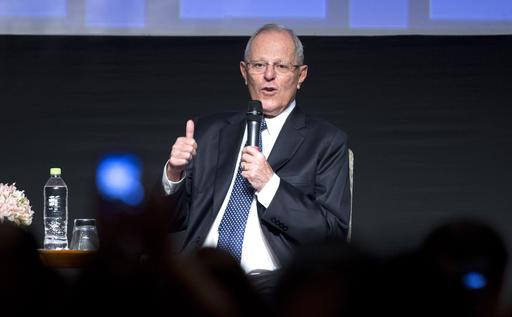
Peru president, Apec host, warns of threats to free trade


LIMA, Peru  — The U.S. presidential election is a sign of growing hostility to free trade that threatens the global economy, the president of Peru warned Friday as he opened an Asian-Pacific summit hosted by his nation.

President Pedro Pablo Kuczynski told delegates gathering in Lima for the Asia Pacific Economic Cooperation Forum that global trade already stopped growing in the last two years and would get much worse if nations close off their economies.

“It is fundamental that world trade grow again and that protectionism be defeated,” Kuczynski said.

The Peruvian president cited the recent U.S. election, though he did not specifically mention U.S. President-elect Donald Trump, who pledged to overhaul the country’s trade policy and tear up trade agreements such as NAFTA or the proposed Trans-Pacific Partnership.

Kuczynski, a U.S.-trained economist and former investment fund manager who took office this year, also cited the vote in June by Britain to leave the European Union as evidence that “protectionist tendencies are taking over” in the world.

“And for anyone who wants to promote protection I suggest they read an economic history of the 1930s,” he said, a reference to the Great Depression that many argue was aggravated by protectionist policies.

APEC has brought more than 1,000 delegates from 21 countries, representing nearly 40 percent of the world’s population, to Lima for a forum aimed at easing global commerce. U.S. President Barack Obama was expected to arrive late Friday for his last international summit before leaving office in January. Also expected were Chinese President Xi Jinping and Russian President Vladimir Putin.

Obama had been expected to promote the TPP, which would have included 12 members of APEC but not China, but that trade pact is now considered politically dead because of Trump’s victory. The Chinese president is expected to see support for an alternate agreement backed by his country. TVJ

source: business.inquirer.net

Tuesday, October 1, 2013

Obama addresses military as gov’t shuts down


WASHINGTON — President Barack Obama is telling members of the military he’ll work to get Congress to re-open the government as soon as possible.

Obama is addressing troops in a video message after Congress missed a midnight deadline to avert a partial government shutdown.

Obama says troops in uniform will remain on duty as usual. He says he’s signed a law ensuring troops get paid on time. He says ongoing operations in Afghanistan and elsewhere will continue and the U.S. will ensure those in harm’s way have what they need.

But Obama says Defense Department civilians may be furloughed. He says that compounds the damage from spending cuts that have already affected the military.

Hundreds of thousands of government workers will be off the job Monday, but some essential services will continue.

source: newsinfo.inquirer.net

Saturday, May 19, 2012

Japan ready to help in euro crisis at G8 talks


WASHINGTON — Japan said that it stood ready to extend help in stemming the eurozone’s debt crisis as the Group of Eight major industrialized nations opened crisis talks.

Japan, the world’s third largest economy and only Asian power in the elite G8 club, has already been a major contributor to an IMF firewall aimed at holding back Europe’s woes with a $60 billion commitment unveiled last month.

Japan’s Prime Minister Yoshihiko Noda will argue in the talks that Europeans hold foremost responsibility in addressing the crisis, foreign ministry spokeswoman Naoko Saiki told reporters on Friday.

“At the same time, in order to help the Europeans solve the European debt crisis, Japan is ready to extend its assistance,” Saiki said.

“The European sovereign debt crisis may endanger the health of the world economy, so we would like to encourage the Europeans to cope with the matter appropriately as soon as possible,” she said.

Further assistance by Japan could include support for the International Monetary Fund or efforts to increase the safety net in Asia, she said.

The G8 talks at the US presidential retreat of Camp David look set to pit President Barack Obama and newly elected President Francois Hollande, both advocates of pro-growth policies, against German Chancellor Angela Merkel who has championed austerity measures.

Japan straddles both positions in the G8. It has sought to stimulate its economy after last year’s tsunami tragedy but Noda is championing a politically risky plan to double sales tax to rein in a giant public debt.

Noda will hold his first meeting with Hollande on Saturday aimed at part at discussing a proposal to launch talks on an ambitious free trade agreement between Japan and the European Union, Japanese officials said.

source: japantoday.com